

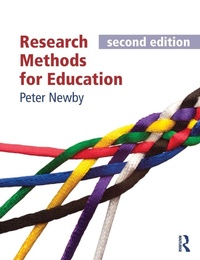
Research Methods for Education
Second Edition
2nd Edition
Published on 26. March 2014
Book
Paperback/Softback
568 pages
978-0-273-77510-2 (ISBN)
Description
Written in a clear and friendly manner, Research Methods for Education, 2/e takes the student by the hand and guides them through the complex subject of research methods in an engaging, witty and clear way. It follows a mixed methods approach, which doesn't simply prioritise quantitative or qualitative methods, allowing for greatest possible coverage. It also contains excellent international examples and case studies specifically from education, which breaks way from a parochial focus on UK education system.
More details
Other editions
Additional editions
Peter Newby
Research Methods for Education, second edition
E-Book
07/2014
1st Edition
Routledge
€74.99
Available for download
Peter Newby
Research Methods for Education, second edition
E-Book
07/2014
1st Edition
Routledge
€74.99
Available for download
Book
03/2014
1st Edition
Routledge
€262.90
Shipment within 15-20 days
Person
For ten years, Peter Newby headed up educational development at Middlesex University. After this he set up an education research and development centre where the focus of the work was the exploration of learning processes and frameworks that could deliver prosperity and greater social equality to communities. Peter is now Emeritus Professor of Higher Education at Middlesex University.
Content
Part One THE CONTEXT FOR YOUR RESEARCH
1 Research: a messy business
2 Understanding the research process
3 Putting your research design together
Part Two THE PROCESS OF DATA COLLECTION
4 Data: assembling the research toolkit
5 Using literature in research
6 Getting the right information
7 Cracking the reseach question
8 Asking questions
9 Talking, listening and watching: other approaches to data collection
Part Three THE PROCESS OF DATA ANALYSIS
10 Extracting the information from statistical data
11 Extracting the information from qualitative data sets
12 Extracting information from quantitative data
13 Using statistics to say something significant
14 Putting it all together
Appendix 1 Calculating sample size
Appendix 2 Calculating critical values for the Kolmogorov-Smirnov test
1 Research: a messy business
2 Understanding the research process
3 Putting your research design together
Part Two THE PROCESS OF DATA COLLECTION
4 Data: assembling the research toolkit
5 Using literature in research
6 Getting the right information
7 Cracking the reseach question
8 Asking questions
9 Talking, listening and watching: other approaches to data collection
Part Three THE PROCESS OF DATA ANALYSIS
10 Extracting the information from statistical data
11 Extracting the information from qualitative data sets
12 Extracting information from quantitative data
13 Using statistics to say something significant
14 Putting it all together
Appendix 1 Calculating sample size
Appendix 2 Calculating critical values for the Kolmogorov-Smirnov test