

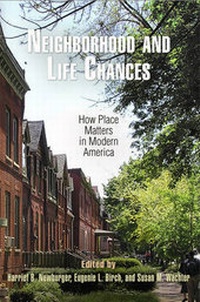
Neighborhood and Life Chances
How Place Matters in Modern America
Published on 17. March 2011
Book
Hardback
392 pages
978-0-8122-4258-4 (ISBN)
Description
Does the place where you lived as a child affect your health as an adult? To what degree does your neighbor's success influence your own potential? The importance of place is increasingly recognized in urban research as an important variable in understanding individual and household outcomes. Place matters in education, physical health, crime, violence, housing, family income, mental health, and discrimination-issues that determine the quality of life, especially among low-income residents of urban areas.
Neighborhood and Life Chances: How Place Matters in Modern America brings together researchers from a range of disciplines to present the findings of studies in the fields of education, health, and housing. The results are intriguing and surprising, particularly the debate over Moving to Opportunity, an experiment conducted by the Department of Housing and Urban Development, designed to test directly the effects of relocating individuals away from areas of concentrated poverty. Its results, while strong in some respects, showed very different outcomes for boys and girls, with girls more likely than boys to experience positive outcomes. Reviews of the literature in education and health, supplemented by new research, demonstrate that the problems associated with residing in a negative environment are indisputable, but also suggest the directions in which solutions may lie.
The essays collected in this volume give readers a clear sense of the magnitude of contemporary challenges in metropolitan America and of the role that place plays in reinforcing them. Although the contributors suggest many practical immediate interventions, they also recognize the vital importance of continued long-term efforts to rectify place-based limitations on lifetime opportunities.
Neighborhood and Life Chances: How Place Matters in Modern America brings together researchers from a range of disciplines to present the findings of studies in the fields of education, health, and housing. The results are intriguing and surprising, particularly the debate over Moving to Opportunity, an experiment conducted by the Department of Housing and Urban Development, designed to test directly the effects of relocating individuals away from areas of concentrated poverty. Its results, while strong in some respects, showed very different outcomes for boys and girls, with girls more likely than boys to experience positive outcomes. Reviews of the literature in education and health, supplemented by new research, demonstrate that the problems associated with residing in a negative environment are indisputable, but also suggest the directions in which solutions may lie.
The essays collected in this volume give readers a clear sense of the magnitude of contemporary challenges in metropolitan America and of the role that place plays in reinforcing them. Although the contributors suggest many practical immediate interventions, they also recognize the vital importance of continued long-term efforts to rectify place-based limitations on lifetime opportunities.
Reviews / Votes
"Public policy interventions do not, sadly, guarantee success at work-or in life. However, Newburger, Birch, and Wachter have illuminated through well-documented research how place can dramatically impact the odds of success."-Nicolas P. Retsinas, Director, Joint Center for Housing Studies, Harvard University "There is much material here that should interest those who care about American city neighborhoods as well as the experience, effects, and challenges of alleviating urban poverty."-Annals of the Association of American Geographers "Social progress and economic opportunity in our society are national ideals but they are realistically advanced in the physical places where Americans live and work. Support for these ideals must exist in our neighborhoods, cities, and metropolitan areas. Neighborhood and Life Chances captures this reality with precision and helps us understand it so that we can act on it."-Henry Cisneros, former Secretary of the Department of Housing and Urban Development and current Executive Chairman, CityView "This collection of essays shows the historical 'people vs. places' urban policy debate to have been a false dichotomy-a difference without distinction. The contributors to this volume convincingly demonstrate that place matters, and that if our political leaders are committed to returning zip code to a metric of residential location rather than a forecast of household destiny, they will benefit from the insights presented in this rich mixture of smart, data-informed policy analysis."-Michael A. Stegman, Director of Policy and Housing, The John D. and Catherine T. MacArthur Foundation "This book is a fascinating compendium of insights and research about the impact of place on a wide range of human behaviors-from health to crime. If you think place matters, but you aren't sure why or how much, you need this book."-Alice M. Rivlin, Senior Fellow, The Brookings Institution "Neighborhood and Life Chances is for the most part an examination of studies on changing urban communities and what happens when families move from impoverished urban neighborhoods to mixed-income communities. . . . The variety and expertise of its contributors, coupled with a successful editing effort to maintain a unified style and coherent voice, make this book an interesting read."-Urban GeographyMore details
Series
Language
English
Place of publication
Pennsylvania
United States
Target group
College/higher education
Illustrations
34 illus.
Dimensions
Height: 229 mm
Width: 152 mm
ISBN-13
978-0-8122-4258-4 (9780812242584)
Copyright in bibliographic data and cover images is held by Nielsen Book Services Limited or by the publishers or by their respective licensors: all rights reserved.
Schweitzer Classification
Other editions
Additional editions
Harriet B. Newburger | Eugenie L. Birch | Susan M. Wachter
Neighborhood and Life Chances
How Place Matters in Modern America
E-Book
02/2011
1st Edition
University of Pennsylvania Press
from
€54.49
Available for download
Persons
Harriet B. Newburger is Community Development Research Advisor for the Federal Reserve Bank of Philadelphia. At the University of Pennsylvania, Eugenie L. Birch is Lawrence C. Nussdorf Professor of Urban Research and Education and Chair of the Department of City and Regional Planning at the School of Design, and Susan M. Wachter is Richard B. Worley Professor of Financial Management and Professor of Real Estate and Finance at The Wharton School and Professor of City and Regional Planning at the School of Design. Together, Birch and Wachter direct the Penn Institute for Urban Research and are the coeditors of Rebuilding Urban Places After Disaster: Lessons from Hurricane Katrina and Growing Greener Cities: Urban Sustainability in the Twenty-First Century, both available from the University of Pennsylvania Press.
Content
List of Abbreviations
Preface
-Eugenie L. Birch, Harriet B. Newburger, and Susan M. Wachter
PART I. PEOPLE AND PLACES: HEALTH, EDUCATION, AND SAFETY
Chapter 1. Health and Residential Location
-Janet Currie
Chapter 2. The Place of Race in Health Disparities: How Family Background and Neighborhood Conditions in Childhood Impact Later-Life Health
-Rucker C. Johnson
Chapter 3. Educational Interventions: Their Effects on the Achievement of Poor Children
-Brian A. Jacob and Jens Ludwig
Chapter 4. Before or After the Bell? School Context and Neighborhood Effects on Student Achievement
-Paul A. Jargowsky and Mohamed El Komi
Chapter 5. Neighborhoods, Social Interactions, and Crime: What Does the Evidence Show?
-Steven Raphael and Michael A. Stoll
Chapter 6. Daily Activities and Violence in Community Landscapes
-Douglas J. Wiebe and Charles C. Branas
PART II. GEOGRAPHIES OF OPPORTUNITY
Chapter 7. Exploring Changes in Low-Income Neighborhoods in the 1990s
-Ingrid Gould Ellen and Katherine O'Regan
Chapter 8. Reinventing Older Communities Through Mixed-Income Development: What Are We Learning from Chicago's Public Housing Transformation?
-Mark L. Joseph
Chapter 9. Reinventing Older Communities: Does Place Matter?
-Janet Rothenberg Pack
PART III. MOVING PEOPLE OUT OF POVERTY
Chapter 10. An Overview of Moving to Opportunity: A Random Assignment Housing Mobility Study in Five U.S. Cities
-Lisa A. Gennetian, Lisa Sanbonmatsu, and Jens Ludwig
Chapter 11. How Does Leaving High-Poverty Neighborhoods Affect the Employment Prospects of Low-Income Mothers and Youth? Evidence from the Moving to Opportunity Experiment
-Xavier de Souza Briggs, Elizabeth Cove, Cynthia Duarte, and Margery Austin Turner
Chapter 12. Teens, Mental Health, and Moving to Opportunity
-Susan Clampet-Lundquist
Chapter 13. Changing the Geography of Opportunity by Helping Poor Households Move Out of Concentrated Poverty: Neighborhood Effects and Policy Design
-George Galster
PART IV. SEGREGATION: THE POWER OF PLACE
Chapter 14. Are Mixed Neighborhoods Always Unstable? Two-Sided and One-Sided Tipping
-David Card, Alexandre Mas, and Jesse Rothstein
Chapter 15. Preferences for Hispanic Neighborhoods
-Fernando Ferreira
Chapter 16. Increasing Diversity and the Future of U.S. Housing Segregation
-Robert DeFina and Lance Hannon
Chapter 17. Understanding Racial Segregation: What Is Known About the Effect of Housing Discrimination?
-Stephen L. Ross
Contents
Notes
Bibliography
List of Contributors
Index
Acknowledgments
Preface
-Eugenie L. Birch, Harriet B. Newburger, and Susan M. Wachter
PART I. PEOPLE AND PLACES: HEALTH, EDUCATION, AND SAFETY
Chapter 1. Health and Residential Location
-Janet Currie
Chapter 2. The Place of Race in Health Disparities: How Family Background and Neighborhood Conditions in Childhood Impact Later-Life Health
-Rucker C. Johnson
Chapter 3. Educational Interventions: Their Effects on the Achievement of Poor Children
-Brian A. Jacob and Jens Ludwig
Chapter 4. Before or After the Bell? School Context and Neighborhood Effects on Student Achievement
-Paul A. Jargowsky and Mohamed El Komi
Chapter 5. Neighborhoods, Social Interactions, and Crime: What Does the Evidence Show?
-Steven Raphael and Michael A. Stoll
Chapter 6. Daily Activities and Violence in Community Landscapes
-Douglas J. Wiebe and Charles C. Branas
PART II. GEOGRAPHIES OF OPPORTUNITY
Chapter 7. Exploring Changes in Low-Income Neighborhoods in the 1990s
-Ingrid Gould Ellen and Katherine O'Regan
Chapter 8. Reinventing Older Communities Through Mixed-Income Development: What Are We Learning from Chicago's Public Housing Transformation?
-Mark L. Joseph
Chapter 9. Reinventing Older Communities: Does Place Matter?
-Janet Rothenberg Pack
PART III. MOVING PEOPLE OUT OF POVERTY
Chapter 10. An Overview of Moving to Opportunity: A Random Assignment Housing Mobility Study in Five U.S. Cities
-Lisa A. Gennetian, Lisa Sanbonmatsu, and Jens Ludwig
Chapter 11. How Does Leaving High-Poverty Neighborhoods Affect the Employment Prospects of Low-Income Mothers and Youth? Evidence from the Moving to Opportunity Experiment
-Xavier de Souza Briggs, Elizabeth Cove, Cynthia Duarte, and Margery Austin Turner
Chapter 12. Teens, Mental Health, and Moving to Opportunity
-Susan Clampet-Lundquist
Chapter 13. Changing the Geography of Opportunity by Helping Poor Households Move Out of Concentrated Poverty: Neighborhood Effects and Policy Design
-George Galster
PART IV. SEGREGATION: THE POWER OF PLACE
Chapter 14. Are Mixed Neighborhoods Always Unstable? Two-Sided and One-Sided Tipping
-David Card, Alexandre Mas, and Jesse Rothstein
Chapter 15. Preferences for Hispanic Neighborhoods
-Fernando Ferreira
Chapter 16. Increasing Diversity and the Future of U.S. Housing Segregation
-Robert DeFina and Lance Hannon
Chapter 17. Understanding Racial Segregation: What Is Known About the Effect of Housing Discrimination?
-Stephen L. Ross
Contents
Notes
Bibliography
List of Contributors
Index
Acknowledgments