

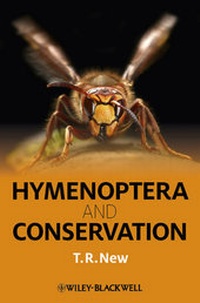
Hymenoptera and Conservation
Published on 3. August 2012
Book
Hardback
230 pages
978-0-470-67180-1 (ISBN)
Unfortunately, price unknown
Article exhausted; check different version
Description
Hymenoptera, the bees, wasps and ant, are one of the largest insect orders, and have massive ecological importance as pollinators and as predators or parasitoids of other insects. These roles have brought them forcefully to human notice , as governors of some key ecological services that strongly influence human food supply. Recent declines of pollinators and introductions of alien pests or biological control agents are only part of the current concerns for conservation of Hymenoptera, and of the interactions in which they participate in almost all terrestrial ecosystems. Both pests and beneficial species abound within the order, sometimes closely related within the same families. Many taxa are both difficult to identify, and very poorly known. This global overview, the first such account for the whole of the Hymenoptera, discusses a broad range of themes to introduce the insects and their conservation roles and needs, and how their wellbeing may be approached. The book is intended as a source of information for research workers, students, conservation managers and naturalists as an introduction to the importance of this dominant insect order.
Reviews / Votes
"I highly recommend Hymenoptera and Conservationto anybody who works with Hymenoptera (including invasive species, biological control and honeybees) or in general conservation, and to anyone with an interest in entomology." (Austral Ecology, 10 October 2014) "Overall, this is an interesting and worthwhile book, which should stimulate more interest in this important order of insects." (British Ecological Society, 1 April 2013) "The highly comprehensive, well-organized book presents an easy-to-understand overview of the challenges and goals associated with conservation efforts. Summing Up: Highly recommended. Students of all levels, researchers/faculty, and professionals/practitioners." (Choice, 1 April 2013) "In Hymenoptera and Conservation New captures the reader, offering a concise chronology of past interventions and, in doing so, provides lessons on which future conservation strategies can be built. For this reason, I recommend this book to anyone interested in a better understanding of the role of insects in conservation as well as the full implications of intervention." (Fauna & Flora International, 1 January 2013)More details
Product info
gebunden
Edition
1. Auflage
Language
English
Place of publication
Hoboken
United Kingdom
Publishing group
John Wiley and Sons Ltd
Target group
Professional and scholarly
Dimensions
Height: 24.7 cm
Width: 17.6 cm
Thickness: 1.6 cm
Weight
620 gr
ISBN-13
978-0-470-67180-1 (9780470671801)
Schweitzer Classification
Other editions
Additional editions
Person
Emeritus Professor Tim New, from the Department of Zoology, La Trobe University, Melbourne has broad interests in insect conservation, ecology and systematics. He has published extensively on these topics and is recognised as one of the leading advocates for insect conservation.
Content
Preface vii
Acknowledgements xii
1 Introducing Hymenoptera and their Conservation 1
Perspective 1
Classification and diversity 1
Importance for conservation 14
Social life and conservation 24
2 Alien Hymenoptera in Classical Biological Control 28
Introducing a dilemma 28
Conservation concerns 28
3 The Junction of Biological Control and Conservation: Conservation Biological Control and Cultural Control 41
4 Introduced Bees: Threats or Benefits? 51
5 Social Wasps and Ants as Aliens 63
Social wasps 63
Ants 68
Current perspective 79
6 Pollinator Declines 82
Introducing the concerns 82
Threats to pollinators 92
Pathogens and parasites 93
Pesticides 97
Pollution 99
7 Levels of Conservation Concern and the Shortcomings of Current Practice 100
Foci for conservation 100
Species focus 104
Biotope and habitat focus 122
8 Habitat Parameters and Manipulation 138
Defining and assessing habitats in the landscape 138
Habitat manipulations for conservation 141
Natural and agricultural environments 141
Urban environments 147
Practical conservation 150
9 Species Case Histories 168
Franklin's bumblebee (Bombus franklini) 170
The great yellow bumblebee (Bombus distinguendus) 170
Wallace's bee (Chalicodoma pluto) 173
Neopasiphae simplicior in Western Australia 174
The antennal-waving wasp (Tachysphex pechumani) 174
The dinosaur ant (Nothomyrmecia macrops) 175
The red-barbed ant (Formica rufi barbis) in Britain 177
10 Assessing Conservation Progress and Priorities for the Future 179
Introduction: The basic need 179
Monitoring 180
The milieux of concern 185
References 191
Index 214