

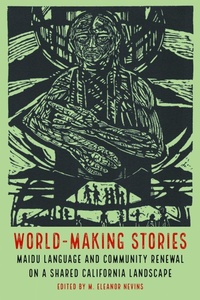
World-Making Stories
Maidu Language and Community Renewal on a Shared California Landscape
Published on 1. August 2017
Book
Paperback/Softback
248 pages
978-1-4962-0155-3 (ISBN)
Description
Published through the Recovering Languages and Literacies of the Americas initiative, supported by the Andrew W. Mellon Foundation
World-Making Stories is a collection of Maidu creation stories that will help readers appreciate California's rich cultural tapestry. At the beginning of the twentieth century, renowned storyteller Hanc'ibyjim (Tom Young) performed Maidu and Atsugewi stories for anthropologist Ronald B. Dixon, who published these stories in 1912. The resulting Maidu Texts presented the stories in numbered block texts that, while serving as a source of linguistic decoding, also reflect the state of anthropological linguistics of the era by not conveying a sense of rhetorical or poetic composition. Sixty years later, noted linguist William Shipley engaged the texts as oral literature and composed a free verse literary translation, which he paired with the artwork of Daniel Stolpe and published in a limited-edition four-volume set that circulated primarily to libraries and private collectors.
Here M. Eleanor Nevins and the Weje-ebis (Keep Speaking) Jamani Maidu Language Revitalization Project team illuminate these important tales in a new way by restoring Maidu elements omitted by William Shipley and by bending the translation to more closely correspond in poetic form to the Maidu original. The beautifully told stories by Hanc'ibyjim are accompanied by Stolpe's intricate illustrations and by personal and pedagogical essays from scholars and Maidu leaders working to revitalize the language. The resulting World-Making Stories is a necessity for language revitalization programs and an excellent model of indigenous community-university collaboration.
World-Making Stories is a collection of Maidu creation stories that will help readers appreciate California's rich cultural tapestry. At the beginning of the twentieth century, renowned storyteller Hanc'ibyjim (Tom Young) performed Maidu and Atsugewi stories for anthropologist Ronald B. Dixon, who published these stories in 1912. The resulting Maidu Texts presented the stories in numbered block texts that, while serving as a source of linguistic decoding, also reflect the state of anthropological linguistics of the era by not conveying a sense of rhetorical or poetic composition. Sixty years later, noted linguist William Shipley engaged the texts as oral literature and composed a free verse literary translation, which he paired with the artwork of Daniel Stolpe and published in a limited-edition four-volume set that circulated primarily to libraries and private collectors.
Here M. Eleanor Nevins and the Weje-ebis (Keep Speaking) Jamani Maidu Language Revitalization Project team illuminate these important tales in a new way by restoring Maidu elements omitted by William Shipley and by bending the translation to more closely correspond in poetic form to the Maidu original. The beautifully told stories by Hanc'ibyjim are accompanied by Stolpe's intricate illustrations and by personal and pedagogical essays from scholars and Maidu leaders working to revitalize the language. The resulting World-Making Stories is a necessity for language revitalization programs and an excellent model of indigenous community-university collaboration.
Reviews / Votes
"A stellar example of Native language pedagogy and scholarship and thus of critical importance to the fields of both linguistic anthropology and Native American studies."-Sean O'Neill, associate professor of anthropology at the University of Oklahoma and author of Cultural Contact and Linguistics Relativity among the Indians of Northwestern California"This book makes a meaningful contribution to the fields of Indigenous studies, language revitalization, and California Indian history. But, more important, by making these stories available to Maidu language learners, it makes a valuable contribution to the Maidu people."-Boyd Cothran, associate professor of U.S. indigenous and cultural history at York University in Toronto
More details
Language
English
Place of publication
Lincoln
United States
Target group
College/higher education
Product notice
Paperback (trade)
Illustrations
58 figures, 2 indexes
Dimensions
Height: 248 mm
Width: 178 mm
Thickness: 13 mm
Weight
454 gr
ISBN-13
978-1-4962-0155-3 (9781496201553)
Copyright in bibliographic data and cover images is held by Nielsen Book Services Limited or by the publishers or by their respective licensors: all rights reserved.
Schweitzer Classification
Other editions
Additional editions
Marybeth Eleanor Nevins
World-Making Stories
Maidu Language and Community Renewal on a Shared California Landscape
E-Book
12/2017
1st Edition
University of Nebraska Press
€36.99
Available for download
Marybeth Eleanor Nevins
World-Making Stories
Maidu Language and Community Renewal on a Shared California Landscape
E-Book
08/2017
1st Edition
University of Nebraska Press
€31.99
Available for download
Person
M. Eleanor Nevins is an associate professor of anthropology at Middlebury College in Vermont. She is the author of Lessons from Fort Apache: Beyond Language Endangerment and Maintenance.
Content
List of Illustrations
Introduction
Part 1: Community Renewal
Chapter 1. "This is Where We Belong": Maidu Voices on a Shared California Landscape
Chapter 2. Placing Communities, Languages and Stories on a Maidu Landscape
Chapter 3. WEjenim BIspadA: A brief history of Maidu language keepers, and other thoughts on language revitalization, by Kenneth Holbrook
Part 2: Creation Narratives of HAnc'ibyjim / Tom Young
Chapter 4. PUktim / Creation
Chapter 5. Hompajtotokymc'om / The Adversaries
Chapter 6. Hybykym Masy Wonom/Love and Death
Chapter 7. K'Odojapem Bom / Worldmaker's Trail
Part 3: Pronunciation and Lessons
Chapter 8. How to Pronounce Maidu, by William Shipley
Chapter 9. Reading the Maidu Language: Nine Beginning Lessons, by William Shipley
Names Index
Bibliography
General Index
Introduction
Part 1: Community Renewal
Chapter 1. "This is Where We Belong": Maidu Voices on a Shared California Landscape
Chapter 2. Placing Communities, Languages and Stories on a Maidu Landscape
Chapter 3. WEjenim BIspadA: A brief history of Maidu language keepers, and other thoughts on language revitalization, by Kenneth Holbrook
Part 2: Creation Narratives of HAnc'ibyjim / Tom Young
Chapter 4. PUktim / Creation
Chapter 5. Hompajtotokymc'om / The Adversaries
Chapter 6. Hybykym Masy Wonom/Love and Death
Chapter 7. K'Odojapem Bom / Worldmaker's Trail
Part 3: Pronunciation and Lessons
Chapter 8. How to Pronounce Maidu, by William Shipley
Chapter 9. Reading the Maidu Language: Nine Beginning Lessons, by William Shipley
Names Index
Bibliography
General Index