

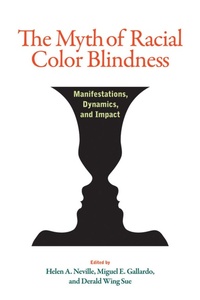
The Myth of Racial Color Blindness
Manifestations, Dynamics, and Impact
Published on 19. October 2015
Book
Hardback
330 pages
978-1-4338-2073-1 (ISBN)
Description
In this edited volume, social scientists dissect the concept of color blind racial ideology, the widely-held belief that skin color does not affect interpersonal interactions, and that interpersonal and institutional racism therefore no longer exists in America.
Is the United States today a amp ldquo post-racial amp rdquo society? Some might point to the election and re-election of a Black president as conclusive evidence of the progress made in race relations, but others are not so sanguine. In this volume, top scholars in psychology, education, sociology, and related fields dissect the concept of color-blind racial ideology (CBRI), the widely-held belief that skin color does not affect interpersonal interactions, and that interpersonal and institutional racism therefore no longer exists in American society.
Contributors survey the theoretical and empirical literature on racial color-blindness discuss novel ways of assessing and measuring color-blind racial beliefs examine related characteristics such as lack of empathy (among Whites) and internalized racism (among people of color) and assess the impact of CBRI in education, the workplace, and health care amp ndash as well as the racial disparities that such beliefs help foster. Finally, they recommend ways to counter color-blind racial beliefs by advocating for and implementing race-conscious policies and practices that aim to create equal access and opportunities for all.
Is the United States today a amp ldquo post-racial amp rdquo society? Some might point to the election and re-election of a Black president as conclusive evidence of the progress made in race relations, but others are not so sanguine. In this volume, top scholars in psychology, education, sociology, and related fields dissect the concept of color-blind racial ideology (CBRI), the widely-held belief that skin color does not affect interpersonal interactions, and that interpersonal and institutional racism therefore no longer exists in American society.
Contributors survey the theoretical and empirical literature on racial color-blindness discuss novel ways of assessing and measuring color-blind racial beliefs examine related characteristics such as lack of empathy (among Whites) and internalized racism (among people of color) and assess the impact of CBRI in education, the workplace, and health care amp ndash as well as the racial disparities that such beliefs help foster. Finally, they recommend ways to counter color-blind racial beliefs by advocating for and implementing race-conscious policies and practices that aim to create equal access and opportunities for all.
More details
Language
English
Place of publication
Washington DC
United States
Target group
Professional and scholarly
Product notice
sewn/stitched
Cloth over boards
Dimensions
Height: 259 mm
Width: 183 mm
Thickness: 23 mm
Weight
907 gr
ISBN-13
978-1-4338-2073-1 (9781433820731)
Copyright in bibliographic data and cover images is held by Nielsen Book Services Limited or by the publishers or by their respective licensors: all rights reserved.
Schweitzer Classification
Persons
Helen A. Neville, PhD, is a professor of educational psychology and African American studies at the University of Illinois at Urbana amp ndash Champaign. She is a past associate editor of The Counseling Psychologist and of the Journal of Black Psychology. Her research on race, racism, and color-blind racial ideology has appeared in a wide range of peer-reviewed journals. For her research and mentoring efforts Dr. Neville has received the APA Graduate Students Kenneth and Mamie Clark Award, the APA Division 45 Charles and Shirley Thomas Award for mentoring and contributions to African American students and community, and the APA Minority Fellowship Program Dalmas Taylor Award for Research. She was honored with the Association of Black Psychologists' Distinguished Psychologist of the Year Award and the Winter Roundtable Janet E. Helms Mentoring Award.
Miguel E. Gallardo, PsyD, is an associate professor of psychology and director of Aliento, The Center for Latina/Latino Communities at Pepperdine University. He maintains an independent, consultation practice in which he conducts therapy with adolescents and adults and consults with organizations and universities on developing culturally responsive systems. He teaches courses on multicultural and social justice, intimate partner violence, and professional practice issues. Dr. Gallardo's areas of scholarship and research include the psychotherapy process when working with ethnocultural communities, particularly the Latina/Latino community, and the processes by which individuals develop cultural awareness and responsiveness. Dr. Gallardo is currently director of research and evaluation for the Multiethnic Collaborative of Community Agencies, a nonprofit organization dedicated to serving monolingual Arab, Farsi, Korean, Vietnamese, and Spanish-speaking communities. He has published refereed journal articles, books, and book chapters in the areas of multicultural psychology, Latina/Latino psychology, and ethics and evidence-based practices.
Derald Wing Sue, PhD, is professor of psychology and education in the Department of Counseling and Clinical Psychology at Teachers College and the School of Social Work, Columbia University. He received his PhD from the University of Oregon and has served as a training faculty member with the Institute for Management Studies and the Columbia University Executive Training Programs. He was the cofounder and first president of the Asian American Psychological Association, past president of APA Division 45 (Society for the Psychological Study of Culture, Ethnicity and Race), and past president of APA Division 7 (Society of Counseling Psychology). Dr. Sue is a member of the American Counseling Association, fellow of APA, the American Psychological Society, and the American Association of Applied and Preventive Psychology. Dr. Sue has served as editor of the Personnel and Guidance Journal (now the Journal for Counseling and Development), and associate editor of the American Psychologist, and editorial member for the Asian Journal of Counselling he serves on the Council of Elders for Cultural Diversity and Ethnic Minority Psychology and has been or continues to be a consulting editor for numerous journals and publications.
Miguel E. Gallardo, PsyD, is an associate professor of psychology and director of Aliento, The Center for Latina/Latino Communities at Pepperdine University. He maintains an independent, consultation practice in which he conducts therapy with adolescents and adults and consults with organizations and universities on developing culturally responsive systems. He teaches courses on multicultural and social justice, intimate partner violence, and professional practice issues. Dr. Gallardo's areas of scholarship and research include the psychotherapy process when working with ethnocultural communities, particularly the Latina/Latino community, and the processes by which individuals develop cultural awareness and responsiveness. Dr. Gallardo is currently director of research and evaluation for the Multiethnic Collaborative of Community Agencies, a nonprofit organization dedicated to serving monolingual Arab, Farsi, Korean, Vietnamese, and Spanish-speaking communities. He has published refereed journal articles, books, and book chapters in the areas of multicultural psychology, Latina/Latino psychology, and ethics and evidence-based practices.
Derald Wing Sue, PhD, is professor of psychology and education in the Department of Counseling and Clinical Psychology at Teachers College and the School of Social Work, Columbia University. He received his PhD from the University of Oregon and has served as a training faculty member with the Institute for Management Studies and the Columbia University Executive Training Programs. He was the cofounder and first president of the Asian American Psychological Association, past president of APA Division 45 (Society for the Psychological Study of Culture, Ethnicity and Race), and past president of APA Division 7 (Society of Counseling Psychology). Dr. Sue is a member of the American Counseling Association, fellow of APA, the American Psychological Society, and the American Association of Applied and Preventive Psychology. Dr. Sue has served as editor of the Personnel and Guidance Journal (now the Journal for Counseling and Development), and associate editor of the American Psychologist, and editorial member for the Asian Journal of Counselling he serves on the Council of Elders for Cultural Diversity and Ethnic Minority Psychology and has been or continues to be a consulting editor for numerous journals and publications.
Content
Contributors
Introduction: Has the United States Really Moved Beyond Race?
Helen A. Neville, Miguel E. Gallardo, and Derald Wing Sue
I. Theoretical and Methodological Foundations
Down the Rabbit Hole: Color-Blind Racism in Obamerica
Eduardo Bonilla-Silva
The Color-Blind Racial Approach: Does Race Really Matter?
James M. Jones
A Broad and Insidious Appeal: Unpacking the Reasons for Endorsing Racial Color Blindness
Laura G. Babbitt, Negin R. Toosi, and Samuel R. Sommers
Understanding Racial Color Blindness and Multiculturalism in Interracial Relationships: Cognitive and Emotional Tensions and Their Implications
Lindy Gullett and Tessa V. West
An International Perspective on Color Consciousness: Brazil and the Universalization of Antiracist Counter-Publics
Jonathan Warren
Telling on Racism: Developing a Race-Conscious Agenda
Lee Anne Bell
II. Context and Costs
Seeing Color Blindness: Color-Blind Racial Ideology Research Methods in Social Psychology
Matthew C. Jackson, Vera Katelyn Wilde, and Phillip Atiba Goff
The Measurement of Color-Blind Racial Ideology
Germine Awad and Karen Moran Jackson
Using Ethnography and Interviews to Study Color-Blind Racial Ideology
Amanda E. Lewis and Margaret Ann Hagerman
III. Manifestations of Color-Blind Racial Ideology
The Good, the Bad, and the Ugly: Color-Blind Racial Ideology and Lack of Empathy
Sharon Y. Tettegah
Color-Blind Racial Ideology and Internalized Racism Among People of Color
Suzette L. Speight, Amber A. Hewitt, and Hether R. Cook
Color-Blind Racial Ideology in K amp ndash 2 Schools
Sheri A. Castro-Atwater
Raising Awareness and Reducing Color-Blind Racial Ideology in Higher Education
Cyndi Kernahan
The Impact of Color-Blind Racial Ideology on Maintaining Racial Disparities in Organizations
Caryn J. Block
Identity Management Strategies in Workplaces With Color-Blind Diversity Policies
Margaret Shih and Maia J Young
Racial Color Blindness and Black amp ndash White Health Care Disparities
Louis A. Penner and John F. Dovidio
Racial Color Blindness in Counseling, Therapy, and Supervision
Alan W. Burkard, Lisa M. Edwards, and Hadiya A. Adams
Index
About the Editors
Introduction: Has the United States Really Moved Beyond Race?
Helen A. Neville, Miguel E. Gallardo, and Derald Wing Sue
I. Theoretical and Methodological Foundations
Down the Rabbit Hole: Color-Blind Racism in Obamerica
Eduardo Bonilla-Silva
The Color-Blind Racial Approach: Does Race Really Matter?
James M. Jones
A Broad and Insidious Appeal: Unpacking the Reasons for Endorsing Racial Color Blindness
Laura G. Babbitt, Negin R. Toosi, and Samuel R. Sommers
Understanding Racial Color Blindness and Multiculturalism in Interracial Relationships: Cognitive and Emotional Tensions and Their Implications
Lindy Gullett and Tessa V. West
An International Perspective on Color Consciousness: Brazil and the Universalization of Antiracist Counter-Publics
Jonathan Warren
Telling on Racism: Developing a Race-Conscious Agenda
Lee Anne Bell
II. Context and Costs
Seeing Color Blindness: Color-Blind Racial Ideology Research Methods in Social Psychology
Matthew C. Jackson, Vera Katelyn Wilde, and Phillip Atiba Goff
The Measurement of Color-Blind Racial Ideology
Germine Awad and Karen Moran Jackson
Using Ethnography and Interviews to Study Color-Blind Racial Ideology
Amanda E. Lewis and Margaret Ann Hagerman
III. Manifestations of Color-Blind Racial Ideology
The Good, the Bad, and the Ugly: Color-Blind Racial Ideology and Lack of Empathy
Sharon Y. Tettegah
Color-Blind Racial Ideology and Internalized Racism Among People of Color
Suzette L. Speight, Amber A. Hewitt, and Hether R. Cook
Color-Blind Racial Ideology in K amp ndash 2 Schools
Sheri A. Castro-Atwater
Raising Awareness and Reducing Color-Blind Racial Ideology in Higher Education
Cyndi Kernahan
The Impact of Color-Blind Racial Ideology on Maintaining Racial Disparities in Organizations
Caryn J. Block
Identity Management Strategies in Workplaces With Color-Blind Diversity Policies
Margaret Shih and Maia J Young
Racial Color Blindness and Black amp ndash White Health Care Disparities
Louis A. Penner and John F. Dovidio
Racial Color Blindness in Counseling, Therapy, and Supervision
Alan W. Burkard, Lisa M. Edwards, and Hadiya A. Adams
Index
About the Editors