

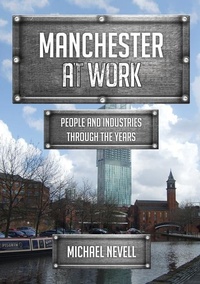
Manchester at Work
People and Industries Through the Years
Published on 15. November 2018
Book
Paperback/Softback
96 pages
978-1-4456-8103-0 (ISBN)
Description
Manchester is a city with an unparalleled industrial heritage. It gave the world technological innovation as well as manufacturing strength. The city's wealth came from textile manufacture during the Industrial Revolution. The great majority of cotton spinning took place in south Lancashire and north Cheshire, and Manchester was for a time the most productive centre of cotton processing in the world, earning it the sobriquet 'Cottonopolis'. Manchester's population grew at an astonishing rate in the early nineteenth century as people flocked there for work from Scotland, Wales, Ireland and other parts of England. The firms that made machines for the cotton trade diversified into general manufacture, the chemical industry expanded into other areas, financial service industries such as banking and insurance began to flourish and its transport and distribution infrastructure expanded in order to sustain booming trade and agrowing population.
Manchester at Work explores the life of the city and its people, from pre-industrial beginnings through to the present day. In a fascinating series of contemporary photographs and illustrations, it takes us through the dramatic rise and fall of the textile industry and the town's role as a major inland port, the trauma of high unemployment between the wars, post-war industrial decline and late twentieth-century regeneration, and into the twenty-first century, showing how this erstwhile 'Second City of Empire' has rediscovered its swagger and successfully transformed itself into a thriving post-industrial centre of arts, culture and commerce.
Manchester at Work explores the life of the city and its people, from pre-industrial beginnings through to the present day. In a fascinating series of contemporary photographs and illustrations, it takes us through the dramatic rise and fall of the textile industry and the town's role as a major inland port, the trauma of high unemployment between the wars, post-war industrial decline and late twentieth-century regeneration, and into the twenty-first century, showing how this erstwhile 'Second City of Empire' has rediscovered its swagger and successfully transformed itself into a thriving post-industrial centre of arts, culture and commerce.
More details
Series
Language
English
Place of publication
Chalford
United Kingdom
Product notice
Paperback (trade)
Unsewn / adhesive bound
Illustrations
160 Illustrations
Dimensions
Height: 235 mm
Width: 165 mm
Thickness: 10 mm
Weight
259 gr
ISBN-13
978-1-4456-8103-0 (9781445681030)
Copyright in bibliographic data and cover images is held by Nielsen Book Services Limited or by the publishers or by their respective licensors: all rights reserved.
Schweitzer Classification
Person
Michael Nevell is a landscape archaeologist with more than 29 years' experience in archaeology, as a consultant, lecturer, and researcher. His research interests include the archaeology of industrialization, community archaeology and historic buildings, especially textile mills and weavers' cottages. He has written extensively on industrial and landscape topics and several of his books have won awards from the Libraries Association, the Association for Industrial Archaeology, and British Archaeological Awards. He is Head of Archaeology at the University of Salford and also co-edits the international journal Industrial Archaeology Review.