

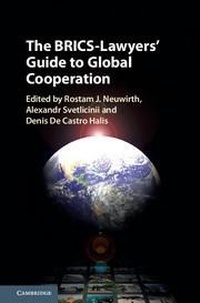
The BRICS-Lawyers' Guide to Global Cooperation
Published on 12. October 2017
Book
Hardback
408 pages
978-1-108-41623-8 (ISBN)
Description
In the international trade and development arena, new and developing economies have created a block that is known as BRICS - Brazil, Russia, India, China and South Africa. Initially conceived to drive global change through economic growth, the financial crisis and reversal of fortunes of the BRICS nations have raised questions about their ability to have an impact on the governance of global affairs. This book explores the role of law in various areas of BRICS cooperation including: trade, investment, competition, intellectual property, energy, consumer protection, financial services, space exploration and legal education. It not only covers the specifics of each of the BRICS nations in the selected areas, but also offers innovative and forward-looking perspectives on the BRICS cooperation and their contribution to the reform of the global governance networks. This is a unique reference book suitable for academics, government officials, legal practitioners, business executives, researchers and students.
Reviews / Votes
'The authors' aim is to contribute to the understanding not only of the law's role in the BRICS countries but also of law's constructive role in various frameworks of cooperation at the multilateral or global level.? The book illustrates the mission of law and legal frameworks in theory and in practice of BRICS activities and highlights what law means for the BRICS countries' successful cooperation.' Maria Novoselova, BRICS Law Journal 'The book contributes to the general understanding of the BRICS and their role in the global economic governance, introduces the methodological framework for the BRICS-related legal research, and provides a future outlook on BRICS legal co-operation in various areas. It introduces concrete proposals concerning the enhancement of the role of law in BRICS co-operation and their participation in various multilateral co-operation frameworks.' Zhang Han, International Trade Law and Regulation 'This book advocates 'BRICS for bridges not walls' and closes a gap in scholarship and academic debate by providing a (not yet duly considered) legal perspective of BRICS cooperation - one of the many reasons it deserves to be read. This book is a very interesting read, a worthwhile acquisition and a unique reference book for academics, government officials, legal practitioners, researchers and students who work in the area of global governance.' Franziska Sucker, Potchefstroom Electronic Law Journal 'The book is a real treasure that will appeal to many lawyers, including legal scholars and legal practitioners interested in a better understanding and wider knowledge of the legal aspects of the BRICS cooperation.' Mateja Durovic, Chinese Journal of Comparative Law 'Only on the basis of a legal foundation can BRICS continue its evolution towards an ever-more cooperative, interrelated, and ultimately maybe even integrated community of states. Pointing this out most clearly and providing illuminating and inspiring insight into the complexities of the BRICS realities, the book provides an invaluable resource and reference for scholars, practitioners, and anybody interested in international and global governance - under a political, an economic, and most importantly: a legal perspective.' Tim W. Dornis, European Review of Private LawMore details
Language
English
Place of publication
Cambridge
United Kingdom
Target group
Professional and scholarly
College/higher education
Product notice
sewn/stitched
Cloth over boards
Illustrations
Worked examples or Exercises; 32 Tables, black and white; 10 Line drawings, black and white
Dimensions
Height: 241 mm
Width: 163 mm
Thickness: 27 mm
Weight
703 gr
ISBN-13
978-1-108-41623-8 (9781108416238)
Copyright in bibliographic data and cover images is held by Nielsen Book Services Limited or by the publishers or by their respective licensors: all rights reserved.
Schweitzer Classification
Other editions
Additional editions
Rostam J. Neuwirth | Alexandr Svetlicinii | Denis De Castro Halis
The BRICS-Lawyers' Guide to Global Cooperation
Book
12/2018
Cambridge University Press
€50.00
Shipment within 15-20 days
Rostam J. Neuwirth
BRICS-Lawyers' Guide to Global Cooperation
E-Book
10/2017
Cambridge University Press
€26.99
Available for download
Rostam J. Neuwirth | Alexandr Svetlicinii | Denis De Castro Halis
The BRICS-Lawyers' Guide to Global Cooperation
E-Book
09/2017
Cambridge University Press
€32.49
Available for download
Persons
Rostam J. Neuwirth is Professor of Law and Programme Coordinator of Master of International Business Law (IBL) at the Faculty of Law of University of Macau (China). He holds law degrees from the European University Institute, Florence (Ph.D.), McGill University, Montreal (LL.M) and the Karl-Franzens University of Graz (Mag. iur.). Before joining Macau University, he taught at two Universities in India and worked in the Voelkerrechtsbuero (International Law Bureau) of the Austrian Federal Ministry for Foreign Affairs. Alexandr Svetlicinii is Assistant Professor of Law at the University of Macau. Dr Svetlicinii received his law degree at the Free International University of Moldova, his LL.M in International Business Law at the Central European University, Hungary, and Master of Research in Law and his Ph.D. in Law at the European University Institute, Florence. His primary fields of expertise are competition law, international trade and investment law, and alternative dispute resolution. Dr Svetlicinii served as a nongovernmental advisor to the International Competition Network and as a legal expert in a number of research projects conducted by the EU Commission. Denis De Castro Halis is a Brazilian scholar who has been working in China since 2005. Since 2007, he has been at the Faculty of Law of the University of Macau, having served as a coordinator and as a Senate member. He has a strong interdisciplinary background, holding degrees in law, social sciences, and philosophy. His investigations vary from business and company law to legal and social theories. He is also a radio commentator.
Content
Introduction; 1. The enantiosis of BRICS: BRICS la[w]yers and the difference that they can make; 2. Diversity and intra-BRICS trade: patterns, risks and potential; 3. Defending trade multilateralism: the BRICS countries in the World Trade Organization's Dispute Settlement Mechanism; 4. The BRICS investment framework: catching up with trade; 5. China-Africa and the BRICS: an insight into the development cooperation and investment policies; 6. Global fragmentation of competition law and BRICS: adaptation or transformation?; 7. Intellectual property negotiations, the BRICS factor and the changing North-South debate; 8. BRICS in the emerging energy trade debate; 9. The BRICS bank: on the edge of international economic law and the new challenges of twenty-first-century capitalism; 10. The political economy challenges of financial regulation in BRICS economies: a case study of capital markets regulation in India; 11. Contract law in the BRICS countries: a comparative approach; 12. Consumer protection law in BRICS and their future cooperation; 13. A dispute resolution centre for the BRICS?; 14. Legal and policy aspects of space cooperation in the BRICS region: inventory, challenges and opportunities; 15. For a BRICS agenda on culture and the creative economy; 16. Making lawyers in BRICS: histories, challenges, and strategies for legal education reform.