

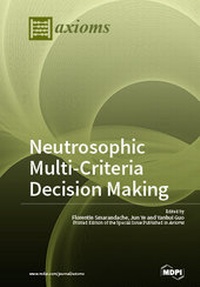
Neutrosophic Multi-Criteria Decision Making
MDPI (Publisher)
1st Edition
Published on 28. September 2018
Book
Paperback/Softback
206 pages
978-3-03897-288-4 (ISBN)
Description
Neutrosophic logic and set are gaining significant attention in solving many real-life problems that involve uncertainty, impreciseness, vagueness, incompleteness, inconsistency, and indeterminacy. A number of new neutrosophic theories have been proposed and have been applied in Multi-Criteria Decision-Making, computational intelligence, multiple-attribute decision-making, image processing, medical diagnosis, fault diagnosis, optimization design, and so on. Neutrosophic logic, set, probability, statistics, etc., are, respectively, generalizations of fuzzy and intuitionistic fuzzy logic and set, classical and imprecise probability, classical statistics and so on.
This Special Issue gathers 11 original research papers that report on the state of the art and recent advancements in Multi-Criteria Decision-Making using neutrosophic environment in computing, artificial intelligence, big and small data mining, group decision-making problems, pattern recognition, information processing, image processing, and many other practical achievements.
This Special Issue gathers 11 original research papers that report on the state of the art and recent advancements in Multi-Criteria Decision-Making using neutrosophic environment in computing, artificial intelligence, big and small data mining, group decision-making problems, pattern recognition, information processing, image processing, and many other practical achievements.
More details
Language
English
Place of publication
Basel
Switzerland
Target group
College/higher education
Professional and scholarly
Professionals/Scholars
Edition type
New edition
Product notice
Klappenbroschur
Illustrations
Illustrations
Dimensions
Height: 244 mm
Width: 170 mm
Thickness: 13 mm
Weight
536 gr
ISBN-13
978-3-03897-288-4 (9783038972884)
DOI
10.3390/books978-3-03897-289-1
Schweitzer Classification