

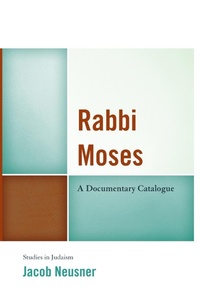
Rabbi Moses
A Documentary Catalogue
Published on 1. March 2013
Book
Paperback/Softback
158 pages
978-0-7618-6091-4 (ISBN)
Description
This book is an exercise in the systematic recourse to anachronism as a theological-exegetical mode of apologetics. Specifically, Neusner demonstrates the capacity of the Rabbinic sages to read ideas attested in their own day as authoritative testaments to - to them - ancient times. Thus, Scripture was read as integral testimony to the contemporary scene.
About a millennium - 750 B.C. E. to 350 C. E. - separates Scripture's prophets from the later sages of the Mishnah and the Talmud. It is quite natural to recognize evidence for differences over a long period of time. Yet Judaism sees itself as a continuum and overcomes difference. The latecomers portray the ancients like themselves. "In our image, after our likeness" captures the current aspiration. The sages accommodated the later documents in their canon by finding the traits of their own time in the record of the remote past. They met the challenges to perfection that the sages brought about.
Of what does the process of harmonization consist? To answer that question the author surveys the presentation of the prophets by the rabbis, beginning with Moses. To overcome the gap, Rabbinic sages turn Moses into a sage like themselves. The prophet performs wonders. The sage sets forth reasonable rulings. The conclusion expands on this account of matters to show the categorical solution that the sages adopted for themselves, and that is the happy outcome of the study.
About a millennium - 750 B.C. E. to 350 C. E. - separates Scripture's prophets from the later sages of the Mishnah and the Talmud. It is quite natural to recognize evidence for differences over a long period of time. Yet Judaism sees itself as a continuum and overcomes difference. The latecomers portray the ancients like themselves. "In our image, after our likeness" captures the current aspiration. The sages accommodated the later documents in their canon by finding the traits of their own time in the record of the remote past. They met the challenges to perfection that the sages brought about.
Of what does the process of harmonization consist? To answer that question the author surveys the presentation of the prophets by the rabbis, beginning with Moses. To overcome the gap, Rabbinic sages turn Moses into a sage like themselves. The prophet performs wonders. The sage sets forth reasonable rulings. The conclusion expands on this account of matters to show the categorical solution that the sages adopted for themselves, and that is the happy outcome of the study.
More details
Series
Language
English
Place of publication
Lanham, MD
United States
Target group
Professional and scholarly
Dimensions
Height: 229 mm
Width: 152 mm
Thickness: 9 mm
Weight
242 gr
ISBN-13
978-0-7618-6091-4 (9780761860914)
Copyright in bibliographic data and cover images is held by Nielsen Book Services Limited or by the publishers or by their respective licensors: all rights reserved.
Schweitzer Classification
Other editions
Additional editions
E-Book
03/2013
1st Edition
University Press of America
€36.99
Available for download
E-Book
03/2013
1st Edition
University Press of America
€36.99
Available for download
Person
Jacob Neusner is a leading figure in the American academic study of religion. He revolutionized the study of Judaism and brought it into the field of religion, and he built intellectual bridges between Judaism and other religions, thereby laying the groundwork for durable understanding and respect among religions. He has advanced the careers of younger scholars and teachers through his teaching and publication programs. Neusner's influence on the study of Judaism and religion is broad, powerful, distinctive, and enduring.
Content
CONTENTS
PREFACE
INTRODUCTION
1. MOSES IN THE MISHNAH AND ABOT
2. MOSES IN THE TOSEFTA
3. MOSES IN SIFRA
4. MOSES IN SIFRE TO NUMBERS AND SIFRE ZUTTA TO NUMBERS
5. MOSES IN SIFRE TO DEUTERONOMY
6. MOSES IN MEKHILTA ATTRIBUTED TO R. ISHMAEL
7. MOSES IN GENESIS RABBAH
8. MOSES IN LEVITICUS RABBAH
9. MOSES IN PESIQTA DERAB KAHANA
10. MOSES IN ESTHER RABBAH I
11. MOSES IN SONG OF SONGS RABBAH
12. MOSES IN RUTH RABBAH
13. MOSES IN LAMENTATIONS RABBAH
14. MOSES IN THE FATHERS ACCORDING TO RABBI NATHAN
15. MOSES IN YERUSHALMI BERAKHOT AND ZERAIM
16. MOSES IN YERUSHALMI MOED
17. MOSES IN YERUSHALMI NASHIM
18. MOSES IN YERUSHALMI NEZIQIN
19. MOSES IN BAVLI BERAKHOT
20. MOSES IN BAVLI MOED
21. MOSES IN BAVLI NASHIM
22. MOSES IN BAVLI NEZIQIN, BAVLI SANHEDRIN
23. MOSES IN BAVLI QODOSHIM AND NIDDAH
24. MOSES AS A FIGURE IN THE DOCUMENTARY CATALOGUE
PREFACE
INTRODUCTION
1. MOSES IN THE MISHNAH AND ABOT
2. MOSES IN THE TOSEFTA
3. MOSES IN SIFRA
4. MOSES IN SIFRE TO NUMBERS AND SIFRE ZUTTA TO NUMBERS
5. MOSES IN SIFRE TO DEUTERONOMY
6. MOSES IN MEKHILTA ATTRIBUTED TO R. ISHMAEL
7. MOSES IN GENESIS RABBAH
8. MOSES IN LEVITICUS RABBAH
9. MOSES IN PESIQTA DERAB KAHANA
10. MOSES IN ESTHER RABBAH I
11. MOSES IN SONG OF SONGS RABBAH
12. MOSES IN RUTH RABBAH
13. MOSES IN LAMENTATIONS RABBAH
14. MOSES IN THE FATHERS ACCORDING TO RABBI NATHAN
15. MOSES IN YERUSHALMI BERAKHOT AND ZERAIM
16. MOSES IN YERUSHALMI MOED
17. MOSES IN YERUSHALMI NASHIM
18. MOSES IN YERUSHALMI NEZIQIN
19. MOSES IN BAVLI BERAKHOT
20. MOSES IN BAVLI MOED
21. MOSES IN BAVLI NASHIM
22. MOSES IN BAVLI NEZIQIN, BAVLI SANHEDRIN
23. MOSES IN BAVLI QODOSHIM AND NIDDAH
24. MOSES AS A FIGURE IN THE DOCUMENTARY CATALOGUE