

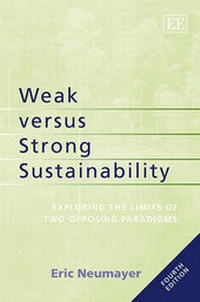
Weak versus Strong Sustainability
Exploring the Limits of Two Opposing Paradigms, Fourth Edition
4th Edition
Published on 30. April 2013
Book
Hardback
296 pages
978-1-78100-707-5 (ISBN)
Description
This fourth edition of an enduring and popular book has been fully updated and revised, exploring the two opposing paradigms of sustainability in an insightful and accessible way. Eric Neumayer contends that central to the debate on sustainable development is the question of whether natural capital can be substituted by other forms of capital. Proponents of weak sustainability maintain that such substitutability is possible, whilst followers of strong sustainability regard natural capital as non-substitutable.The author examines the availability of natural resources for the production of consumption goods and the environmental consequences of economic growth. He identifies the critical forms of natural capital in need of preservation given risk, uncertainty and ignorance about the future and opportunity costs of preservation. He goes on to provide a critical discussion of measures of sustainability. Indicators of weak sustainability such as Genuine Savings and the Index of Sustainable Economic Welfare - also known as the Genuine Progress Indicator - are analysed, as are indicators of strong sustainability, including ecological footprints, material flows and sustainability gaps.
This book will prove essential reading for students, scholars and policymakers with an interest in ecological and environmental economics and sustainable development.
Contents:
Preface to the Fourth Edition
1. Introduction and Overview
2. Sustainable Development: Conceptual, Ethical and Paradigmatic Issues
3. Resources, the Environment and Economic Growth: Is Natural Capital Substitutable?
4. Preserving Natural Capital in a World of Risk, Uncertainty and Ignorance
5. Measuring Weak Sustainability
6. Measuring Strong Sustainability
7. Conclusions
Appendix 1. How Present-value Maximisation Can Lead to Extinction
Appendix 2. The Hotelling Rule and Ramsey Rule in a Simple General Equilibrium Model
Appendix 3. The Hotelling Rule and the Ramsey Rule in a More Complex Model
Bibliography
Index
This book will prove essential reading for students, scholars and policymakers with an interest in ecological and environmental economics and sustainable development.
Contents:
Preface to the Fourth Edition
1. Introduction and Overview
2. Sustainable Development: Conceptual, Ethical and Paradigmatic Issues
3. Resources, the Environment and Economic Growth: Is Natural Capital Substitutable?
4. Preserving Natural Capital in a World of Risk, Uncertainty and Ignorance
5. Measuring Weak Sustainability
6. Measuring Strong Sustainability
7. Conclusions
Appendix 1. How Present-value Maximisation Can Lead to Extinction
Appendix 2. The Hotelling Rule and Ramsey Rule in a Simple General Equilibrium Model
Appendix 3. The Hotelling Rule and the Ramsey Rule in a More Complex Model
Bibliography
Index
More details
Edition
4th edition
Language
English
Place of publication
Cheltenham
United Kingdom
Target group
College/higher education
Dimensions
Height: 234 mm
Width: 156 mm
ISBN-13
978-1-78100-707-5 (9781781007075)
Copyright in bibliographic data and cover images is held by Nielsen Book Services Limited or by the publishers or by their respective licensors: all rights reserved.
Schweitzer Classification
Other editions
New editions
Eric Neumayer
Weak versus Strong Sustainability
Exploring the Limits of Two Opposing Paradigms, Fifth Edition
Book
07/2025
5th Edition
Edward Elgar Publishing
€163.68
Shipment within 10-20 days
Previous edition
Eric Neumayer
Weak versus Strong Sustainability
Exploring the Limits of Two Opposing Paradigms, Third Edition
Book
02/2010
3rd Edition
Edward Elgar Publishing
€126.48
Article exhausted; check for reprint
Person
Eric Neumayer, Professor of Environment and Development, Vice President (Planning and Resources), Deputy President and Vice Chancellor, London School of Economics and Political Science, UK
Content
Contents: Preface to the Fourth Edition 1. Introduction and Overview 2. Sustainable Development: Conceptual, Ethical and Paradigmatic Issues 3. Resources, the Environment and Economic Growth: Is Natural Capital Substitutable? 4. Preserving Natural Capital in a World of Risk, Uncertainty and Ignorance 5. Measuring Weak Sustainability 6. Measuring Strong Sustainability 7. Conclusions Appendix 1. How Present-value Maximisation Can Lead to Extinction Appendix 2. The Hotelling Rule and Ramsey Rule in a Simple General Equilibrium Model Appendix 3. The Hotelling Rule and the Ramsey Rule in a More Complex Model Bibliography Index