

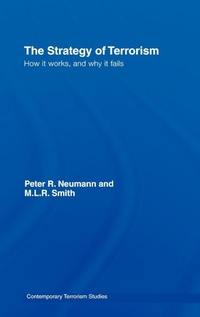
The Strategy of Terrorism
How it Works, and Why it Fails
1st Edition
Published on 18. October 2007
Book
Hardback
144 pages
978-0-415-42618-3 (ISBN)
Description
This is the first book to set out a comprehensive framework by which to understand terrorism as strategy. It contends that even terrorism of the supposedly nihilist variety can be viewed as a bona fide method for distributing means to fulfil the ends of policy, that is, as a strategy.
The main purpose of the work is to describe the dynamics of terrorism and evaluate their effectiveness, as well as to theorize upon, and clarify the correlation between, political ends and terrorist means. The text explains the modus operandi of terrorism, and demonstrates how terrorism relies on manipulating the psychological impact of (usually) relatively small-scale attacks. Using a variety of case studies, The Strategy of Terrorism shows how many campaigns of terrorism end in failure when they lose their power to terrify. The authors spell out what a proper understanding of terrorism as a strategy implies for those who want to make terrorism ineffective, and offer a number of policy recommendations derived directly from their critique.
This is the first contribution of strategic studies to the study of terrorism, and will be of much interest to students of terrorism, strategy and security studies, as well as military professionals and policy makers.
The main purpose of the work is to describe the dynamics of terrorism and evaluate their effectiveness, as well as to theorize upon, and clarify the correlation between, political ends and terrorist means. The text explains the modus operandi of terrorism, and demonstrates how terrorism relies on manipulating the psychological impact of (usually) relatively small-scale attacks. Using a variety of case studies, The Strategy of Terrorism shows how many campaigns of terrorism end in failure when they lose their power to terrify. The authors spell out what a proper understanding of terrorism as a strategy implies for those who want to make terrorism ineffective, and offer a number of policy recommendations derived directly from their critique.
This is the first contribution of strategic studies to the study of terrorism, and will be of much interest to students of terrorism, strategy and security studies, as well as military professionals and policy makers.
More details
Series
Language
English
Place of publication
London
United Kingdom
Publishing group
Taylor & Francis Ltd
Target group
College/higher education
Professional and scholarly
Dimensions
Height: 240 mm
Width: 161 mm
Thickness: 12 mm
Weight
379 gr
ISBN-13
978-0-415-42618-3 (9780415426183)
Copyright in bibliographic data and cover images is held by Nielsen Book Services Limited or by the publishers or by their respective licensors: all rights reserved.
Schweitzer Classification
Other editions
Additional editions
Book
03/2009
1st Edition
Routledge
€84.20
Shipment within 15-20 days
E-Book
10/2007
Routledge
€77.49
Available for download
E-Book
10/2007
Routledge
€77.49
Available for download
Persons
Peter R. Neumann is Director of the Centre for Defence Studies, King's College London.
M. L. R. Smith is Reader in War Studies, Department of War Studies, King's College London.
M. L. R. Smith is Reader in War Studies, Department of War Studies, King's College London.
Content
1. Introduction 2. Terrorism and Strategic Theory 3. The Strategy of Terrorism 4. Flawed Assumptions 5. The Escalation Trap 6. Conclusion