

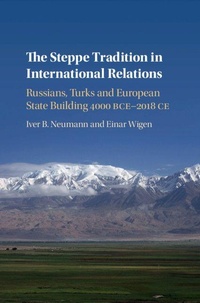
The Steppe Tradition in International Relations
Russians, Turks and European State Building 4000 BCE-2017 CE
Published on 19. July 2018
Book
Hardback
322 pages
978-1-108-42079-2 (ISBN)
Description
Neumann and Wigen counter Euro-centrism in the study of international relations by providing a full account of political organisation in the Eurasian steppe from the fourth millennium BCE up until the present day. Drawing on a wide range of archaeological and historical secondary sources, alongside social theory, they discuss the pre-history, history and effect of what they name the 'steppe tradition'. Writing from an International Relations perspective, the authors give a full treatment of the steppe tradition's role in early European state formation, as well as explaining how politics in states like Turkey and Russia can be understood as hybridising the steppe tradition with an increasingly dominant European tradition. They show how the steppe tradition's ideas of political leadership, legitimacy and concepts of succession politics can help us to understand the policies and behaviour of such leaders as Putin in Russia and Erdogan in Turkey.
Reviews / Votes
'For far too long our large-scale, broad-stroke histories have revolved around sedentary and maritime empires, agro-capitalist regimes, and nation states. This powerful book provides a compelling counter narrative by re-examining a long sweep of Eurasian history from steppe worlds outward rather than sedentary domains outward. The results are revelatory. Even today, if looked closely, we can see traces of the two-millennia-old steppe tradition behind the facade of the modern states system.' Pekka Haemaelaeinen, author of The Comanche Empire 'Neumann and Wigen have produced a veritable masterpiece. Their book opens up exciting new vistas for the comparative study of international systems, filling a critical lacuna in our understanding of Eurasia's political development. And it also provides timely insight into the enduring imprint of the steppe state-building tradition, and the deep historical roots of authoritarianism in Turkey and the post-Soviet space. The Steppe Tradition in International Relations is destined to be a classic, and should be required reading for all serious students of comparative state formation and historical international relations.' Andrew Phillips, University of QueenslandMore details
Language
English
Place of publication
Cambridge
United Kingdom
Target group
Professional and scholarly
Illustrations
Worked examples or Exercises; 2 Tables, black and white; 2 Maps; 2 Line drawings, black and white
Dimensions
Height: 235 mm
Width: 157 mm
Thickness: 22 mm
Weight
624 gr
ISBN-13
978-1-108-42079-2 (9781108420792)
Copyright in bibliographic data and cover images is held by Nielsen Book Services Limited or by the publishers or by their respective licensors: all rights reserved.
Schweitzer Classification
Other editions
Additional editions
Iver B. Neumann | Einar Wigen
The Steppe Tradition in International Relations
Russians, Turks and European State Building 4000 BCE-2017 CE
Book
02/2020
Cambridge University Press
€49.30
Shipment within 15-20 days
Iver B. Neumann
Steppe Tradition in International Relations
Russians, Turks and European State Building 4000 BCE-2017 CE
E-Book
07/2018
Cambridge University Press
€24.49
Available for download
Iver B. Neumann | Einar Wigen
The Steppe Tradition in International Relations
Russians, Turks and European State Building 4000 BCE-2017 CE
E-Book
06/2018
Cambridge University Press
€88.99
Available for download
Persons
Iver B. Neumann, Ph.D., is a researcher at the Norwegian Institute of International Affairs and Adjunct Professor at the Museum of Cultural History, Universitetet i Oslo. He has taken a career-long interest in the differences between Russia and Europe and has published two previous books on the matter: Russia and the Idea of Europe (1996, 2nd edition, 2017) and Uses of the Other: 'The East' in European Identity Formation (1999). He has also published widely on diplomacy and statebuilding. Einar Wigen, Ph.D. (Universitetet i Oslo, Turkish studies) is post doctoral fellow at the Department for Culture Studies and Oriental Languages,Universitetet i Oslo. As well as being trained as an Ottomanist, he holds one M.A. in political science from the Universitetet i Oslo, and another in peace and conflict studies from European Peace University, Austria. Wigen is the author of the monograph State of Translation: Turkey in Interlingual Relations (2018).
Content
Introduction; 1. The steppe as the great unknown; 2. The emergence of the steppe tradition; 3. The steppe tradition settles down; 4. The steppe in the emergent Rus' polity; 5. Russia and Turkey between the steppe and Europe.