

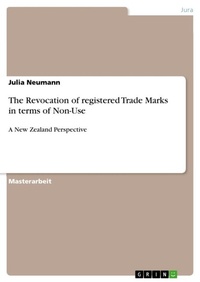
The Revocation of registered Trade Marks in terms of Non-Use
A New Zealand Perspective
3rd Edition
Published on 16. February 2011
Book
Paperback/Softback
56 pages
978-3-640-83169-2 (ISBN)
Description
Masterarbeit aus dem Jahr 2010 im Fachbereich Jura - Andere Rechtssysteme, Rechtsvergleichung, Note: B, University of Auckland, Sprache: Deutsch, Abstract: This paper deals with the non-use of registered trade marks. It mainly focuses on the trade mark system of New Zealand; however it compares this with selected issues of foreign trade mark systems. Unexpectedly, the non-use of registered trade marks is a topic which closely relates to the vivid field of promotion, competition, and globalization, although it is embedded in the rather static system of registration and administration. The non-use of a registered trade mark enables the opposition to initiate a procedure of revocation from the trade mark register against the respective trade mark. With removal from the trade mark register the trade mark rights of the owner hereby granted cease. Therefore, the application of revocation from the trade mark register in terms of non-use is, beside other grounds for removal, a common tactic of competitors to shed blocking trade marks.
This paper shall give an overview of the formal procedure of application, including the legal aspects of the requisite standing, the competent forum and the burden of proof. However, the main focus of this analysis encompasses the legal term and definition of the use (¿genuine use¿) of a trade mark. Unfortunately, New Zealand legislation as well as other Common Law and Civil Law jurisdictions gives minimal guidance on the interpretation of the term ¿genuine use¿. Although, European jurisdiction created and confirmed a common understanding by pointing out some main criteria, this definition only constitutes a framework. Subsequently, the term has been formed through case-by-case decisions of national and overseas courts and the Intellectual Property Office. Therefore, this paper will provide different case examples of the jurisdiction of New Zealand and other jurisdictions. However, the line of cases will show the variety regarding the determination of ¿genuine use¿. A comprehensive and universal definition of the term cannot be established. Actions made in respect of a trade mark can only be evaluated as ¿genuine use¿ in regard to the specific circumstances.
More details
Edition
3. Auflage
Language
German
Place of publication
Germany
Product notice
Paperback (trade)
Unsewn / adhesive bound
Dimensions
Height: 210 mm
Width: 148 mm
Thickness: 5 mm
Weight
96 gr
ISBN-13
978-3-640-83169-2 (9783640831692)
Copyright in bibliographic data and cover images is held by Nielsen Book Services Limited or by the publishers or by their respective licensors: all rights reserved.
Schweitzer Classification
Other editions
Additional editions
E-Book
02/2011
1st Edition
GRIN Verlag
€18.99
Available for download