

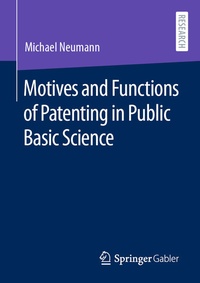
Motives and Functions of Patenting in Public Basic Science
Published on 6. July 2021
Book
Paperback/Softback
XIX, 272 pages
978-3-658-33121-4 (ISBN)
Description
Taking German public basic research as an example, this book explores how the ongoing implementation of knowledge and technology transfer as the Third Mission of academic science creates not only new incentives for academic patenting, but also triggers new patenting motives and strategies of researchers and organizations. Analyzing these motives and strategies, the book highlights how the complex regulatory interplay of the patent system, research policy and self-governed academic communities creates a situation in which new patent functions emerge: beyond their intended function as a protection for upstream inventions, patents become a signaling device for scientists to communicate their commitment and competence in the Third Mission. As an exploratory study, this book combines qualitative empirical research with concepts and insights from multiple fields such as economics, law, political sciences and regulation. In consequence, the book addresses anyone interested in patenting incentives and motives and their impact on the functional change and regulatory effectiveness of patents in polycentric regulatory environments.
More details
Edition
1st ed. 2021
Language
English
Place of publication
Wiesbaden
Germany
Publishing group
Springer Fachmedien Wiesbaden GmbH
Target group
Professional and scholarly
Illustrations
63 s/w Abbildungen
XIX, 272 p. 63 illus.
Dimensions
Height: 210 mm
Width: 148 mm
Thickness: 16 mm
Weight
381 gr
ISBN-13
978-3-658-33121-4 (9783658331214)
DOI
10.1007/978-3-658-33122-1
Schweitzer Classification
Other editions
Additional editions
Michael Neumann
Motives and Functions of Patenting in Public Basic Science
E-Book
07/2021
Springer Gabler
€96.29
Available for download
Person
With a background in institutional economics and philosophy of science, Michael Neumann joined the DFG graduate school on "Intellectual Property and the Public Domain" and the MPI for Innovation and Competition to write this doctoral thesis. He now works as a consultant on research and innovation policy.
Content
Introduction.- Methodology.- Theory: Community Governance and Patenting in Science.- Policy Analysis: Patenting for the Third Mission.- Empirics: Patenting Motives in Basic Science.- Synthesis: Contextual Patent Functions.- Summary