

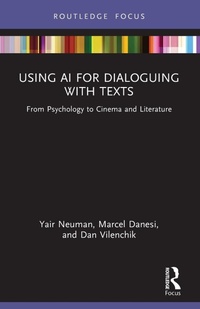
Using AI for Dialoguing with Texts
From Psychology to Cinema and Literature
1st Edition
Published on 26. August 2024
Book
Paperback/Softback
118 pages
978-1-032-36329-5 (ISBN)
Description
This concise volume offers an accessible introduction to state-of-the-art artificial intelligence (AI) language models, providing a platform for their use in textual interpretation across the humanities and social sciences.
The book outlines the affordances of new technologies for textual analysis, which has historically employed established approaches within the humanities. Neuman, Danesi, and Vilenchik argue that these different forms of analysis are indeed complementary, demonstrating the ways in which AI-based perspectives echo similar theoretical and methodological currents in traditional approaches while also offering new directions for research. The volume showcases examples from a wide range of texts, including novels, television shows, and films to illustrate the ways in which the latest AI technologies can be used for "dialoguing" with textual characters and examining textual meaning coherence.
Illuminating the potential of AI language models to both enhance and extend research on the interpretation of texts, this book will appeal to scholars interested in cognitive approaches to the humanities in such fields as literary studies, discourse analysis, media studies, film studies, psychology, and artificial intelligence.
The book outlines the affordances of new technologies for textual analysis, which has historically employed established approaches within the humanities. Neuman, Danesi, and Vilenchik argue that these different forms of analysis are indeed complementary, demonstrating the ways in which AI-based perspectives echo similar theoretical and methodological currents in traditional approaches while also offering new directions for research. The volume showcases examples from a wide range of texts, including novels, television shows, and films to illustrate the ways in which the latest AI technologies can be used for "dialoguing" with textual characters and examining textual meaning coherence.
Illuminating the potential of AI language models to both enhance and extend research on the interpretation of texts, this book will appeal to scholars interested in cognitive approaches to the humanities in such fields as literary studies, discourse analysis, media studies, film studies, psychology, and artificial intelligence.
More details
Series
Language
English
Place of publication
London
United Kingdom
Publishing group
Taylor & Francis Ltd
Target group
College/higher education
Professional and scholarly
Academic, Postgraduate, and Undergraduate Advanced
Illustrations
12 s/w Abbildungen, 12 s/w Zeichnungen, 5 s/w Tabellen
5 Tables, black and white; 12 Line drawings, black and white; 12 Illustrations, black and white
Dimensions
Height: 216 mm
Width: 140 mm
Thickness: 7 mm
Weight
172 gr
ISBN-13
978-1-032-36329-5 (9781032363295)
Copyright in bibliographic data and cover images is held by Nielsen Book Services Limited or by the publishers or by their respective licensors: all rights reserved.
Schweitzer Classification
Other editions
Additional editions
Yair Neuman | Marcel Danesi | Dan Vilenchik
Using AI for Dialoguing with Texts
From Psychology to Cinema and Literature
E-Book
11/2022
1st Edition
Routledge
€27.49
Available for download
Yair Neuman | Marcel Danesi | Dan Vilenchik
Using AI for Dialoguing with Texts
From Psychology to Cinema and Literature
E-Book
11/2022
1st Edition
Routledge
€27.49
Available for download
Yair Neuman | Marcel Danesi | Dan Vilenchik
Using AI for Dialoguing with Texts
From Psychology to Cinema and Literature
Book
11/2022
1st Edition
Routledge
€71.50
Shipment within 10-20 days
Persons
Yair Neuman (b. 1968) is Head of the Functor Lab, Department of Cognitive and Brain Sciences, Ben-Gurion University of the Negev. He is the author of numerous papers and eight books and has a long-standing interest in interdisciplinary approaches to the interpretation of texts.
Marcel Danesi (b. 1946) is Professor Emeritus of Anthropology at the University of Toronto and the author of numerous papers and books. He has published in semiotics, linguistics, and popular culture. He is interested in the relation between sign systems and cognitive processes.
Dan Vilenchik (b. 1977) is Senior Lecturer at the School of Electrical Engineering, Ben-Gurion University of the Negev. He is interested in the development of new methodologies to enhance multidisciplinary research, with a special focus on online social networks and natural language processing.
Marcel Danesi (b. 1946) is Professor Emeritus of Anthropology at the University of Toronto and the author of numerous papers and books. He has published in semiotics, linguistics, and popular culture. He is interested in the relation between sign systems and cognitive processes.
Dan Vilenchik (b. 1977) is Senior Lecturer at the School of Electrical Engineering, Ben-Gurion University of the Negev. He is interested in the development of new methodologies to enhance multidisciplinary research, with a special focus on online social networks and natural language processing.
Content
Contents
Preface
Acknowledgments
Chapter 1. What Is a Text?
Chapter 2. A Friendly Introduction to Machine Learning and Deep Neural Networks
Chapter 3. A Friendly Introduction to Large Language Models
Chapter 4. Using AI for Dialoguing with Texts
Chapter 5. Bart Simpson: The Rebellious Mind
Chapter 6. Marilyn Monroe: Are Diamonds Really a Girl's Best Friend?
Chapter 7. The Mind of a Killer: From Pulp Fiction to Seung-Hui Cho
Chapter 8. To Die Will Be an Awfully Big Adventure: AI in Neverland
Chapter 9. When Harry Met Sally: AI and the Fake Orgasm
Chapter 10. Final Summary
Index
Preface
Acknowledgments
Chapter 1. What Is a Text?
Chapter 2. A Friendly Introduction to Machine Learning and Deep Neural Networks
Chapter 3. A Friendly Introduction to Large Language Models
Chapter 4. Using AI for Dialoguing with Texts
Chapter 5. Bart Simpson: The Rebellious Mind
Chapter 6. Marilyn Monroe: Are Diamonds Really a Girl's Best Friend?
Chapter 7. The Mind of a Killer: From Pulp Fiction to Seung-Hui Cho
Chapter 8. To Die Will Be an Awfully Big Adventure: AI in Neverland
Chapter 9. When Harry Met Sally: AI and the Fake Orgasm
Chapter 10. Final Summary
Index