

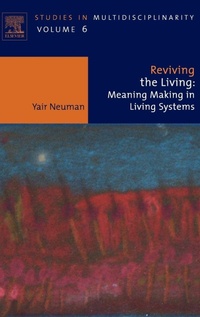
Reviving the Living: Volume 6
Meaning Making in Living Systems
Published on 7. April 2008
Book
Hardback
320 pages
978-0-444-53033-2 (ISBN)
Description
Reviving the Living: Meaning Making in Living Systems presents a novel perspective that relates to current biological knowledge and issues. Written by polymath Dr. Yair Neuman, the book challenges the dogmas that frame our understanding of living systems and presents a radical alternative approach to understanding the world around us, one that avoids the pitfalls of non-scientific perspectives such as Vitalism and Creationism.
In this thought provoking and iconoclastic manuscript, Neuman follows the footsteps of Gregory Bateson, Mikhail Bakhtin, Michael Polanyi and others, to suggest that living systems are meaning making systems. The book delves into the unique processes of meaning making that characterize organisms as a unique category of nature, and offers new and fascinating insights into a variety of enigmatic biological phenomena from immune memory to hidden life (cryptobiosis). It consists of four parts divided into 18 chapters and covers topics ranging from reductionism and its pitfalls to genetics; why organisms are irreducible; immunology; meaning making in language and biology; meaning-bridging the gap between physics and semantics; context and memory; and the poetry of living. Core concepts and themes are illustrated using examples based in current science.
This text would be of high interest to biologists, philosophers, cognitive scientists, psychologists, and semioticians, as well as to any reflective individual who is willing to examine the realm of the living from a novel and fascinating perspective.
In this thought provoking and iconoclastic manuscript, Neuman follows the footsteps of Gregory Bateson, Mikhail Bakhtin, Michael Polanyi and others, to suggest that living systems are meaning making systems. The book delves into the unique processes of meaning making that characterize organisms as a unique category of nature, and offers new and fascinating insights into a variety of enigmatic biological phenomena from immune memory to hidden life (cryptobiosis). It consists of four parts divided into 18 chapters and covers topics ranging from reductionism and its pitfalls to genetics; why organisms are irreducible; immunology; meaning making in language and biology; meaning-bridging the gap between physics and semantics; context and memory; and the poetry of living. Core concepts and themes are illustrated using examples based in current science.
This text would be of high interest to biologists, philosophers, cognitive scientists, psychologists, and semioticians, as well as to any reflective individual who is willing to examine the realm of the living from a novel and fascinating perspective.
Reviews / Votes
"Neuman's approach is an ingenious way to introduce an issue..." "A compilation of highly interesting topic that will undoubtedly transform the way readers think about organisms". Angewandte Chemie International 2009."This enthusiastically written and thought-provoking book ... challenges dogmas of received wisdom such as reductionism, both mechanical and genetic... Neuman's observations about the fallacy of sacrificing real-world properties in the interest of formal tractability are of great importance to systems thinkers, analysts, and modelers in various application areas, who wish to avoid serious failures in their work". Computing Reviews 2009 (an ACM Review Journal)
"Neuman presents a fascinating analysis of biological interactions that aims to transcend the sort of billiard-ball model of causation that seems to be presupposed by the reductionists who are his target... Neuman has put the issues into what seems to be a more appropriate context, and that is a splendid accomplishment". Perspectives in Biology and Medicine 2009.
More details
Series
Language
English
Place of publication
Oxford
United Kingdom
Publishing group
Elsevier Science & Technology
Target group
Professional and scholarly
Biologists, philosophers, cognitive scientists, psychologists, semioticians, general audience
Product notice
Laminated cover
Dimensions
Height: 234 mm
Width: 156 mm
Thickness: 19 mm
Weight
626 gr
ISBN-13
978-0-444-53033-2 (9780444530332)
Copyright in bibliographic data and cover images is held by Nielsen Book Services Limited or by the publishers or by their respective licensors: all rights reserved.
Schweitzer Classification
Other editions
Additional editions
E-Book
08/2011
Elsevier
€165.00
Available for download
Person
Content
PART 1. HOW LOW CAN YOU GO? REDUCTIONISM AND ITS LIMITATIONSCh. 1: What is Reductionism?Ch. 2: Who is Reading the Book of Life?Ch. 3: Genetics: From Grammar to Meaning MakingCh. 4: A Point for Thought: Why are Organisms Irreducible?Ch. 5: A Point for Thought: Does the Genetic System Include a Meta-Language?Ch. 6: Immunology: From Soldiers to Housewives?Ch. 7: A Point for Thought: Immune Specificity and Brancusi's KissCh. 8: A Point for Thought: Reflections on the Immune SelfPART 2. WHAT IS THE MEANING OF THIS STORY?Ch. 9: Meaning Making in Language and BiologyCh. 10: God's Sacred WordsCh. 11: It Means NothingCh. 12: A Point for Thought: Meaning-Bridging the Gap Between Physics and SemanticsCh. 13: The Rest is SilencePART 3. ON THE WILD SIDE: FOUR LESSONSCh. 14: The Polysemy of the Sign: A Quantum LessonCh. 15: Recursive-Hierarchy: A Lesson From the TardigradeCh. 16: Context and Memory: A Lesson From Funes the MemoriousCh. 17: Transgradience: A Lesson from BakhtinPART 4. FROM MECHANICS TO POIESISCh. 18: The Poetry of Living