

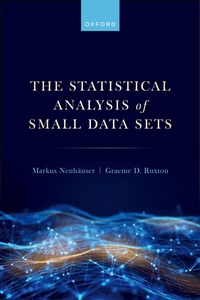
The Statistical Analysis of Small Data Sets
Published on 30. August 2024
Book
Paperback/Softback
160 pages
978-0-19-887298-6 (ISBN)
Description
We live in the era of big data. However, small data sets are still common for ethical, financial, or practical reasons. Small sample sizes can cause researchers to seek out the most powerful methods to analyse their data, but they may also be wary that some methodologies and assumptions may not be appropriate when samples are small. The book offers advice on the statistical analysis of small data sets for various designs and levels of measurement, helping researchers to analyse such data sets, but also to evaluate and interpret others' analyses.
The book discusses the potential challenges associated with a small sample, as well as the ways in which these challenges can be mitigated. General topics with strong relevance to small sample sizes such as meta-analysis, sequential and adaptive designs, and multiple testing are introduced. While the focus is on hypothesis tests and confidence intervals, Bayesian analyses are also covered. Code written in the statistical software R is presented to carry out the proposed methods, many of which are not limited to use on small data sets, and the book also discusses approaches to computing the power or the necessary sample size, respectively.
The book discusses the potential challenges associated with a small sample, as well as the ways in which these challenges can be mitigated. General topics with strong relevance to small sample sizes such as meta-analysis, sequential and adaptive designs, and multiple testing are introduced. While the focus is on hypothesis tests and confidence intervals, Bayesian analyses are also covered. Code written in the statistical software R is presented to carry out the proposed methods, many of which are not limited to use on small data sets, and the book also discusses approaches to computing the power or the necessary sample size, respectively.
More details
Language
English
Place of publication
Oxford
United Kingdom
Target group
College/higher education
Product notice
Paperback (trade)
Unsewn / adhesive bound
Dimensions
Height: 231 mm
Width: 152 mm
Thickness: 8 mm
Weight
280 gr
ISBN-13
978-0-19-887298-6 (9780198872986)
Copyright in bibliographic data and cover images is held by Nielsen Book Services Limited or by the publishers or by their respective licensors: all rights reserved.
Schweitzer Classification
Other editions
Additional editions
Markus Neuhäuser | Graeme D. Ruxton
The Statistical Analysis of Small Data Sets
E-Book
10/2024
OUP eBook
€43.99
Available for download
Markus Neuhaeuser | Graeme D. Ruxton
The Statistical Analysis of Small Data Sets
Book
08/2024
Oxford University Press
€106.50
Shipment within 15-20 days
Persons
After studying statistics (with biology as minor) at the University of Dortmund, Professor Markus Neuhaeuser worked as a biostatistician in the pharmaceutical industryfrom 1996 to 2001. Back in academia, he was Senior Lecturer in the Department of Mathematics and Statistics at the University of Otago, New Zealand from 2002 to 2004 and at the University Hospital Essen, Germany from 2004 to 2006). Since 2006 he has been working as a Professor of Statistics at the RheinAhrCampus in Remagen, Germany.
Professor Graeme Ruxton FRSE is a zoologist known for his research into behavioural ecology and evolutionary ecology. Ruxton received his PhD in Statistics and Modelling Science in 1992 from the University of Strathclyde. His studies focus on the evolutionary pressures on aggregation by animals, and predator-prey aspects of sensory ecology. He researched visual communication in animals at the University of Glasgow, where he was professor of theoretical ecology. In 2013 he became professor at the University of St Andrews, Scotland. Ruxton has published numerous papers on antipredator adaptations, along with contributions to textbooks. In 2012 Ruxton was elected a Fellow of the Royal Society of Edinburgh.
Professor Graeme Ruxton FRSE is a zoologist known for his research into behavioural ecology and evolutionary ecology. Ruxton received his PhD in Statistics and Modelling Science in 1992 from the University of Strathclyde. His studies focus on the evolutionary pressures on aggregation by animals, and predator-prey aspects of sensory ecology. He researched visual communication in animals at the University of Glasgow, where he was professor of theoretical ecology. In 2013 he became professor at the University of St Andrews, Scotland. Ruxton has published numerous papers on antipredator adaptations, along with contributions to textbooks. In 2012 Ruxton was elected a Fellow of the Royal Society of Edinburgh.
Content
1: General principles
2: Note on permutation and bootstrap tests
3: A single sample of continuous data
4: Comparing continuous data across levels of one or more factors
5: Correlation and regression
6: Binomial data
7: Multinomial data
8: Sequential analysis and adaptive designs
9: Meta-analysis
10: Multiple testing
11: Bayesian analysis
2: Note on permutation and bootstrap tests
3: A single sample of continuous data
4: Comparing continuous data across levels of one or more factors
5: Correlation and regression
6: Binomial data
7: Multinomial data
8: Sequential analysis and adaptive designs
9: Meta-analysis
10: Multiple testing
11: Bayesian analysis