

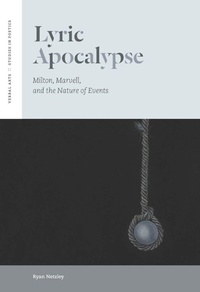
Lyric Apocalypse
Milton, Marvell, and the Nature of Events
Published on 22. January 2015
Book
Hardback
288 pages
978-0-8232-6347-9 (ISBN)
Description
What's new about the apocalypse? Revelation does not allow us to look back after the end and enumerate pivotal turning points. It happens in an immediate encounter with the transformatively new.
John Milton's and Andrew Marvell's lyrics attempt to render the experience of such an apocalyptic change in the present. In this respect they take seriously the Reformation's insistence that eschatology is a historical phenomenon. Yet these poets are also reacting to the Regicide, and, as a result, their works explore very modern questions about the nature of events, what it means for a significant historical occasion to happen.
Lyric Apocalypse argues that Milton's and Marvell's lyrics challenge any retrospective understanding of events, including one built on a theory of revolution. Instead, these poems show that there is no "after" to the apocalypse, that if we are going to talk about change, we should do so in the present, when there is still time to do something about it. For both of these poets, lyric becomes a way to imagine an apocalyptic event that would be both hopeful and new.
John Milton's and Andrew Marvell's lyrics attempt to render the experience of such an apocalyptic change in the present. In this respect they take seriously the Reformation's insistence that eschatology is a historical phenomenon. Yet these poets are also reacting to the Regicide, and, as a result, their works explore very modern questions about the nature of events, what it means for a significant historical occasion to happen.
Lyric Apocalypse argues that Milton's and Marvell's lyrics challenge any retrospective understanding of events, including one built on a theory of revolution. Instead, these poems show that there is no "after" to the apocalypse, that if we are going to talk about change, we should do so in the present, when there is still time to do something about it. For both of these poets, lyric becomes a way to imagine an apocalyptic event that would be both hopeful and new.
Reviews / Votes
"Lyric Apocalypse is a fine piece of work: timely, original, and persuasive-a powerful combination of theoretical argument with illuminating close reading. Netzely's sensitivity to verbal and syntactical alternatives is remarkable." -- -Judith H. Anderson Indiana University "This book explores both poets' views of apocalyptic change in the present." -The Chronicle of Higher Education "Netzley offers a theoretically sophisticated contemplation of the relationship between lyric and history. As he shows, lyric's concern with the momentary and evental holds the potential to disrupt historical narrativization, which in the sixteenth and seventeenth centuries is also the potential to query the Providential and the prophetic. This book ought to be read by scholars of Milton and Marvell, and will be appreciated well beyond early modern studies for an approach to lyric poetry informed by the work of Agamben, Adorno, and Deleuze and Guattari." -- -Feisal Mohamed author of Milton and the Post-Secular PresentMore details
Series
Language
English
Place of publication
New York
United States
Target group
Professional and scholarly
Product notice
Cloth over boards
Dimensions
Height: 231 mm
Width: 155 mm
Thickness: 28 mm
Weight
522 gr
ISBN-13
978-0-8232-6347-9 (9780823263479)
Copyright in bibliographic data and cover images is held by Nielsen Book Services Limited or by the publishers or by their respective licensors: all rights reserved.
Schweitzer Classification
Other editions
Additional editions
E-Book
01/2015
1st Edition
Fordham University Press
€44.49
Available for download
E-Book
01/2015
1st Edition
Fordham University Press
€31.99
Available for download
Person
Ryan Netzley is Associate Professor of English at Southern Illinois University, Carbondale.
Content
Acknowledgments Introduction. Lyric Apocalypses, Transformative Time, and the Possibility of Endings 1. Apocalyptic Means: Allegiance, Force, and Events in Marvell's Cromwell Trilogy and Royalist Elegies 2. Hope in the Present: Paratactic Apocalypses and Contemplative Events in Milton's Sonnets 3. What Happens in Lycidas Apocalypse, Possibility, and Events in Milton's Pastoral Elegy 4. How Poems End: Apocalypse, Symbol, and the Event of Ending in "Upon Appleton House" Conclusion. Revelation: Learning Freedom and the End of Crisis Notes Bibliography Index