

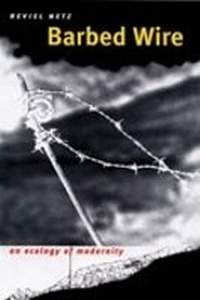
Barbed Wire
An Ecology of Modernity
Published on 29. November 2004
Book
Hardback
288 pages
978-0-8195-6719-2 (ISBN)
Description
In this original and controversial book, historian and philosopher Reviel Netz explores the development of a controlling and pain-inducing technology - barbed wire. Surveying its development from 1874 to 1954, Netz describes its use to control cattle during the colonization of the American West and to control people in Nazi concentration camps and the Russian Gulag. Physical control over space was no longer symbolic after 1874. This is a history told from the perspective of its victims. With vivid examples of the interconnectedness of humans, animals, and the environment, this dramatic account of barbed wire presents modern history through the lens of motion being prevented. Drawing together the history of humans and animals, Netz delivers a compelling new perspective on the issues of colonialism, capitalism, warfare, globalization, violence, and suffering. Theoretically sophisticated but written with a broad readership in mind, Barbed Wire calls for nothing less than a reconsideration of modernity.
More details
Language
English
Place of publication
United States
Target group
College/higher education
Illustrations
figures, 9 maps
Dimensions
Height: 216 mm
Width: 140 mm
ISBN-13
978-0-8195-6719-2 (9780819567192)
Copyright in bibliographic data and cover images is held by Nielsen Book Services Limited or by the publishers or by their respective licensors: all rights reserved.
Schweitzer Classification
Other editions
Additional editions
E-Book
12/2022
Wesleyan University Press
€19.25
Available for download
Person
Reviel Netz is Associate Professor at Stanford University, teaching history and the philosophy of science. His books include The Shaping of Deduction in Greek Mathematics: A Study in Cognitive History (1999) and the forthcoming Archimedes: Translation and Commentary.