

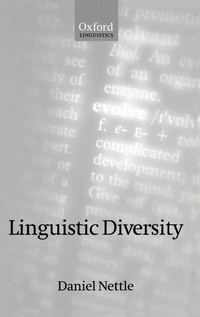
Linguistic Diversity
Published on 6. May 1999
Book
Hardback
180 pages
978-0-19-823858-4 (ISBN)
Description
There are some 6,500 different languages in the world, belonging to around 250 distinct families and conforming to numerous grammatical types. This book explains why. Given that the biological mechanisms underlying language are the same in all normal human beings, would we not be a more successful species if we spoke one language? Daniel Nettle considers how this extraordinary and rich diversity arose, how it relates to the nature of language, cognition, and culture, and how it is linked with the main patterns of human geography and history.
Human languages and language families are not distributed evenly: there are relatively few in Eurasia compared to the profusion found in Australasia, the Pacific, and the Americas. There is also a marked correlation between biodiversity and linguistic diversity. The author explains the processes by which this distribution evolved and changes still. To do so he returns to the earliest origins of language, reconstructing the processes of linguistic variation and diffusion that occurred when humans first filled the continents and, thousands of years later, turned to agriculture. He ends by examining the causes of linguistic mortality, and why the number of the world's languages may halve before 2100.
Linguistic Diversity draws on work in anthropology, linguistics, geography, archaeology, and evolutionary science to provide a comprehensive account of the patterns of linguistic diversity. It is written in a clear, lively and accessible style, and will appeal broadly across the natural and human sciences, as well as to the informed general reader.
Human languages and language families are not distributed evenly: there are relatively few in Eurasia compared to the profusion found in Australasia, the Pacific, and the Americas. There is also a marked correlation between biodiversity and linguistic diversity. The author explains the processes by which this distribution evolved and changes still. To do so he returns to the earliest origins of language, reconstructing the processes of linguistic variation and diffusion that occurred when humans first filled the continents and, thousands of years later, turned to agriculture. He ends by examining the causes of linguistic mortality, and why the number of the world's languages may halve before 2100.
Linguistic Diversity draws on work in anthropology, linguistics, geography, archaeology, and evolutionary science to provide a comprehensive account of the patterns of linguistic diversity. It is written in a clear, lively and accessible style, and will appeal broadly across the natural and human sciences, as well as to the informed general reader.
Reviews / Votes
This volume represents the synthesis of a bewildering amount of information and theory in numerous disciplines. * The Journal of The Royal Anthropological Institute * Nettle has produced a careful, thoughtful, and valuable study. He is to be commended for being unafraid to challenge the shibboleth that biological and linguistic diversity are wholly unrelated. He substantially adds to our knowledge of why languages have come to be distributed the way they are. * Language Policy * Nettle makes an important contribution to our understanding of reasons for the variation in the number of languages by correlating economic factors of subsistence with linguistic diversity. * Language Policy * A panopoly of possible microprocesses of language variation are explored painstakingly and with great ingenuity by the author ... This book is a mine of geolinguistic and sociolinguistic data, presented in a plain and captivating style. * TREE * His conclusions ... are eminently reasonable and manage to tie together a number of strands of thought in an original and creative way ... a valuable contribution to our understanding of how and why languages have changed over time. * Journal of Linguistics *More details
Language
English
Place of publication
Oxford
United Kingdom
Target group
Professional and scholarly
Illustrations
numerous graphs
Dimensions
Height: 240 mm
Width: 161 mm
Thickness: 15 mm
Weight
446 gr
ISBN-13
978-0-19-823858-4 (9780198238584)
Copyright in bibliographic data and cover images is held by Nielsen Book Services Limited or by the publishers or by their respective licensors: all rights reserved.
Schweitzer Classification
Other editions
Additional editions
Daniel Nettle
Linguistic Diversity
Book
04/1999
Oxford University Press
€69.80
Shipment within 15-20 days
Person
Content
1. Introduction ; 1.1 Preamble ; 1.2 The Family Tree Model ; 1.3 The Linguistic Item and Linguistic Pool ; 1.4 Levels and Diversity in the Linguistic Pool ; 1.5 Justification, Disguised as Apology ; 1.6 The Need for an Interdisciplinary Approach ; 2. Language Evolution: Basic Mechanisms ; 2.1 Introduction ; 2.2 The Neutral Model ; 2.3 Problems with the Neutral Model ; 2.4 Additional Amplifiers ; 2.5 Summary and Conclusions ; 3. Language Evolution: Computer Simulations ; 3.1 Introduction ; 3.2 The Use of Computer Simulations ; 3.3 Methods ; 3.4 Basic Results ; 3.5 More Realistic Social Structures ; 3.6 Social Selection ; 3.7 Functional Selection ; 3.8 Discrete Traits ; 3.9 Discussion ; 3.10 Adaptive Significance of Social Selection ; 4. Language Diversity: Patterns in Space ; 4.1 Introduction ; 4.2 Quantifying Language Diversity ; 4.3 Vectors of Language Spread ; 4.4 Case Studies ; 4.5 Ecological Risk as a Universal Constraint ; 4.6 Testing the Theory: Methods ; 4.7 Testing the Theory: Results ; 4.8 Hunter-gatherers ; 4.9 Conclusions ; 5. Language Diversity: Changes in Time ; 5.1 Introduction ; 5.2 The Palaeolithic Equilibrium ; 5.3 The Neolithic Punctuation ; 5.4 The Neolithic Aftershock ; 5.5 The Industrial Punctuation ; 5.6 Prospect ; 6. Phylogenetic Diversity ; 6.1 Introduction ; 6.2 Lineages and Stocks ; 6.3 The Distribution of Stocks ; 6.4 Stocks and Time: Nichol's Model ; 6.5 Stocks and Time: An Alternative Model ; 6.6 Validating the Model ; 6.7 Conclusions ; 7. Structural Diversity ; 7.1 Introduction ; 7.2 Causes of Structural Diversity ; 7.3 Geographical Distribution of Structural Diversity ; 7.4 Case Study: Phonological Inventory and the Lexicon ; 7.5 Conclusions ; Epilogue ; Appendix - Global Language Diversity Data