

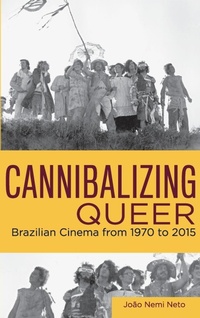
Cannibalizing Queer
Brazilian Cinema from 1970 to 2015
Published on 8. February 2022
Book
Hardback
180 pages
978-0-8143-4609-9 (ISBN)
Description
Puts forward a new, provocative history of queer cinema in Brazil.
Through an analysis of contemporary Brazilian cinematic production,Cannibalizing Queer: Brazilian Cinema from 1970 to 2015 discusses which queer representations are erased and which are acknowledged in the complex processes of cultural translation, adaptation, and "devouring" that defines the Brazilian understanding of sexual dissidents and minorities. Joao Nemi Neto argues for Brazilian cinema studies to acknowledge the importance of 1920s modernism and of antropografia, a conceptual mode of cannibalism, to adopt and extrapolate a perverse form of absorption and raise the stakes on queer theory and postcolonialism, and to demonstrate how they are crucial to the development of a queer tradition in Brazilian cinema.
In five chapters and two "trailers," Nemi Neto understands the term "queer" through its political dimensions because the films he analyzes represent characters that conform neither to American coming-out politics nor to Brazilian identity politics. Nonetheless, the films are queer precisely because the queer experiences and affection explored in these films do not necessarily insist on identifying characters as a particular sexuality or gender identity. Therefore, attention to characters within a unique cinematic world raises the stakes on several issues that hinge on cinematic form, narrative, and representation. Nemi Neto interviews and examines the work of Joao Silverio Trevisan and provides readings of films such as AIDS o furor do sexo explicito (AIDS the Furor of Explicit Sex, 1986), and Dzi Croquettes (2009) to theorize a productive overlap between queer and antropofagia. Moreover, the films analyzed here depict queer alternative representations to both homonormativity and heteronormativity as forms of resistance, at the same time as prejudice and heteronormativity remain present in contemporary Brazilian social practices.
Graduate students and scholars of cinema and media studies, queer studies, Brazilian modernism, and Latin American studies will value what one early reader called "a point of departure for all future research on Brazilian queer cinema.
Through an analysis of contemporary Brazilian cinematic production,Cannibalizing Queer: Brazilian Cinema from 1970 to 2015 discusses which queer representations are erased and which are acknowledged in the complex processes of cultural translation, adaptation, and "devouring" that defines the Brazilian understanding of sexual dissidents and minorities. Joao Nemi Neto argues for Brazilian cinema studies to acknowledge the importance of 1920s modernism and of antropografia, a conceptual mode of cannibalism, to adopt and extrapolate a perverse form of absorption and raise the stakes on queer theory and postcolonialism, and to demonstrate how they are crucial to the development of a queer tradition in Brazilian cinema.
In five chapters and two "trailers," Nemi Neto understands the term "queer" through its political dimensions because the films he analyzes represent characters that conform neither to American coming-out politics nor to Brazilian identity politics. Nonetheless, the films are queer precisely because the queer experiences and affection explored in these films do not necessarily insist on identifying characters as a particular sexuality or gender identity. Therefore, attention to characters within a unique cinematic world raises the stakes on several issues that hinge on cinematic form, narrative, and representation. Nemi Neto interviews and examines the work of Joao Silverio Trevisan and provides readings of films such as AIDS o furor do sexo explicito (AIDS the Furor of Explicit Sex, 1986), and Dzi Croquettes (2009) to theorize a productive overlap between queer and antropofagia. Moreover, the films analyzed here depict queer alternative representations to both homonormativity and heteronormativity as forms of resistance, at the same time as prejudice and heteronormativity remain present in contemporary Brazilian social practices.
Graduate students and scholars of cinema and media studies, queer studies, Brazilian modernism, and Latin American studies will value what one early reader called "a point of departure for all future research on Brazilian queer cinema.
More details
Series
Language
English
Place of publication
Detroit, MI
United States
Target group
Professional and scholarly
Illustrations
23 B&W images
Dimensions
Height: 235 mm
Width: 157 mm
Thickness: 14 mm
Weight
420 gr
ISBN-13
978-0-8143-4609-9 (9780814346099)
Copyright in bibliographic data and cover images is held by Nielsen Book Services Limited or by the publishers or by their respective licensors: all rights reserved.
Schweitzer Classification
Person
Joao Nemi Neto (he/his) is a senior lecturer at Columbia University in the Latin American and Iberian Cultures Department. His research focuses on queer theory, queer pedagogy, Brazilian culture, and visual media.