

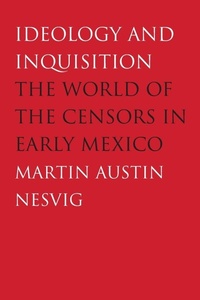
Ideology and Inquisition
The World of the Censors in Early Mexico
Will be published approx. on 4. September 2009
Book
Paperback/Softback
384 pages
978-0-300-14040-8 (ISBN)
Description
This book is the first comprehensive treatment in English of the ideology and practice of the Inquisitional censors, focusing on the case of Mexico from the 1520s to the 1630s. Others have examined the effects of censorship, but Martin Nesvig employs a nontraditional approach that focuses on the inner logic of censorship in order to examine the collective mentality, ideological formation, and practical application of ideology of the censors themselves.
Nesvig shows that censorship was not only about the regulation of books but about censorship in the broader sense as a means to regulate Catholic dogma and the content of religious thought. In Mexico, decisions regarding censorship involved considerable debate and disagreement among censors, thereby challenging the idea of the Inquisition as a monolithic institution. Once adapted to cultural circumstances in Mexico, the Inquisition and the Index produced not a weapon of intellectual terror but a flexible apparatus of control.
Nesvig shows that censorship was not only about the regulation of books but about censorship in the broader sense as a means to regulate Catholic dogma and the content of religious thought. In Mexico, decisions regarding censorship involved considerable debate and disagreement among censors, thereby challenging the idea of the Inquisition as a monolithic institution. Once adapted to cultural circumstances in Mexico, the Inquisition and the Index produced not a weapon of intellectual terror but a flexible apparatus of control.
Reviews / Votes
"We like to think of the Spanish Inquisition as a well-oiled institution, efficiently stamping out dissent. In a marvelously crafted study, Martin Nesvig shows the many fault lines in such an account. The shibboleths of the past give way to a nuanced narrative, painstakingly based on archival research. Nesvig demonstrates that in Mexico, the Inquisition was a rather inefficient repressive apparatus, constantly changing and constitutionally riddled by competing ideological agendas. Nesvig sheds abundant new light on the workings of (canon) law in the early modern Spanish Empire. The flexibility with which censure and the law were applied could well explain the longevity of the empire."-Jorge Canizares-Esguerra, University of Texas at Austin -- Jorge Canizares-Esguerra "Nesvig seamlessly combines prosopography with intellectual, institutional, and social history of a very high caliber to provide a vivid portrait of inquisitional thinking, successes, and failures in early colonial Mexico."-Eric Van Young, University of California, San Diego -- Eric Van Young "A unique and thorough study of Inquisitional censors in the Mexican context."--Rebecca Price, Catholic Library World -- Rebecca Price * Catholic Library World * "Nesvig's book is a most useful instrument for those interested in adopting new perspectives to the approach of supposedly well-known subjects."-Raquel Gutierrez Estupinan, Sixteenth Century Journal -- Raquel Gutierrez Estupinan * Sixteenth Century Journal * "Erudite, thought-provoking, and meticulously researched."-Amos Megged, The Americas -- Amos Megged * The Americas *More details
Language
English
Place of publication
United States
Product notice
Paperback (trade)
Illustrations
10 b-w illus.
Dimensions
Height: 229 mm
Width: 152 mm
Thickness: 22 mm
Weight
561 gr
ISBN-13
978-0-300-14040-8 (9780300140408)
Copyright in bibliographic data and cover images is held by Nielsen Book Services Limited or by the publishers or by their respective licensors: all rights reserved.
Schweitzer Classification
Other editions
Additional editions
Claude-Anne Lopez
Ideology and Inquisition
E-Book
09/2009
1st Edition
Yale University Press
€88.95
Available for download
Person
Martin Nesvig is assistant professor of history at the University of Miami. He is the editor of Local Religion in Colonial Mexico and Religious Culture in Modern Mexico.