

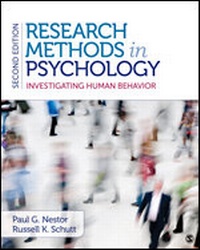
Research Methods in Psychology
Investigating Human Behavior
2nd Edition
Published on 24. April 2014
Book
Paperback/Softback
448 pages
978-1-4833-4376-1 (ISBN)
Description
The Second Edition of Paul G. Nestor and Russell K. Schutt's successful and unique Research Methods in Psychology: Investigating Human Behavior draws from substantive research stories to illustrate how research is presented while systematically unifying the entire research process within a conceptual framework. This accessible text examines engaging research studies and examples, considering research ethics throughout.
Reviews / Votes
"This is a great text that emphasizes the important concepts within research methods. The resources are excellent; they incorporate up-to-date research and technology and introduce the student to empirical articles, and the information is presented in a way that challenges the student to apply the material." -- Maria Pacella, Kent State University "The greatest strength is the wide breadth of topics in RM discussed. Most Psyc RM books focus heavily on experimental design, giving only cursory attention to quasi- and non-experimental designs, as well as qualitative (and small N samples) procedures." -- Kenneth S. Shultz, California State University, San Bernardino "Overall the Nestor/Schutt text content is well discussed and uses relevant and reasonably current published research to review and discuss the concepts. The use of landmark cases and supplement web 2.0 elements for visualization and further study are extremely beneficial to students. The activities and review questions clearly help students review the chapter content and self-test their mastery. The student study-site resource is user-friendly and includes resources that my students have stated helped them master and review the text content. I have used the text now for three course offerings and find that my students perform quite well and attain the desired objectives. Many students comment the skills they have acquired and polished during the learning journey with the activities and reading have given them more confidence with respect to reading, evaluating and using research." -- Jan Lucas, North Carolina State University "The text is comprehensive. It covers a wide variety of information without being overwhelming. This is a very good textbook for an introductory course in research methods. I like that its focus is on psychological research specifically." -- Angela M. Heads, Prairie View A&M UniversityMore details
Edition
2nd Revised edition
Language
English
Place of publication
Thousand Oaks
United States
Target group
College/higher education
Edition type
Revised edition
Dimensions
Height: 254 mm
Width: 203 mm
Weight
793 gr
ISBN-13
978-1-4833-4376-1 (9781483343761)
Copyright in bibliographic data and cover images is held by Nielsen Book Services Limited or by the publishers or by their respective licensors: all rights reserved.
Schweitzer Classification
Other editions
New editions
Book
02/2019
3rd Edition
SAGE Publications Inc
€218.38
Shipment within 15-20 days
Previous edition
Book
04/2011
1st Edition
SAGE Publications Inc
€102.94
Article exhausted; check for reprint
Persons
Paul G. Nestor, PhD, is professor of psychology at the University of Massachusetts, Boston, and assistant professor in psychology in the department of psychiatry at Harvard Medical School. A summa cum laude and Phi Beta Kappa graduate of Boston University, he earned his MA and PhD in clinical psychology from The Catholic University of America, and was a postdoctoral fellow in the National Institute of Mental Health Clinical Research Training Program at Harvard Medical School. His peer-reviewed publications cover a variety of areas in behavioral science, including neuropsychology, structural and functional neuroimaging, attention, memory, personality, forensic psychology, and schizophrenia. He has authored or co-authored over one-hundred peer-reviewed articles in some of the most prominent journals. His research has been federally supported by competitive grants from both the National Institute of Mental Health and the Department of Veterans Affairs. He is a past recipient of a Veterans Administration Merit Review Award, "Cognitive Neuroscience Studies of Schizophrenia." He is also the past recipient of the University of Massachusetts, Boston Chancellor's Award for Distinguished Scholarship for his research in psychology. His teaching has been recognized by the University of Massachusetts, Boston College of Arts and Sciences' Outstanding Faculty Achievement Award. Nestor also has experience in media presentation for both television and radio, including having his research featured on the Discovery Channel and on WUMB. He is a licensed psychologist in Massachusetts, specializing in clinical psychology, neuropsychology, and forensic psychology.
Russell K. Schutt, PhD, is professor emeritus of sociology at the University of Massachusetts Boston, where he received the 2007 Chancellor's Award for Distinguished Service and taught from 1979 to 2022. He is also a Clinical Research Scientist I at Beth Israel Deaconess Medical Center and a Lecturer (part-time) in the Department of Psychiatry, Harvard Medical School. He completed his BA, MA, and PhD degrees at the University of Illinois at Chicago and was a postdoctoral fellow in the Sociology of Social Control Training Program at Yale University (where he met Dan). In addition to ten editions of Investigating the Social World: The Process and Practice of Research and one of Understanding the Social World, as well as coauthored versions for the fields of social work, criminal justice, psychology, and education, his other books include Homelessness, Housing, and Mental Illness (2011), Social Neuroscience: Brain, Mind, and Society (coedited, 2015), and Organization in a Changing Environment (1986). He has authored and coauthored more than 65 peer reviewed journal articles, as well as book chapters and research reports on homelessness, mental health, organizations, law, and teaching research methods. His currently a Dual Principal Investigator (with Matcheri Keshavan, MD) in randomized comparative effectiveness trial of two socially-oriented interventions to improve community functioning among persons diagnosed with serious mental illness, funded by the Patient-Centered Outcomes Research Institute (PCORI). His other recently concluded research includes co-principal investigator on a National Science Foundation-funded study of the social impact of the pandemic in Boston, and co-investigator on a Veterans Health Administration-funded study of peer support. His earlier research has been funded by the National Cancer Institute, the Veterans Health Administration, the National Institute of Mental Health, the Fetzer Institute, and state agencies. Details are available at https://blogs.umb.edu/russellkschutt/.
Russell K. Schutt, PhD, is professor emeritus of sociology at the University of Massachusetts Boston, where he received the 2007 Chancellor's Award for Distinguished Service and taught from 1979 to 2022. He is also a Clinical Research Scientist I at Beth Israel Deaconess Medical Center and a Lecturer (part-time) in the Department of Psychiatry, Harvard Medical School. He completed his BA, MA, and PhD degrees at the University of Illinois at Chicago and was a postdoctoral fellow in the Sociology of Social Control Training Program at Yale University (where he met Dan). In addition to ten editions of Investigating the Social World: The Process and Practice of Research and one of Understanding the Social World, as well as coauthored versions for the fields of social work, criminal justice, psychology, and education, his other books include Homelessness, Housing, and Mental Illness (2011), Social Neuroscience: Brain, Mind, and Society (coedited, 2015), and Organization in a Changing Environment (1986). He has authored and coauthored more than 65 peer reviewed journal articles, as well as book chapters and research reports on homelessness, mental health, organizations, law, and teaching research methods. His currently a Dual Principal Investigator (with Matcheri Keshavan, MD) in randomized comparative effectiveness trial of two socially-oriented interventions to improve community functioning among persons diagnosed with serious mental illness, funded by the Patient-Centered Outcomes Research Institute (PCORI). His other recently concluded research includes co-principal investigator on a National Science Foundation-funded study of the social impact of the pandemic in Boston, and co-investigator on a Veterans Health Administration-funded study of peer support. His earlier research has been funded by the National Cancer Institute, the Veterans Health Administration, the National Institute of Mental Health, the Fetzer Institute, and state agencies. Details are available at https://blogs.umb.edu/russellkschutt/.
Content
Preface
Acknowledgments
Chapter 1. Uncommon Sense and the Scientific Method
Chapter 2. The Practice of Psychological Research
Chapter 3. Ethics of Research
Chapter 4. Conceptualization and Measurement
Chapter 5. Sampling and Surveys
Chapter 6. Causation and Research Design: Single-Factor Experiments
Chapter 7. Complex Research Designs: Multifactorial Experiments
Chapter 8. Quasiexperimental and Nonexperimental Designs
Chapter 9. Small-N and Single-Subject Designs
Chapter 10. Quantitative Data Analysis
Chapter 11. Qualitative Methods
Chapter 12. Writing a Research Paper
Appendix A: Summaries of Frequently Cited Research Articles
Appendix B: Questions to Ask About a Research Article
Appendix C: How to Read a Research Article
Appendix D: Proportions of Area Under Standard Normal Curve
Appendix E: Critical Values for t Distribution
Appendix F: Critical Values of F
Appendix G: Critical Values of Chi-Square
Appendix H: Critical Values of the Correlation Coefficient
Appendix I: Table of Random Numbers
Glossary
References
Exhibit Credits
Index
About the Authors
Acknowledgments
Chapter 1. Uncommon Sense and the Scientific Method
Chapter 2. The Practice of Psychological Research
Chapter 3. Ethics of Research
Chapter 4. Conceptualization and Measurement
Chapter 5. Sampling and Surveys
Chapter 6. Causation and Research Design: Single-Factor Experiments
Chapter 7. Complex Research Designs: Multifactorial Experiments
Chapter 8. Quasiexperimental and Nonexperimental Designs
Chapter 9. Small-N and Single-Subject Designs
Chapter 10. Quantitative Data Analysis
Chapter 11. Qualitative Methods
Chapter 12. Writing a Research Paper
Appendix A: Summaries of Frequently Cited Research Articles
Appendix B: Questions to Ask About a Research Article
Appendix C: How to Read a Research Article
Appendix D: Proportions of Area Under Standard Normal Curve
Appendix E: Critical Values for t Distribution
Appendix F: Critical Values of F
Appendix G: Critical Values of Chi-Square
Appendix H: Critical Values of the Correlation Coefficient
Appendix I: Table of Random Numbers
Glossary
References
Exhibit Credits
Index
About the Authors