

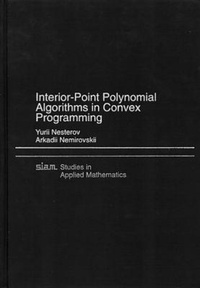
Interior Point Polynomial Methods in Convex Programming
Will be published approx. on 30. June 2006
Book
Paperback/Softback
414 pages
978-0-89871-515-6 (ISBN)
Description
Written for specialists working in optimization, mathematical programming, or control theory. The general theory of path-following and potential reduction interior point polynomial time methods, interior point methods, interior point methods for linear and quadratic programming, polynomial time methods for nonlinear convex programming, efficient computation methods for control problems and variational inequalities, and acceleration of path-following methods are covered.
The authors describe the first unified theory of polynomial-time interior-point methods. Their approach provides a simple and elegant framework in which all known polynomial-time interior-point methods can be explained and analyzed. This approach yields polynomial-time interior-point methods for a wide variety of problems beyond the traditional linear and quadratic programs.
The book contains new and important results in the general theory of convex programming, e.g., their ""conic"" problem formulation in which duality theory is completely symmetric. For each algorithm described, the authors carefully derive precise bounds on the computational effort required to solve a given family of problems to a given precision. In several cases they obtain better problem complexity estimates than were previously known. Several of the new algorithms described in this book, e.g., the projective method, have been implemented, tested on ""real world"" problems, and found to be extremely efficient in practice.
Special Features:
The developed theory of polynomial methods covers all approaches known so far.
Presents detailed descriptions of algorithms for many important classes of nonlinear problems.
The authors describe the first unified theory of polynomial-time interior-point methods. Their approach provides a simple and elegant framework in which all known polynomial-time interior-point methods can be explained and analyzed. This approach yields polynomial-time interior-point methods for a wide variety of problems beyond the traditional linear and quadratic programs.
The book contains new and important results in the general theory of convex programming, e.g., their ""conic"" problem formulation in which duality theory is completely symmetric. For each algorithm described, the authors carefully derive precise bounds on the computational effort required to solve a given family of problems to a given precision. In several cases they obtain better problem complexity estimates than were previously known. Several of the new algorithms described in this book, e.g., the projective method, have been implemented, tested on ""real world"" problems, and found to be extremely efficient in practice.
Special Features:
The developed theory of polynomial methods covers all approaches known so far.
Presents detailed descriptions of algorithms for many important classes of nonlinear problems.
More details
Series
Language
English
Place of publication
New York
United States
Target group
Professional and scholarly
Product notice
Paperback (trade)
Unsewn / adhesive bound
Dimensions
Height: 255 mm
Width: 177 mm
Thickness: 25 mm
Weight
853 gr
ISBN-13
978-0-89871-515-6 (9780898715156)
Copyright in bibliographic data and cover images is held by Nielsen Book Services Limited or by the publishers or by their respective licensors: all rights reserved.
Schweitzer Classification
Content
Chapter 1: Self-Concordant Functions and Newton Method
Chapter 2: Path-Following Interior-Point Methods
Chapter 3: Potential Reduction Interior-Point Methods
Chapter 4: How to Construct Self-Concordant Barriers
Chapter 5: Applications in Convex Optimization
Chapter 6: Variational Inequalities with Monotone Operators
Chapter 7: Acceleration for Linear and Linearly Constrained Quadratic Problems
Bibliography
Appendix 1
Appendix 2.
Chapter 2: Path-Following Interior-Point Methods
Chapter 3: Potential Reduction Interior-Point Methods
Chapter 4: How to Construct Self-Concordant Barriers
Chapter 5: Applications in Convex Optimization
Chapter 6: Variational Inequalities with Monotone Operators
Chapter 7: Acceleration for Linear and Linearly Constrained Quadratic Problems
Bibliography
Appendix 1
Appendix 2.