

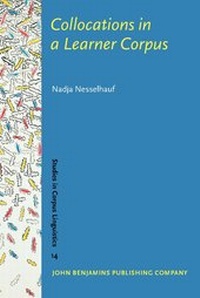
Collocations in a Learner Corpus
Published on 27. January 2005
Book
Hardback
331 pages
978-90-272-2285-5 (ISBN)
Description
Collocations are both pervasive in language and difficult for language learners, even at an advanced level. In this book, these difficulties are for the first time comprehensively investigated. On the basis of a learner corpus, idiosyncratic collocation use by learners is uncovered, the building material of learner collocations examined, and the factors that contribute to the difficulty of certain groups of collocations identified. An extensive discussion of the implications of the results for the foreign language classroom is also presented, and the contentious issue of the relation of corpus linguistic research and language teaching is thus extended to learner corpus analysis.
Reviews / Votes
"Collocations in a Learner Corpus" is a notable book for anyone interested in the acquisition of collocations, since it provides both theoretical discussion and detailed empirical analysis. The book is well written and follows a rational organization of chapters. -- Fabiana Rosi, University of Pavia, on Linguist LIst Vol.16-2896, 2005More details
Series
Language
English
Place of publication
Amsterdam
Netherlands
Target group
Professional and scholarly
Dimensions
Height: 225 mm
Width: 154 mm
Weight
590 gr
ISBN-13
978-90-272-2285-5 (9789027222855)
Copyright in bibliographic data and cover images is held by Nielsen Book Services Limited or by the publishers or by their respective licensors: all rights reserved.
Schweitzer Classification
Other editions
Additional editions
Nadja Nesselhauf
Collocations in a Learner Corpus
E-Book
01/2005
1st Edition
John Benjamins Publishing Company
€130.99
Available for download
Person
Content
1. Abbreviations; 2. Acknowledgements; 3. Collocations in native and non-native speaker language; 4. Investigating collocations in a learner corpus; 5. The use of collocations by advanced learners; 6. Building material of non-native-like collocations; 7. Factors correlating with learners' difficulties with collocations; 8. Implications of the findings; 9. Notes; 10. References; 11. Appendix I; 12. Appendix II; 13. Index