

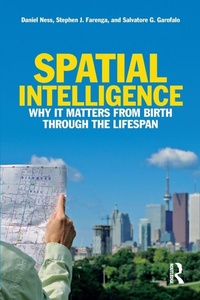
Spatial Intelligence
Why It Matters from Birth through the Lifespan
1st Edition
Published on 16. May 2017
Book
Paperback/Softback
274 pages
978-1-138-85085-9 (ISBN)
Description
Spatial Intelligence examines public and professional conceptions of the relationships between thinking about spatial attributes and active engagement in spatially related constructions and designs. Even though children's and adolescents' spatial propensities in constructive activities parallel the skills needed by professionals in both established and emerging fields, spatial education is often missing from K-12 curricula and is easily impeded by teachers, parents, or other individuals who do not provide contexts in formalized settings, such as schools, to nurture its potential. This book bridges the gap by linking the natural spatial inclinations, interests, and proclivities of individuals from a variety of cultures with professional training and expertise in engineering, architecture, science, and mathematics. Educators will be better able to achieve the skills and awareness necessary to provide children and young adults with the vital opportunities inherent in spatial education.
Reviews / Votes
This is a fascinating book that draws on a remarkably broad assortment of theoretical and research traditions addressed to spatial thinking. What is unusual about it is the authors' steadfast focus on linking esoteric conceptual work on space to mundane demands of disciplines, classrooms, and daily lives. Spatial Intelligence is an engaging read, and offers a rich resource for researchers, teachers, students, and parents alike.-Lynn S. Liben, PhD, McCourtney Professor of Child Studies, The Pennsylvania State University
This fascinating and far-ranging book surveys the broad territory of spatial thinking. The authors build a powerful case for how important spatial thinking is in human intelligence, and they give concrete ideas for including it in education.
-Nora S. Newcombe, PhD, Laura H. Carnell Professor of Psychology, Temple University
More details
Language
English
Place of publication
London
United Kingdom
Publishing group
Taylor & Francis Ltd
Target group
Professional and scholarly
Postgraduate
Illustrations
58 s/w Abbildungen, 21 s/w Photographien bzw. Rasterbilder, 37 s/w Zeichnungen, 4 s/w Tabellen
4 Tables, black and white; 37 Line drawings, black and white; 21 Halftones, black and white; 58 Illustrations, black and white
Dimensions
Height: 229 mm
Width: 152 mm
Thickness: 16 mm
Weight
424 gr
ISBN-13
978-1-138-85085-9 (9781138850859)
Copyright in bibliographic data and cover images is held by Nielsen Book Services Limited or by the publishers or by their respective licensors: all rights reserved.
Schweitzer Classification
Other editions
Additional editions
Daniel Ness | Stephen J. Farenga | Salvatore G. Garofalo
Spatial Intelligence
Why It Matters from Birth through the Lifespan
Book
05/2017
1st Edition
Routledge
€232.00
Shipment within 10-20 days
Daniel Ness | Stephen J. Farenga | Salvatore G. Garofalo
Spatial Intelligence
Why It Matters from Birth through the Lifespan
E-Book
05/2017
Routledge
€68.49
Available for download
Daniel Ness | Stephen J. Farenga | Salvatore G. Garofalo
Spatial Intelligence
Why It Matters from Birth through the Lifespan
E-Book
05/2017
Routledge
€68.49
Available for download
Persons
Daniel Ness is Associate Professor of STEM Education in the Department of Curriculum and Instruction, St. John's University, Queens, New York, USA.
Stephen J. Farenga
is Professor of Science Education, Queens College, City University of New York, USA.
Salvatore G. Garofalo
is Adjunct Lecturer of Science Education, Queens College, City University of New York, USA.
Stephen J. Farenga
is Professor of Science Education, Queens College, City University of New York, USA.
Salvatore G. Garofalo
is Adjunct Lecturer of Science Education, Queens College, City University of New York, USA.
Content
Prologue
Chapter 1. The Spatial Definition: A Time-honored Enigma
Chapter 2. Developing a Sense of Space
Chapter 3. Alternative Spatial Thinking Models
Chapter 4. From g to ?: Spatial Ability-The Primal Intelligence
Chapter 5. "You Are Here": Mapping Space
Chapter 6. Redefining Affordance to Maximize Spatial Intelligence
Chapter 7 Making Space: Bows, Brushes, and Plaster
Chapter 8. Free Space: Spatial Thinking in the Curriculum
Chapter 9. Technospace: From Atoms to Bits
Chapter 10. Humane Space
References
Chapter 1. The Spatial Definition: A Time-honored Enigma
Chapter 2. Developing a Sense of Space
Chapter 3. Alternative Spatial Thinking Models
Chapter 4. From g to ?: Spatial Ability-The Primal Intelligence
Chapter 5. "You Are Here": Mapping Space
Chapter 6. Redefining Affordance to Maximize Spatial Intelligence
Chapter 7 Making Space: Bows, Brushes, and Plaster
Chapter 8. Free Space: Spatial Thinking in the Curriculum
Chapter 9. Technospace: From Atoms to Bits
Chapter 10. Humane Space
References