

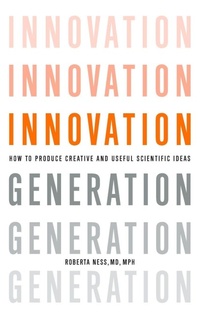
Innovation Generation
How to Produce Creative and Useful Scientific Ideas
1st Edition
Published on 22. March 2012
Book
Hardback
272 pages
978-0-19-989259-4 (ISBN)
Description
Whether you are a student or an established scientist, researcher, or engineer, you can learn to be more innovative. In Innovation Generation, internationally renowned physician and scientist Roberta Ness provides all the tools you need to cast aside your habitual ways of navigating the every-day world and to think "outside the box." Based on an extraordinarily successful program at the University of Texas, this book provides proven techniques to expand your ability to generate original ideas. These tools include analogy, expanding assumptions, pulling questions apart, changing your point of view, reversing your thinking, and getting the most out of multidisciplinary groups, to name a few. Woven into the discussion are engaging stories of famous scientists who found fresh paths to innovation, including groundbreaking primate scientist Jane Goodall, father of lead research Herb Needleman, and physician Ignaz Semmelweis, whose discovery of infection control saved millions. Finally, the book shows how to combine your newly acquired skills in innovative thinking with the normal process of scientific thinking, so that your new abilities are more than playthings. Innovation will power your science.
Reviews / Votes
through 24 short, insightful chapters, Ness provides the reader with plenty of new tools to overcome barriers and encourage innovative thinking. Innovation generation comes at a time when the need for scienti?ic innovation has never been more urgent, and I would recommend that at least one person in every research group read this book and discuss it in their journal clubs. * Akshat Rathi, Chemistry World * The book is replete with engaging anecdotes, challenging puzzles, and skill-building exercises. It has a useful bibliography that sweeps across the many topics that are relevant to innovation ... it entertains and can be read quickly. * The American Journal of Epdemiology, April 2013 *More details
Language
English
Place of publication
New York
United States
Target group
Science students, undergraduate through graduate-level; scientists; engineers and technology industry professionals; general population interested in science or creativity
Dimensions
Height: 240 mm
Width: 161 mm
Thickness: 19 mm
Weight
578 gr
ISBN-13
978-0-19-989259-4 (9780199892594)
Copyright in bibliographic data and cover images is held by Nielsen Book Services Limited or by the publishers or by their respective licensors: all rights reserved.
Schweitzer Classification
Other editions
Additional editions
E-Book
05/2012
1st Edition
OUP eBook
€20.99
Available for download
E-Book
03/2012
1st Edition
OUP eBook
€20.99
Available for download
Person
Roberta Ness is Dean of the University of Texas School of Public Health and the University of Texas-Houston Vice President for Innovation.
Content
Chapter 1: Don't Read this Book ; PART I. The Big Picture: Understanding and Overcoming Barriers to Innovation ; Chapter 2: It All Depends on How You Look at It ; Chapter 3: Overcoming Frames ; Chapter 4: Say it Like you Mean ; Chapter 5: Overcoming Metaphors ; Chapter 6: Check this Out! ; Chapter 7: Becoming a Keener Observer ; Chapter 8: How Biased are You? ; Chapter 9: Overcoming Bias ; Chapter 10: The Brain and Creativity: The Seat of Inspiration ; Chapter 11: The Brain and Creativity: Getting Out in Front ; PART II. Asking and Answering a Scientific Question through Innovation ; Chapter 12: The Joy of Science ; Chapter 13: Asking the Right Question ; Chapter 14: How is a Marriage like a Matchbox? ; Chapter 15: Flip it! ; Chapter 16: A Man Walked into a Bar ; Chapter 17: The Power of Group Intelligence ; Chapter 18: Getting the Most from a Group ; Chapter 19: Incubation ; Chapter 20: Testing Your Idea ; Chapter 21: That Right Idea ; Chapter 22: The Stodginess of Science ; Chapter 23: Overcoming the Stodginess of Science ; Chapter 24: Innovation Incubators ; References ; Answers