

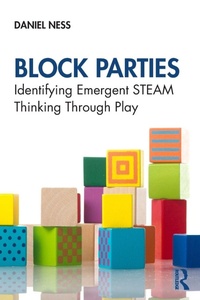
Block Parties
Identifying Emergent STEAM Thinking Through Play
1st Edition
Published on 12. August 2021
Book
Paperback/Softback
224 pages
978-0-367-56255-7 (ISBN)
Description
Block Parties examines young children's spatial development through the lens of emergent STEAM thinking. This book explores the physical and psychological tools that children use when they engage in constructive free play, and how these tools contribute to and shape the constructions they produce. Providing readers with the tools and understanding necessary to develop children's spatial sense through the domains of mapping and architecture, this cutting-edge volume lays the groundwork for both cognitive development and early childhood specialists and educators to develop more robust models of STEAM-related curriculum that span the early years through to adolescence.
More details
Language
English
Place of publication
London
United Kingdom
Publishing group
Taylor & Francis Ltd
Target group
College/higher education
Professional and scholarly
Illustrations
26 s/w Abbildungen, 26 s/w Zeichnungen, 3 s/w Tabellen
3 Tables, black and white; 26 Line drawings, black and white; 26 Illustrations, black and white
Dimensions
Height: 229 mm
Width: 152 mm
Thickness: 13 mm
Weight
351 gr
ISBN-13
978-0-367-56255-7 (9780367562557)
Copyright in bibliographic data and cover images is held by Nielsen Book Services Limited or by the publishers or by their respective licensors: all rights reserved.
Schweitzer Classification
Other editions
Additional editions
Book
08/2021
1st Edition
Routledge
€206.40
Shipment within 15-20 days
E-Book
07/2021
1st Edition
Routledge
€55.49
Available for download
E-Book
07/2021
1st Edition
Routledge
€55.49
Available for download
Person
Daniel Ness is Professor of Curriculum and Instruction at St. John's University, USA.
Content
1. Discovering STEAM in the Early Years 2. Play Matters 3. Bricks, Blocks, and Planks: Visuo-Spatial Constructive Play Objects (VCPOs) 4. Simple VCPOs Are Best 5. Young Children Think Like Scientists and Mathematicians 6. Young Children Think Like Architects and Engineers 7. Coding Children's Constructions: The SPatial ARchitectural Coding (SPARC) System 8. Promoting STEAM Play with VCPOs: What Young Children Can Tell Us