

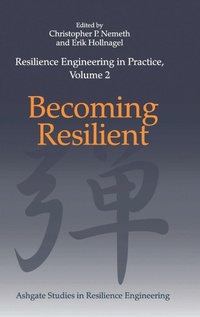
Resilience Engineering in Practice, Volume 2
Becoming Resilient
1st Edition
Published on 5. November 2014
Book
Hardback
248 pages
978-1-4724-2515-7 (ISBN)
Description
This is the fifth book published within the Ashgate Studies in Resilience Engineering series. The first volume introduced resilience engineering broadly. The second and third volumes established the research foundation for the real-world applications that then were described in the fourth volume: Resilience Engineering in Practice. The current volume continues this development by focusing on the role of resilience in the development of solutions. Since its inception, the development of resilience engineering as a concept and a field of practice has insisted on expanding the scope from a preoccupation with failure to include also the acceptable everyday functioning of a system or an organisation. The preoccupation with failures and adverse outcomes focuses on situations where something goes wrong and the tries to keep the number of such events and their (adverse) outcomes as low as possible. The aim of resilience engineering and of this volume is to describe how safety can change from being protective to become productive and increase the number of things that go right by improving the resilience of the system.
Reviews / Votes
'Resilience engineering is becoming the new paradigm for conceptualising safety in complex systems. Adopting a proactive, socio-technical, systems-based approach to safety is becoming de rigueur in high jeopardy-risk endeavours. With contributions from international contributors with a wealth of experience, this book is essential reading for both practitioners and researchers who are interested in the application of resilience engineering principles in practice.' Don Harris, Coventry University, UK 'There is no doubt that resilience is a core requirement for handling the risks of todayA?s and tomorrow's ever more complex socio-technical systems. This book provides the perfect mix of conceptual discussion and practical application to guide academics and practitioners towards designing more resilient systems.' Gudela Grote, ETH ZA1/4rich, SwitzerlandMore details
Series
Language
English
Place of publication
London
United Kingdom
Publishing group
Taylor & Francis Ltd
Target group
College/higher education
Academic and Professional Practice & Development
Dimensions
Height: 240 mm
Width: 161 mm
Thickness: 18 mm
Weight
540 gr
ISBN-13
978-1-4724-2515-7 (9781472425157)
Copyright in bibliographic data and cover images is held by Nielsen Book Services Limited or by the publishers or by their respective licensors: all rights reserved.
Schweitzer Classification
Other editions
Additional editions
Christopher P. Nemeth | Erik Hollnagel
Resilience Engineering in Practice, Volume 2
Becoming Resilient
E-Book
11/2016
CRC Press
€138.99
Available for download
Christopher P. Nemeth | Erik Hollnagel
Resilience Engineering in Practice, Volume 2
Becoming Resilient
E-Book
11/2016
CRC Press
€138.99
Available for download
Persons
Erik Hollnagel, PhD, is Professor at the University of Southern Denmark, Chief Consultant at the Center for Quality Improvement, Region of Southern Denmark, Visiting Professorial Fellow at the University of New South Wales (Australia), and Professor Emeritus at University of Linkoeping (Sweden). Christopher Nemeth, PhD, is a Principal Scientist III and Group Leader for Cognitive Systems Engineering at Cognitive Solutions Division of Applied Research Associates, Inc.
Content
Preface: Seeking Resilience Chapter 1 An Emergent Means to Assurgent Ends: Societal Resilience for Safety and Sustainability Chapter 2 Describing and Prescribing for Safe Operations within a Large Technical System (LTS): First Reflections Chapter 3 Fundamental on Situational Surprise: a Case Study with Implications for Resilience Chapter 4 Resilience Engineering for Safety of Nuclear Power Plant with Accountability Chapter 5 Criteria for Assessing Safety Performance Measurement Systems: Insights from Resilience Engineering Chapter 6 A Framework for Learning from Adaptive Performance Chapter 7 Resilience Must Be Managed: a Proposal for a Safety Management Process that Includes a Resilience Approach Chapter 8 A Case Study of Challenges Facing the Design of Resilient Socio-technical Systems Chapter 9 Some Thoughts on How to Align the Theoretical Understanding of Team Performance with Resilience Engineering TheoryChapter 10 Noticing Brittleness, Designing for Resilience Chapter 11 Sensor-driven Discovery of Resilient Performance: The Case of Debris Removal at Ground Zero, NYC, 2001nChapter 12 Becoming Resilient