

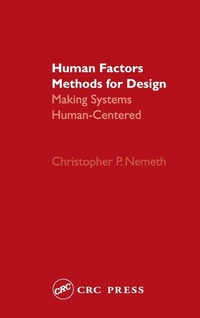
Human Factors Methods for Design
Making Systems Human-Centered
1st Edition
Published on 17. February 2004
Book
Hardback
416 pages
978-0-415-29798-1 (ISBN)
Description
There is no shortage of available human factors information, but until now there was no single guide on how to use this information. Human Factors Methods for Design: Making Systems Human-Centered is an in-depth field guide to solving human factors challenges in the development process. It provides design and human factors professionals, systems engineers, and research and development managers with the orientation, process, and methods to perform human-centered research.
The book delivers an overview of human factors and the application of research to product and service development. It enables the reader to define a design opportunity, develop product goals, and establish criteria to meet those goals. The text offers a road map for collecting and analyzing human performance information, applying that information to the creation of solutions, and using the information to evaluate potential solutions.
The book demonstrates, in three sections, a way to design products that extend, amplify, and enhance human capabilities. Human Factors Practice explains research context including the operational environment and internal and external influences. Human Factors Methods explains how to perform a wide variety of procedures for human-oriented research and development. Application demonstrates how to put the results to use.
The book delivers an overview of human factors and the application of research to product and service development. It enables the reader to define a design opportunity, develop product goals, and establish criteria to meet those goals. The text offers a road map for collecting and analyzing human performance information, applying that information to the creation of solutions, and using the information to evaluate potential solutions.
The book demonstrates, in three sections, a way to design products that extend, amplify, and enhance human capabilities. Human Factors Practice explains research context including the operational environment and internal and external influences. Human Factors Methods explains how to perform a wide variety of procedures for human-oriented research and development. Application demonstrates how to put the results to use.
Reviews / Votes
"... primary motivation for writing this book was to provide a guide on how to use the vast amount of available human factors information to design things for people. He suggests that readers use the book to help define and solve problems, to develop new solutions, and to evaluate the effectiveness of those solutions. The text provides a basic understanding of human behavior; ways to recognize, approach, analyze, and solve problems; a means to evaluate solution alternatives; and a process for effectively communication results. ... The text has many excellent features that contribute to its usability. ... I recommend this text as a reference for the wide array of questions and methods involved in human factors design, as a text for professionals in the field, for advanced undergraduate or graduate design classes, and as an easily understood reference for the layperson. The book would greatly benefit from having a companion electronic version that is searchable while working on your computer or online. I will definitely be keeping it within easy reach in my work space."-John W. Ruffner, in Ergonomics in Design, Vol. 14, No. 1, Winter 2006
"This is a useful practitioner's book, clearly grounded in industry practice with an eye on current research and philosophical groundwork. At nearly 400 pages, it is comprehensive without any padding. The core of the book is its understandable descriptions of methods. These provide valuable professional guidance ... [it's] an invaluable reference work."
- John Knight, User-Lab, Birmingham Institute of Art and Design, UK, in Leonardo Reviews - ISAST, Vol. 39, No. 3, 2006
"The approach [in this book] is always lucid and concise, with additional background references, and the methods are illuminated with examples of their use in practice. ... It is a genuinely useful guide to conducting user-oriented research for design."
-Nigel Cross, Design Research Society Newsletter, Vol. 10, No. 1, January 2005
"Christopher Nemeth's book "Human Factors Methods for Design: Making Systems Human-Centered" is an impressive and comprehensive survey of the many different issues and methods for the development of successful, exciting products. It can be used in two ways. First, read the book from front to back to learn about the wide range of issues and methods. Second, the book shines as a problem-focused resource. Find the relevant sections, read, and put them to use for just-in-time learning, which is the best kind."
Don Norman, Nielsen Norman group & Northwestern University; Author of "Emotional Design"
More details
Language
English
Place of publication
London
United Kingdom
Publishing group
Taylor & Francis Ltd
Target group
College/higher education
Professional and scholarly
Professional
Illustrations
201 s/w Abbildungen, 303 s/w Tabellen
303 Tables, black and white; 201 Illustrations, black and white
Dimensions
Height: 235 mm
Width: 157 mm
Thickness: 27 mm
Weight
753 gr
ISBN-13
978-0-415-29798-1 (9780415297981)
Copyright in bibliographic data and cover images is held by Nielsen Book Services Limited or by the publishers or by their respective licensors: all rights reserved.
Schweitzer Classification
Other editions
Additional editions
E-Book
02/2004
1st Edition
CRC Press
€244.99
Available for download
E-Book
02/2004
1st Edition
CRC Press
€244.99
Available for download
Person
Content
Human Factors Practice. The Human-Made Environment. Human Abilities and Limits. How We Think about Development Problems. What Influences Development? Human Factors in Research and Development. Human Factors Methods. Analysis Methods. Design Guidance Methods. Evaluation Methods. Surveys: Interviews and Questionnaires. Usability Assessment. Controlled Studies. Application. Cost-Effectiveness. Effecting Change. Communication. Examples.