

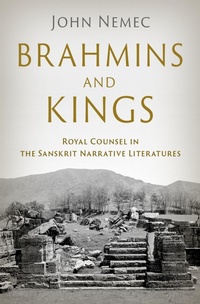
Brahmins and Kings
Royal Counsel in the Sanskrit Narrative Literatures
Published on 21. May 2025
Book
Hardback
320 pages
978-0-19-779199-8 (ISBN)
Description
Brahmins and Kings examines some of the most well-known and widely circulated narratives in the history of Sanskrit literature, including the Mahabharata, the Ramaya?a, Vi??usarman's famed animal stories (the Pancatantra), Somadeva's labyrinthine Ocean of Rivers of Stories (the Kathasaritsagara), Kalha?a's Chronicle of the Kings of Kashmir (the Rajatara?gi?i), and two of the most famous plays in the history of Sanskrit literature, Kalidasa's Abhijnanasakuntala and Har?a's Ratnavali. Offering a sustained, close, intertextual reading of these works, John Nemec shows that these texts all share a common frame: they feature stories of the mutual relations of k?atriya kings with Brahmins, and they depict Brahmins advising political figures. More than this, they not only narrate instances of royal counsel but also are composed in a manner that renders the stories themselves as instances of counsel.
Based in the technical literatures on Hindu Law and on statecraft-the Dharmasastras and the Arthasastra and related works-the counsel in question elaborates a model of action that synthesizes views found in both, recommending a kind of virtue ethic that suggests one may do well in the world by being good. Doing well involves succeeding in both worldly and otherworldly affairs; being good involves following Brahminical teachings and upholding the dharmic norms they regularly articulate in text. This ethic encompasses all human action and practice, defines the counsel offered by these texts, and seeks with it to engage the king, his princes, and queens across the spectrum of their subjective experience: intellectually, emotionally, humorously.
Ultimately, this book argues that, just as the rulers in these narratives receive moral instruction, their audiences do, as well. By putting metaphorical flesh on the proverbial bare bones of doctrinal ideals and ideas, these texts seek to shape not just readers' thoughts but also their emotions and cultivated instincts, intending to transform their very way of engaging the world by immersing them in the dreamworld of stories.
Based in the technical literatures on Hindu Law and on statecraft-the Dharmasastras and the Arthasastra and related works-the counsel in question elaborates a model of action that synthesizes views found in both, recommending a kind of virtue ethic that suggests one may do well in the world by being good. Doing well involves succeeding in both worldly and otherworldly affairs; being good involves following Brahminical teachings and upholding the dharmic norms they regularly articulate in text. This ethic encompasses all human action and practice, defines the counsel offered by these texts, and seeks with it to engage the king, his princes, and queens across the spectrum of their subjective experience: intellectually, emotionally, humorously.
Ultimately, this book argues that, just as the rulers in these narratives receive moral instruction, their audiences do, as well. By putting metaphorical flesh on the proverbial bare bones of doctrinal ideals and ideas, these texts seek to shape not just readers' thoughts but also their emotions and cultivated instincts, intending to transform their very way of engaging the world by immersing them in the dreamworld of stories.
More details
Language
English
Place of publication
New York
United States
Target group
Professional and scholarly
Product notice
sewn/stitched
Cloth over boards
Dimensions
Height: 236 mm
Width: 167 mm
Thickness: 26 mm
Weight
621 gr
ISBN-13
978-0-19-779199-8 (9780197791998)
Copyright in bibliographic data and cover images is held by Nielsen Book Services Limited or by the publishers or by their respective licensors: all rights reserved.
Schweitzer Classification
Other editions
Additional editions
E-Book
03/2025
OUP eBook
€85.99
Available for download
E-Book
03/2025
OUP eBook
€85.99
Available for download
Person
John Nemec is Professor of Indian Religions and South Asian Studies in the Department of Religious Studies at the University of Virginia. The author of three books and numerous articles and other publications, he holds a Ph.D. from the University of Pennsylvania, an M.Phil. from the University of Oxford, an M.A. from the University of California at Santa Barbara, and a B.A. from the University of Rochester. He was an India Fulbright Scholar in 2002-2003, Directeur d'etudes invite at the Ecole Pratique des Hautes Etudes in 2016, and the Khaitan Fellow at the Oxford Centre for Hindu Studies in 2023.
Content
Acknowledgements
Introduction Chapter One - When the Parampara Breaks: On Gurus and Students In the Mahabharata Chapter Two - The Perfect King: Rama's Suffering, and Why His Story Must Be Told Anew Chapter Three - Kingship in Kashmir: Brahminical Norms in Kalhana's Rajatarangini Chapter Four - Wizards and Kings, or "Tantra Beyond the Tantras:" The Saiva-Brahminical Narrative of the Kathasaritsagara Chapter Five - The King in the Garden: Pleasure in Dramatic Imagination Chapter Six - The Wisdom of Animals: Kingship and the Pancatantra Conclusion
Bibliography
Index
Introduction Chapter One - When the Parampara Breaks: On Gurus and Students In the Mahabharata Chapter Two - The Perfect King: Rama's Suffering, and Why His Story Must Be Told Anew Chapter Three - Kingship in Kashmir: Brahminical Norms in Kalhana's Rajatarangini Chapter Four - Wizards and Kings, or "Tantra Beyond the Tantras:" The Saiva-Brahminical Narrative of the Kathasaritsagara Chapter Five - The King in the Garden: Pleasure in Dramatic Imagination Chapter Six - The Wisdom of Animals: Kingship and the Pancatantra Conclusion
Bibliography
Index