

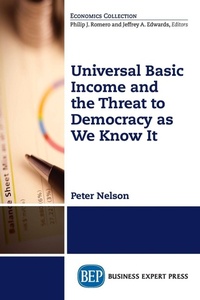
Universal Basic Income and the Threat to Democracy As We Know It
Published on 30. May 2018
Book
Paperback/Softback
146 pages
978-1-948198-64-6 (ISBN)
Description
Some of the greatest minds of the century have predicted that computers or artificial intelligence will replace 80 percent, if not more, of the world's workforce. The only uncertainty is the time frame, with the average prediction at about 30 years, although many believe it will be sooner. No matter the exact period, the impact on our planet will eventually be enormous because governments will still need to find a way to provide the unemployed with money on which to live and a Universal Basic Income (UBI), or something similar, is proposed to be paid to everyone without means test. That solution might appear well in theory, but the large numbers of unemployed will not want to be marginalized and will demand over time that the UBI be increased. Following human nature, under a democratic system as we know it, supposedly based on one person one vote, people will vote for whoever gives them more, and more, until the economic system breaks down, unable to afford the payments. The question is whether democracy will survive the challenge or whether we finish with a benign group of bureaucrats at the top who decide what is in the best interests of the majority and the rest of the global population simply accepts it.
More details
Language
English
Place of publication
Sterling Forest
United States
Target group
Professional and scholarly
Dimensions
Height: 229 mm
Width: 152 mm
Thickness: 8 mm
Weight
226 gr
ISBN-13
978-1-948198-64-6 (9781948198646)
Copyright in bibliographic data and cover images is held by Nielsen Book Services Limited or by the publishers or by their respective licensors: all rights reserved.
Schweitzer Classification
Other editions
Additional editions
E-Book
05/2018
Business Expert Press
€13.49
Available for download
Person
Peter Nelson was brought up in Australia, attended the Royal Military College Duntroon and the later entered Medicine at Adelaide University. With neither suiting him, he completed an economics degree at Sydney University to apprentice at Price-Waterhouse in their MCS Division and later form his own Chartered Accounting practice. Wanting wider fields, he joined the Food and Agricultural Organization of the United Nations covering first restructuring of SOEs in Tanzania and Kenya before spending four years with the Asian Development Bank in Manila. Since then he has covered consulting assignments in 52 countries for all major donors focusing of corporate re-engineering, while lecturing part time under various university MBA programs. He continues with a current focus on integrating cooperation between government development plans and private sector support.