

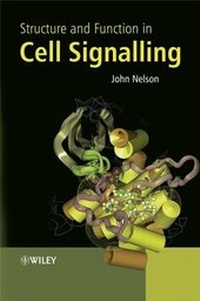
Structure and Function in Cell Signalling
Published on 4. July 2008
Book
Paperback/Softback
410 pages
978-0-470-02551-2 (ISBN)
Description
Structure and Function in Cell Signalling is a concise and accessible introduction to the dynamic but complex field of signal transduction. Rather than simply cataloguing all signalling molecules and delineating every known pathway, this book aims to break signalling down into common elements and activities - the 'nuts and bolts' of cellular information exchange.
With an emphasis on clarity of presentation throughout, the book teaches the basic principles focusing on a mature core of knowledge, providing students with a foundation of learning in this complex and potentially confusing subject. It also addresses the issue of variation in the numbering of key amino acids as well as featuring interaction with RasMol software, and exercises to aid understanding.
Structure and Function in Cell Signalling is a concise and accessible introduction to the dynamic but complex field of signal transduction. Rather than simply cataloguing all signalling molecules and delineating every known pathway, this book aims to break signalling down into common elements and activities - the 'nuts and bolts' of cellular information exchange.
* An accessible introduction to the complex field of cell signalling.
* Interacts with RasMol software - freely downloadable for viewing structures in 3D.
* Includes exercises and clear instructions in the use of RasMol.
* Well illustrated in full colour throughout.
Structure and Function in Cell Signalling will prove invaluable to students across a range of life science degree programmes including biochemistry, cell and molecular biology, physiology, biomedicine and oncology. This book will provide a clear, accessible introduction to this rapidly expanding field.
Reviews / Votes
"Richly illustrated with full-color molecular graphics (created by RasMol, a freeware molecular visualization program), Structure and Function in Cell Signaling provides a clear, engaging introduction to signal transduction. Each of the book's 10 chapters includes tables and charts in color to illustrate signal transduction pathways and genetic relationships between signal transduction molecules. Nelson (Queens Univ. Belfast, UK) provides enough background information to make this complex subject accessible even to beginning students. Readers can easily re-create all of the molecular graphics for themselves in an interactive format by following simple instructions included in the appendix. Signal transduction has applications in all of the biological sciences. Thus, students in cell biology, biochemistry, immunology, molecular genetics, and other life sciences will all find much valuable information in this work. Summing Up: Highly recommended. Academic libraries, all levels."(Choice, February 2009) "From basics to details, this is an elegantly written and carefully edited book. The chapters on cell cycle control and oncogenesis are particularly fascinating and valuable to biomedical research. This is the book to have if you are interested in molecular mechanisms of signal transduction. It is a great introduction to the literature that will be welcomed by students and experts alike." (Doody's, January 2009)More details
Other editions
Additional editions
John Nelson
Structure and Function in Cell Signalling
E-Book
09/2008
Wiley
€50.99
Available for download
John Nelson
Structure and Function in Cell Signalling
Book
07/2008
Wiley
Unfortunately, price unknown
Article exhausted; check different version
Person
Content
Acknowledgments
Preface
1 The components and foundations of signalling
References
2 Enzymes and receptors - quantitative aspects
References
3 Modules and motifs in transduction
References
4 Protein kinase enzymes - activation and auto-inhibition
References
5 7-pass receptors and the catabolic response
References
6 Single pass growth factor receptors
References
7 G proteins (I) - monomeric G proteins
References
8 G proteins (II) - heterotrimeric G proteins
References
9 The insulin receptor and the anabolic response
References
10 Mitogens and cell cycle progression
References
Appendix 1: Worked examples
Appendix 2: RasMol: installation and use
Index