

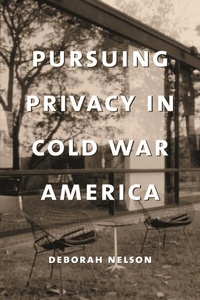
Pursuing Privacy in Cold War America
Will be published approx. on 26. December 2001
Book
Hardback
232 pages
978-0-231-11120-1 (ISBN)
Description
Pursuing Privacy in Cold War America explores the relationship between confessional poetry and constitutional privacy doctrine, both of which emerged at the end of the 1950s. While the public declarations of the Supreme Court and the private declamations of the lyric poet may seem unrelated, both express the upheavals in American notions of privacy that marked the Cold War era. Nelson situates the poetry and legal decisions as part of a far wider anxiety about privacy that erupted across the social, cultural, and political spectrum during this period. She explores the panic over the "death of privacy" aroused by broad changes in postwar culture: the growth of suburbia, the advent of television, the popularity of psychoanalysis, the arrival of computer databases, and the spectacles of confession associated with McCarthyism. Examining this interchange between poetry and law at its most intense moments of reflection in the 1960s, '70s, and '80s, Deborah Nelson produces a rhetorical analysis of a privacy concept integral to postwar America's self-definition and to bedrock contradictions in Cold War ideology.
Nelson argues that the desire to stabilize privacy in a constitutional right and the movement toward confession in postwar American poetry were not simply manifestations of the anxiety about privacy. Supreme Court justices and confessional poets such as Anne Sexton, Robert Lowell, W. D. Snodgrass, and Sylvia Plath were redefining the nature of privacy itself. Close reading of the poetry alongside the Supreme Court's shifting definitions of privacy in landmark decisions reveals a broader and deeper cultural metaphor at work.
Nelson argues that the desire to stabilize privacy in a constitutional right and the movement toward confession in postwar American poetry were not simply manifestations of the anxiety about privacy. Supreme Court justices and confessional poets such as Anne Sexton, Robert Lowell, W. D. Snodgrass, and Sylvia Plath were redefining the nature of privacy itself. Close reading of the poetry alongside the Supreme Court's shifting definitions of privacy in landmark decisions reveals a broader and deeper cultural metaphor at work.
Reviews / Votes
[Nelson's] approach is often provocative and her research exhaustive. Choice Rethinks confessional poetry in liberating ways... rich insights. Modernism/ Modernity Nelson cogently details the emergence of women's privacy as an act of confession and examines confessional poets such as Plath and Sexton, whose personal self-disclosures anticipate the Supreme Court's emerging interpretation of prviacy as no longer available in silence. -- Shelly Eversley American Literature Refusing to simplify, she produces what might well be one of the most intellectually challenging and provactive views of lyric poetry in the postwar years -- Edward Brunner Contemporary LiteratureMore details
Series
Language
English
Place of publication
New York
United States
Product notice
Trade binding
Weight
28 gr
ISBN-13
978-0-231-11120-1 (9780231111201)
Copyright in bibliographic data and cover images is held by Nielsen Book Services Limited or by the publishers or by their respective licensors: all rights reserved.
Schweitzer Classification
Other editions
Additional editions
Deborah Nelson
Pursuing Privacy in Cold War America
E-Book
10/2015
1st Edition
De Gruyter
from
€29.95
Available for download
Deborah Nelson
Pursuing Privacy in Cold War America
Book
12/2001
Columbia University Press
€34.72
Article not available at the moment
Deborah Nelson
Pursuing Privacy in Cold War America
E-Book
12/2001
1st Edition
Columbia University Press
from
€38.69
Available for download
Person
Deborah Nelson is assistant professor of English and gender studies at the University of Chicago.
Content
Preface: The Death of Privacy Part II: Sovereign Domains Part I: The Sudden Visibility of Privacy Introduction Chapter 1 Chapter 2 "Thirsting for the Hierarchic Privacy of Queen Victoria's Century": Robert Lowell and the Transformations of Privacy Chapter 3 Penetrating Privacy: Confessional Poetry, Griswold v. Connecticut , and Containment Ideology Chapter 4 Confessions Between a Woman and Her Doctor: Roe v. Wade and the Gender of Privacy Chapter 5 Confessing the Ordinary: Bowers v. Hardwick and Paul Monette's Love Alone - An Epilogue Notes Bibliography Index