

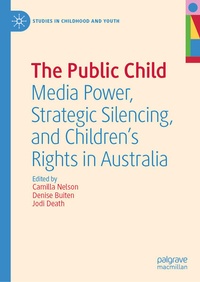
The Public Child
Description
This edited book examines the cultural construction of the "public child" and its impact on children's rights in Australia. The "public child" refers to a real child or groups of children whose lives have attracted media attention- either because concerns have been raised about their safety or because they have been identified as threats to others. Positioned at the intersection of media, politics, and policymaking, this collection explores how, in an increasingly mediatized political landscape, discursive constructions of the "public child" shape state responses, exerting a logic of control and silencing.
Amid international debates on child social media bans and increasingly punitive justice systems, this timely work will appeal to scholars of family and youth sociology, criminology, media and gender studies, and education, as well as journalists and legal practitioners specializing in children's rights.
The book includes five sections: Media and Regulatory Theatre , Domestic Family and Sexual Violence , Justice Systems , Sex and Gender , and Speaking Out and Listening In . The final section focuses on how children exercise agency and express their perspectives, and how adults can serve as allies to them.
Reviews / Votes
"This scholarly collection breaks new ground by offering interdisciplinary perspectives on the portrayal of children in and through media in a wide range of contexts and its impact on children's rights and freedoms. It convincingly shows that children's rights are both affected and defined by how society constructs children and their behaviour, and that media plays a critical role in this regard. The relevance of this work extends well beyond Australia." (Professor Dr. Ton Liefaard, UNICEF Chair in Children's Rights, Leiden University, The Netherlands)
"This highly recommended book challenges adult narratives of children's experiences and champions children's fundamental right to be heard and believed. If there is one thing that the Royal Commission taught us, it's that silenced children are never protected children. Yet we are reminded here just how pervasively the media works to silence children, consistently portraying children as either threats or victims and denying them agency as citizens in their own right. We are given a provocation to rethink how the 'public child' has been conceived in the media and support reforms that prioritise children's rights and honours their lived experiences in authentic ways." (Megan Mitchell - Inaugural Children's Commissioner, Australian Human Rights Commission)
"Public, political and media imaginaries of childhood matter. While seemingly 'just words', how society talks about children has very real and sometimes damaging consequences. Disadvantaged groups, especially, can find themselves castigated in public myth-making, held accountable for harms beyond their control, and refused the symbolic and practical resources they need. This ambitious book explains how, why, and what should change. (Professor Sonia Livingstone - Digital Futures for Children Centre, London School of Economics)
More details
Other editions
Additional editions
Persons
Camilla Nelson is Associate Professor in Media at the University of Notre Dame, Australia.
Denise Buiten is Senior Lecturer in Social Justice at the University of Notre Dame, Australia.
Jodi Death is Associate Professor in the School of Justice at Queensland University of Technology, Australia.
Content
1. The Public Child.- Part I Media, the State and Regulatory Theatre.- 2. On board the Australian social media 'ban wagon': Regulatory theatre, the public child, and the hyper-enthusiastic State.- 3. The Aboriginal Child and the Neocolonial State: Some Notes on Section 22C and Recent Changes to Bail Laws in New South Wales.- Part II Domestic, Family and Sexual Violence.- 4. Believing Children: Parental Disputes, Parental Alienation.- 5. Children as Victims in their Own Right: A Participatory Understanding of Children as Victim-survivors of Domestic Violence.- 6. Child Sexual Abuse: Media Power and Silenced Voices.- 7. Filicide: How Media and Childhood Discourses Shape Filicide Risk and Children's Rights.- Part III Justice Systems.- 8. Blaming Children: Exploring Criminal Justice Responses to Children in Scotland and Australia.- 9. Child Incarceration: Children's Rights, Racialized Media Narratives and Youth (in)Justices in Australia.- Part IV Sex and Gender.- 10. Sex Education: More than Putting a Condom on a Banana.- 11. Boys: Against the Cultural Construction of Boys as Problems.- 12. Trans Youth in the Media: Discursive Constructions.- Part V Speaking Out and Listening In.- 13. Whistleblowing: Adults as Allies in the Justice System.- 14. Anti-racism: Making Space in the Classroom.- 15. Children take action: Courtroom and other tales of the climate generation.