

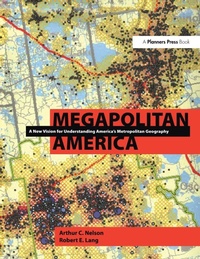
Megapolitan America
A New Vision for Understanding America's Metropolitan Geography
1st Edition
Published on 31. January 2013
Book
Hardback
312 pages
978-1-932364-97-2 (ISBN)
Description
With an expected population of 400 million by 2040, America is morphing into an economic system composed of twenty-three 'megapolitan' areas that will dominate the nation's economy by midcentury. These 'megapolitan' areas are networks of metropolitan areas sharing common economic, landscape, social, and cultural characteristics.
The rise of 'megapolitan' areas will change how America plans. For instance, in an area comparable in size to France and the low countries of the Netherlands and Belgium - considered among the world's most densely settled - America's 'megapolitan' areas are already home to more than two and a half times as many people. Indeed, with only eighteen percent of the contiguous forty-eight states' land base, America's megapolitan areas are more densely settled than Europe as a whole or the United Kingdom.
Megapolitan America goes into spectacular demographic, economic, and social detail in mapping the dramatic - and surprisingly optimistic - shifts ahead. It will be required reading for those interested in America's future.
The rise of 'megapolitan' areas will change how America plans. For instance, in an area comparable in size to France and the low countries of the Netherlands and Belgium - considered among the world's most densely settled - America's 'megapolitan' areas are already home to more than two and a half times as many people. Indeed, with only eighteen percent of the contiguous forty-eight states' land base, America's megapolitan areas are more densely settled than Europe as a whole or the United Kingdom.
Megapolitan America goes into spectacular demographic, economic, and social detail in mapping the dramatic - and surprisingly optimistic - shifts ahead. It will be required reading for those interested in America's future.
Reviews / Votes
This book is part planning manual, part atlas, part reference guide, part call to action-all about the most important economic and social development taking place in the country today. Arthur Nelson and Robert Lang's description of the nation's "megapolitan" regions will change the way we think of the economy and how we all have come to live. Let's hope it also changes the way we act in the future. -Bill Bishop, author of The Big Sort: Why the Clustering of Like-Minded America Is Tearing Us Apart This is an extraordinary book. It completely and--in my largely lay judgment--correctly reorients our thinking about where our cities and communities are going both physically and in terms of actual living. What an extraordinary contribution to our thinking on these issues. This should be required reading--and I rarely say that--for every governor, mayor, legislator, city council member, Chamber of Commerce member, and, indeed, citizen! --Michael K. Young, President, University of WashingtonMore details
Language
English
Place of publication
Chicago
United States
Publishing group
Taylor & Francis Inc
Target group
Professional and scholarly
Professional Practice & Development
Illustrations
111 Farbfotos bzw. farbige Rasterbilder
111 Halftones, color
Dimensions
Height: 241 mm
Width: 196 mm
Thickness: 21 mm
Weight
783 gr
ISBN-13
978-1-932364-97-2 (9781932364972)
Copyright in bibliographic data and cover images is held by Nielsen Book Services Limited or by the publishers or by their respective licensors: all rights reserved.
Schweitzer Classification
Other editions
Additional editions
Arthur Nelson | Robert Lang
Megapolitan America
A New Vision for Understanding America's Metropolitan Geography
Book
10/2019
1st Edition
Routledge
€84.31
Shipment within 15-20 days
Arthur Nelson | Robert Lang
Megapolitan America
E-Book
02/2018
1st Edition
Routledge
€89.99
Available for download
Persons
Arthur C. Nelson, FAICP, is Presidential Professor of City and Metropolitan Planning at the University of Utah, where he is also director of the Metropolitan Research Center.
Robert E. Lang is the director of Brookings Mountain West?and a professor of sociology at the University of Nevada-Las Vegas; he is also a nonresident senior fellow of the Brookings Institution, Washington, D.C.
Robert E. Lang is the director of Brookings Mountain West?and a professor of sociology at the University of Nevada-Las Vegas; he is also a nonresident senior fellow of the Brookings Institution, Washington, D.C.
Content
1. From Cities to Megaregions 2. Megapolitan Convergence 3. Defining What is Megapolitan 4. The Rural-Megapolitan Continuum 5. Megapolitan Areas as America's New Economic Core 6. Megapolitan Attractiveness 7. Key Population Trends 8. Megapolitan Cluster and Megapolitan Development 9. Transportation Planning and the Megapolitans 10. Implications of Megapolitan Clusters and Megapolitan Areas for Land, Air, and Water Resources 11. Cascadia Megapolitan Cluster 12. Sierra Pacific Megapolitan Area 13. Southwest Megaregion 14. Mountain Megapolitan Cluster 15. Texas Triangle Megapolitan Cluster 16. Twin Cities Megapolitan Area 17. Great Lakes Megapolitan Cluster 18. Florida Megapolitan Cluster 19. Piedmont Megapolitan Cluster 20. Megalopolis Megapolitan Cluster 21. The Megapolitan Century and U.S. Demographic Change to 2100