

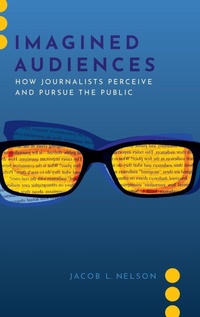
Imagined Audiences
How Journalists Perceive and Pursue the Public
Published on 21. April 2021
Book
Hardback
234 pages
978-0-19-754259-0 (ISBN)
Description
Many believe the solution to ongoing crises in the news industry--including profound financial instability and public distrust--is for journalists to improve their relationship with their audiences. This raises important questions: How do journalists conceptualize their audiences in the first place? What is the connection between what journalists think about their audiences and what they do to reach them? Perhaps most importantly, how aligned are these "imagined" audiences with the real ones?
Imagined Audiences draws on ethnographic case studies of three news organizations to reveal how journalists' assumptions about their audiences shape their approaches to their audiences. Jacob L. Nelson examines the role that audiences have traditionally played in journalism, how that role has changed, and what those changes mean for both the profession and the public. He concludes by drawing on audience studies research to compare journalism's "imagined" audiences with actual observations of news audience behavior. The result is a comprehensive study of both news production and reception at a moment when the relationship between the two has grown more important than ever before.
Imagined Audiences draws on ethnographic case studies of three news organizations to reveal how journalists' assumptions about their audiences shape their approaches to their audiences. Jacob L. Nelson examines the role that audiences have traditionally played in journalism, how that role has changed, and what those changes mean for both the profession and the public. He concludes by drawing on audience studies research to compare journalism's "imagined" audiences with actual observations of news audience behavior. The result is a comprehensive study of both news production and reception at a moment when the relationship between the two has grown more important than ever before.
Reviews / Votes
The book is important both because it shows the many different ways of dealing with the audiences and because it contains a very important side story...this book is to be recommended to both journalists and researchers who are interested in the fundamental questions of the relations between journalism and its audiences. * J. Moller Hartley, Roskilde University, De Gruyter Mouton * This is a well-researched, thoughtful addition to the literature about journalism's decline ... It will be a superb acquisition for libraries supporting graduate journalism programs and for mass communications collections. Highly recommended. Graduate students, faculty, and professionals. * R. A. Logan, University of Missouri Columbia, CHOICE * Sharply written and closely observed, Imagined Audiences argues that journalists' beliefs about the audiences they attempt to serve often fall short. Nelson shows that in an era of 24/7 online audience data, what journalists actually understand about their audiences is surprisingly limited and uncertain. Grounded in ethnographic study of three news organizations, Imagined Audiences provides an important and timely framework for thinking about the industry-wide embrace of-and ambivalence about-audience engagement, particularly with respect to audiences traditionally overlooked by mainstream news. Ultimately, Nelson argues, while this focus on connecting with audiences may or may not succeed in improving journalism's bottom line, it may nevertheless improve journalism. * Regina G. Lawrence, University of Oregon * There are lots of assumptions about how journalists are engaging their audiences in the digital age-but many of them haven't been put to the test like they are in this book. Jacob L. Nelson presents a must-read account of how journalists may variously see their audiences as a source of frustration or a source of inspiration, and why those imaginations and the complications and contradictions surrounding them are at the heart of the most consequential debate about the future of news happening today. * Seth C. Lewis, University of Oregon * As journalism faces a profound structural crisis, Nelson's timely and nuanced ethnographic analysis provides an invaluable roadmap for understanding the ever-shifting relationships between different kinds of audiences and different types of journalists. The book is both deeply researched and a joy to read. It's perfect for students, scholars, journalists, and citizens concerned about the future of their news media and their democracy. * Victor Pickard, University of Pennsylvania * In this illuminating work, Jacob L. Nelson complicates the notion that 'engagement' with audiences alone will save the press. Imagined Audiences asks newsrooms to get real about trust-building obstacles, accept that news audiences are ultimately unknowable, and combine approaches-including engagement-toward relevancy. Read it all the way to the end: You will not be disappointed and might even come away with an idea for how to fix news media. * Sue Robinson, University of Wisconsin-Madison, and author of Networked News, Racial Divides *More details
Series
Language
English
Place of publication
New York
United States
Target group
Professional and scholarly
Dimensions
Height: 240 mm
Width: 161 mm
Thickness: 17 mm
Weight
520 gr
ISBN-13
978-0-19-754259-0 (9780197542590)
Copyright in bibliographic data and cover images is held by Nielsen Book Services Limited or by the publishers or by their respective licensors: all rights reserved.
Schweitzer Classification
Other editions
Additional editions
Book
04/2021
Oxford University Press Inc
€38.50
Shipment within 15-20 days
E-Book
02/2021
1st Edition
OUP eBook
€17.49
Available for download
E-Book
02/2021
1st Edition
OUP eBook
€17.49
Available for download
Person
Jacob L. Nelson is an Assistant Professor at the Walter Cronkite School of Journalism and Mass Communication at Arizona State University, and a fellow with the Tow Center for Digital Journalism at Columbia University. He researches the relationship between journalism and the public.
Content
Preface
Introduction
Chapter One: The Journalist-Audience Relationship
Chapter Two: The Promise of Audience Engagement
Chapter Three: Journalism's Imagined Audiences
Chapter Four: When Data and Intuition Converge
Chapter Five: First Imagined, Then Pursued
Chapter Six: The Obstacles to Audience Engagement
Chapter Seven: Understanding News Audience Behavior
Conclusion
Acknowledgments
Method
References
Introduction
Chapter One: The Journalist-Audience Relationship
Chapter Two: The Promise of Audience Engagement
Chapter Three: Journalism's Imagined Audiences
Chapter Four: When Data and Intuition Converge
Chapter Five: First Imagined, Then Pursued
Chapter Six: The Obstacles to Audience Engagement
Chapter Seven: Understanding News Audience Behavior
Conclusion
Acknowledgments
Method
References