

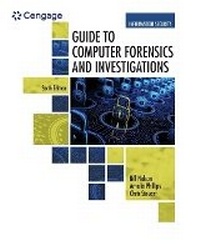
Guide to Computer Forensics and Investigations
6th Edition
Published on 17. April 2018
Book
Paperback/Softback
688 pages
978-1-337-56894-4 (ISBN)
Description
Master the skills you need to conduct a successful digital investigation with Nelson/Phillips/Steuart's GUIDE TO COMPUTER FORENSICS AND INVESTIGATIONS, Sixth Edition--the most comprehensive forensics resource available. While other books offer just an overview of the field, this hands-on learning text provides clear instruction on the tools and techniques of the trade, walking you through every step of the computer forensics investigation--from lab setup to testifying in court. It also explains how to use current forensics software and provides free demo downloads. It includes the most up-to-date coverage available of Linux and Macintosh, virtual machine software such as VMware and Virtual Box, Android, mobile devices, handheld devices, cloud forensics, email, social media and the Internet of Anything. With its practical applications, you can immediately put what you learn into practice.
More details
Edition
6th edition
Language
English
Place of publication
Boston, MA
United States
Publishing group
Cengage Learning, Inc
Target group
College/higher education
Dimensions
Height: 33 mm
Width: 203 mm
Thickness: 254 mm
Weight
1293 gr
ISBN-13
978-1-337-56894-4 (9781337568944)
Copyright in bibliographic data and cover images is held by Nielsen Book Services Limited or by the publishers or by their respective licensors: all rights reserved.
Schweitzer Classification
Other editions
New editions
Bill Nelson | Amelia Phillips | Christopher Steuart
Guide to Computer Forensics and Investigations
Book
04/2024
7th Edition
Course Technology Inc
€276.50
Shipment within 15-20 days
Persons
Bill Nelson has worked for two global Fortune 100 companies in information technologies for over 32 years, including 18-plus years in corporate digital forensics and information security. In addition, he has taught digital forensics classes at the City University of Seattle and the University of Washington's Professional and Continuing Education Department for 10 years. He also has experience in Automated Fingerprint Identification System software engineering and reserve police work. A former president and vice president for Computer Technology Investigators Northwest, he routinely lectures at several colleges and universities in the Pacific Northwest. Bill Nelson has worked for two global Fortune 100 companies in information technologies for over 32 years, including 18-plus years in corporate digital forensics and information security. In addition, he has taught digital forensics classes at the City University of Seattle and the University of Washington's Professional and Continuing Education Department for 10 years. He also has experience in Automated Fingerprint Identification System software engineering and reserve police work. A former president and vice president for Computer Technology Investigators Northwest, he routinely lectures at several colleges and universities in the Pacific Northwest. Amelia Phillips is a tenured faculty member at Highline College in Seattle, Washington. After serving as an engineer at the Jet Propulsion Laboratory, she worked with e-commerce websites and began training in computer forensics to prevent credit card numbers from being stolen from sensitive e-commerce databases. Dr. Phillips designed certificate and AAS programs for community colleges in e-commerce, network security, computer forensics and data recovery. She designed the Bachelor of Applied Science in Cybersecurity and Forensics, which was approved in 2014. A Fulbright Scholar, Dr. Phillips taught at Polytechnic of Namibia in 2005 and 2006 and continues her work with developing nations, traveling there frequently. She earned BS degrees in astronautical engineering and archaeology and an MBA in technology management from the Massachusetts Institute of Technology, and an interdisciplinary Ph.D. in computer security from the University of Alaska, Fairbanks. Christopher K. Steuart is a practicing attorney maintaining a general litigation practice, with experience in information systems security for a Fortune 50 company and the U.S. Army. He is also an honorary life member and the former general counsel for Computer Technology Investigators Northwest. He has presented computer forensics seminars in regional and national forums, including the American Society for Industrial Security, Agora, Northwest Computer Technology Crime Analysis Seminar and CTIN. Christopher K. Steuart is a practicing attorney maintaining a general litigation practice, with experience in information systems security for a Fortune 50 company and the U.S. Army. He is also an honorary life member and the former general counsel for Computer Technology Investigators Northwest. He has presented computer forensics seminars in regional and national forums, including the American Society for Industrial Security, Agora, Northwest Computer Technology Crime Analysis Seminar and CTIN.
Content
1. Understanding the Digital Forensics Profession and Investigations.
2. The Investigator's Office and Laboratory.
3. Data Acquisition.
4. Processing Crime and Incident Scenes.
5. Working with Windows and CLI Systems.
6. Current Computer Forensics Tools.
7. Linux Boot Processes and File Systems.
8. Recovering Graphics Files.
9. Digital Forensics Analysis and Validation.
10. Virtual Machine Forensics, Live Acquisitions and Cloud Forensics.
11. Email and Social Media.
12. Mobile Device Forensics and the Internet of Anything.
13. Cloud Forensics.
14. Report Writing for High-Tech Investigations.
15. Expert Testimony in Digital Forensic Investigations.
16. Ethics for the Digital Forensic Examiner and Expert Witness.
Appendix A: Digital Forensics Test References.
Appendix B: Digital Forensics References.
Appendix C: Digital Forensics Lab Considerations.
Appendix D: Digital Forensics Alternative Tools and Methods.
2. The Investigator's Office and Laboratory.
3. Data Acquisition.
4. Processing Crime and Incident Scenes.
5. Working with Windows and CLI Systems.
6. Current Computer Forensics Tools.
7. Linux Boot Processes and File Systems.
8. Recovering Graphics Files.
9. Digital Forensics Analysis and Validation.
10. Virtual Machine Forensics, Live Acquisitions and Cloud Forensics.
11. Email and Social Media.
12. Mobile Device Forensics and the Internet of Anything.
13. Cloud Forensics.
14. Report Writing for High-Tech Investigations.
15. Expert Testimony in Digital Forensic Investigations.
16. Ethics for the Digital Forensic Examiner and Expert Witness.
Appendix A: Digital Forensics Test References.
Appendix B: Digital Forensics References.
Appendix C: Digital Forensics Lab Considerations.
Appendix D: Digital Forensics Alternative Tools and Methods.