

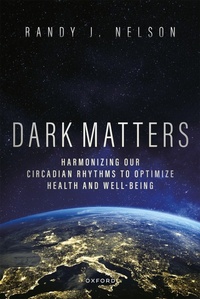
Dark Matters
Harmonizing Our Circadian Rhythms to Optimize Health and Well-Being
Will be published approx. on 19. August 2028
Book
Hardback
240 pages
978-0-19-763994-8 (ISBN)
Description
Work in clinical and laboratory settings has indicated that lack of bright light during the day can compromise mood, accelerate cancer growth, and impair cognition. Even sustained exposure to the equivalent of a child's night light has been shown to have an impact on everything from how well our brains function every day to how well our bodies recover from injury. Professor Randy J. Nelson brings together the most reliable research on the different ways exposure to light at night affects how our bodies function and, ultimately, our health. Each chapter explores the role of light and dark in our bodies' most important regulatory processes.
In humans, virtually every aspect of our physiology and behavior is mediated by our internal biological clocks. One feature of modern life that may have negative consequences for our health is exposure to light levels that are not aligned with the 24-hour solar day. Circadian rhythms, the internal biological rhythms of our body's processes, require short wavelength (blue) light early during the day to optimize their temporal regulation. Experiencing light at night or insufficient light during the day can lead to a host of problems such as obesity, major depression, bipolar depressive disorder, seasonal affective disorder, sleep disorders, cancer, heart disease and more. Dark Matters sets out to shine a light on the health and well-being consequences of poor circadian hygiene and provide strategies to offset the negative health effects of disrupted circadian rhythms.
In humans, virtually every aspect of our physiology and behavior is mediated by our internal biological clocks. One feature of modern life that may have negative consequences for our health is exposure to light levels that are not aligned with the 24-hour solar day. Circadian rhythms, the internal biological rhythms of our body's processes, require short wavelength (blue) light early during the day to optimize their temporal regulation. Experiencing light at night or insufficient light during the day can lead to a host of problems such as obesity, major depression, bipolar depressive disorder, seasonal affective disorder, sleep disorders, cancer, heart disease and more. Dark Matters sets out to shine a light on the health and well-being consequences of poor circadian hygiene and provide strategies to offset the negative health effects of disrupted circadian rhythms.
More details
Language
English
Place of publication
New York
United States
Target group
College/higher education
Illustrations
14 black and white illustrations
Dimensions
Height: 148 mm
Width: 219 mm
Thickness: 23 mm
Weight
400 gr
ISBN-13
978-0-19-763994-8 (9780197639948)
Copyright in bibliographic data and cover images is held by Nielsen Book Services Limited or by the publishers or by their respective licensors: all rights reserved.
Schweitzer Classification
Other editions
Additional editions
E-Book
05/2025
OUP eBook
€24.99
Available for download
E-Book
05/2025
OUP eBook
€24.99
Available for download
Person
Randy J. Nelson, PhD, studies circadian rhythms in health and illness. For the past 10 years his lab has focused on the role of disrupted circadian rhythms on physiology and behavior. He has published hundreds of papers and more than 12 books during his career.
Professor Nelson earned his AB, MA, a PhD in Psychology, and a second PhD in Endocrinology, at UC, Berkeley, where he was the first in the US to simultaneously earn two PhDs. He then joined the faculty at Johns Hopkins. After promotion to full professor, he moved to Ohio State. Dr. Nelson was recruited to WVU in 2018 to serve as inaugural chair for their Department of Neuroscience.
Professor Nelson earned his AB, MA, a PhD in Psychology, and a second PhD in Endocrinology, at UC, Berkeley, where he was the first in the US to simultaneously earn two PhDs. He then joined the faculty at Johns Hopkins. After promotion to full professor, he moved to Ohio State. Dr. Nelson was recruited to WVU in 2018 to serve as inaugural chair for their Department of Neuroscience.
Content
Acknowledgments
Introduction to Circadian Rhythms
Light and Body Weight
Light and Mood
Light and Sleep
Light, Cognition, and Memory
Light and Cancer
Light and Cardiac Function
Strategies to Reduce Disrupted Circadian Rhythms and Improve Health
Index
Introduction to Circadian Rhythms
Light and Body Weight
Light and Mood
Light and Sleep
Light, Cognition, and Memory
Light and Cancer
Light and Cardiac Function
Strategies to Reduce Disrupted Circadian Rhythms and Improve Health
Index