

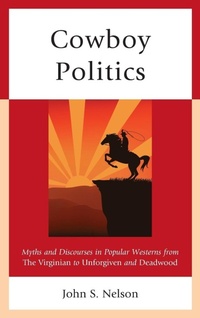
Cowboy Politics
Myths and Discourses in Popular Westerns from The Virginian to Unforgiven and Deadwood
Published on 1. November 2017
Book
Hardback
412 pages
978-1-4985-4947-9 (ISBN)
Description
The politics of popular westerns are surprising in substance and significance, especially of late. Cowboy Politics shows how westerns in literature, cinema, and television face the challenges of Western Civilization even more than the perils of American frontiers. Its strategy is to compare key westerns with major theories of modern and postmodern politics. So it analyzes novels from Owen Wister to Zane Grey and Larry McMurtry. It focuses on films from the western revival beginning in the 1990s and featuring Clint Eastwood's Unforgiven, while its interest in TV stretches from singing cowboys and Gunsmoke to David Milch's Deadwood.
Critics are apt to find in westerns the modern politics of Thomas Hobbes and John Locke. They tap devices of individuality, rationality, contract, sovereign enforcement, and representation to overcome the chaotic violence of a wild zone. Cowboy Politics examines how westerns often find such measures insufficient to tame the West as a culture of honor and anger that deteriorates into feud-al vengeance. Instead westerns see the West as the sunset land that is already growing old and moving on. So westerns seek fresh starts informed by comparing civilizations more than demonizing savages. Westerns worry that modern politics devolve into exploitation, oppression, spectacle, and terror. So they pursue supplements in such postmodern politics as republicanism, perfectionism, populism, feminism, and environmentalism. Especially westerns explore politics of persuasive speech-in-action-in-public, doing beauty, and self-reliance in the modes of Hannah Arendt and Ralph Waldo Emerson.
The first two chapters of Cowboy Politics explain how westerns do political theory for popular audiences by making many of our myths: the symbolic stories of individuals and communities which we live daily. The next three chapters trace the initially modern theories of government in many westerns. Then western turns to republican honor, rhetoric, response-ability, and character tracking occupy the following four chapters. And these set the stage for another four chapters on western attention to postmodern terror, mythmaking, celebrity, spectacle, and forgiveness. The final two chapters analyze how "late," "satirical," and "transformative" westerns develop realist defenses for their surprisingly postmodern politics.
Critics are apt to find in westerns the modern politics of Thomas Hobbes and John Locke. They tap devices of individuality, rationality, contract, sovereign enforcement, and representation to overcome the chaotic violence of a wild zone. Cowboy Politics examines how westerns often find such measures insufficient to tame the West as a culture of honor and anger that deteriorates into feud-al vengeance. Instead westerns see the West as the sunset land that is already growing old and moving on. So westerns seek fresh starts informed by comparing civilizations more than demonizing savages. Westerns worry that modern politics devolve into exploitation, oppression, spectacle, and terror. So they pursue supplements in such postmodern politics as republicanism, perfectionism, populism, feminism, and environmentalism. Especially westerns explore politics of persuasive speech-in-action-in-public, doing beauty, and self-reliance in the modes of Hannah Arendt and Ralph Waldo Emerson.
The first two chapters of Cowboy Politics explain how westerns do political theory for popular audiences by making many of our myths: the symbolic stories of individuals and communities which we live daily. The next three chapters trace the initially modern theories of government in many westerns. Then western turns to republican honor, rhetoric, response-ability, and character tracking occupy the following four chapters. And these set the stage for another four chapters on western attention to postmodern terror, mythmaking, celebrity, spectacle, and forgiveness. The final two chapters analyze how "late," "satirical," and "transformative" westerns develop realist defenses for their surprisingly postmodern politics.
Reviews / Votes
Cowboy Politics is an immensely learned volume that distills a lifetime of study, thinking, reading and viewing into fascinating analyses of novels by Owen Wister, Zane Grey, Louis L'Amour and Larry McMurtry, films such as Clint Eastwood's Unforgiven (1992), and also television programs such as Deadwood (2004-6). . . . Cowboy Politics stands as an important piece of cultural and political theorizing. But the main contribution of the work for me is pedagogical. In this study, John Nelson has made an important and convincing case for the inclusion of westerns as worthy lenses onto the history of political theory and the emerging politics of the early twenty first century. * VoegelinView * [Nelson's book is ] worth reading for any scholar of American Studies, Film Studies and political science. * Popcultureshelf.com * Nelson argues that literature, films, and TV shows about the American West reveal deep aspects of The West as a civilization. The result is full of surprising insights into both his fictional material, and the nature and sources of our common culture. -- Charles T. Rubin, Duquesne University In this encyclopedic study of political myth-making in the genre of Westerns, John Nelson provides a range of tools, questions, and themes for students of political theory to deploy while watching, engaging, and teaching films. Westerns turn out to be an extraordinary font of narratives, rhetorical strategies, and images about American political life when illuminated by Nelson's probing questions and analysis. As with Nelson's earlier forays into various noirs, horror, and science fiction, Cowboy Politics is a stunning intellectual achievement that braids the history of cinema with political history and theory in a lucid style that deepens (without diluting) the fun of watching and discussing the films in question. -- Christopher C. Robinson, Clarkson University In Cowboy Politics, John Nelson explores how popular Westerns are a key site for grappling with contemporary political dilemmas. With intriguing examples and humor, Cowboy Politics shows how Westerns point beyond modernity, mixing liberalism with republicanism, and grappling with environmental, feminist, populist and authoritarian challenges. Theorizing in the style of Hannah Arendt, Nelson demonstrates the potential moves that Westerns offer us-responsibility, speech, forgiveness-in facing the political questions of our own times. -- Linda Beail, Point Loma Nazarene UniversityMore details
Series
Language
English
Place of publication
United States
Publishing group
Bloomsbury Publishing Plc
Target group
Professional and scholarly
Illustrations
1 tables;
Dimensions
Height: 235 mm
Width: 157 mm
Thickness: 29 mm
Weight
820 gr
ISBN-13
978-1-4985-4947-9 (9781498549479)
Copyright in bibliographic data and cover images is held by Nielsen Book Services Limited or by the publishers or by their respective licensors: all rights reserved.
Schweitzer Classification
Other editions
Additional editions
John S. Nelson
Cowboy Politics
Myths and Discourses in Popular Westerns from The Virginian to Unforgiven and Deadwood
E-Book
11/2017
1st Edition
Bloomsbury eBooks US
€125.99
Available for download
John S. Nelson
Cowboy Politics
Myths and Discourses in Popular Westerns from the Virginian to Unforgiven and Deadwood
E-Book
11/2017
1st Edition
Lexington Books
€125.99
Available for download
Person
John S. Nelson is professor of political theory and communication at the University of Iowa.
Content
Preface
Chapter 1: "The Signs in This Book Spoke to Him": The Western Craft of Culture and Convention
Chapter 2: "The Stories of the West Are Many": The Western Craft of Dream and Daring
Chapter 3: "Strike First and Then Give Tongue": The Western Culture of Honor and Anger
Chapter 4: "Without Law, Man Becomes a Beast": The Western Culture of Rationality and Sovereignty
Chapter 5: "The Cowboy Represents That Independent Spirit": The Western Culture of Individuals and Nations
Chapter 6: "Live with Honor and [Leave] Our Mark": The Western Culture of Honor and Character
Chapter 7: "What's He Going to Get Out of This?": The Western Culture of Interest and Character
Chapter 8: "Why Had He Waited So Long to Speak?": The Western Craft of Pride and Performance
Chapter 9: "A Track Is Not Only Marks upon the Earth": The Western Craft of Faces and Traces
Chapter 10: "It's Not Revenge He's After; It's a Reckoning": The Western Culture of Fear and Terror
Chapter 11: "Accurate Description [with] Poetry to the Lan
Chapter 1: "The Signs in This Book Spoke to Him": The Western Craft of Culture and Convention
Chapter 2: "The Stories of the West Are Many": The Western Craft of Dream and Daring
Chapter 3: "Strike First and Then Give Tongue": The Western Culture of Honor and Anger
Chapter 4: "Without Law, Man Becomes a Beast": The Western Culture of Rationality and Sovereignty
Chapter 5: "The Cowboy Represents That Independent Spirit": The Western Culture of Individuals and Nations
Chapter 6: "Live with Honor and [Leave] Our Mark": The Western Culture of Honor and Character
Chapter 7: "What's He Going to Get Out of This?": The Western Culture of Interest and Character
Chapter 8: "Why Had He Waited So Long to Speak?": The Western Craft of Pride and Performance
Chapter 9: "A Track Is Not Only Marks upon the Earth": The Western Craft of Faces and Traces
Chapter 10: "It's Not Revenge He's After; It's a Reckoning": The Western Culture of Fear and Terror
Chapter 11: "Accurate Description [with] Poetry to the Lan