

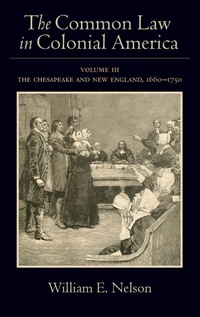
The Common Law in Colonial America
Volume III: The Chesapeake and New England, 1660-1750
Published on 9. June 2016
Book
Hardback
240 pages
978-0-19-046505-6 (ISBN)
Description
In a projected four-volume series, The Common Law in Colonial America, William E. Nelson will show how the legal systems of Britain's thirteen North American colonies, which were initially established in response to divergent political, economic, and religious initiatives, slowly converged until it became possible by the 1770s to imagine that all thirteen participated in a common American legal order, which diverged in its details but differed far more substantially from English common law. Volume three, The Chesapeake and New England, 1660-1750, reveals how Virginia, which was founded to earn profit, and Massachusetts, which was founded for Puritan religious ends, had both adopted the common law by the mid-eighteenth century and begun to converge toward a common American legal model. The law in the other New England colonies, Nelson argues, although it was distinctive in some respects, gravitated toward the Massachusetts model, while Maryland's law gravitated toward that of Virginia.
Reviews / Votes
This volume continues a multi-volume history of the common law in America by our greatest authority on the foundations of the American legal system. Like his other work, it is the product of unmatched meticulous research into the archival record of legal institutions as they affected the lives of ordinary Americans a male and female, white and black, powerful and weak. It is as much a human study as it is an institutional one, and it takes its well-earned place as a classic in legal history. * David Thomas Konig, Professor of Law at Washington University *More details
Language
English
Place of publication
New York
United States
Target group
College/higher education
Professional and scholarly
Dimensions
Height: 240 mm
Width: 161 mm
Thickness: 19 mm
Weight
569 gr
ISBN-13
978-0-19-046505-6 (9780190465056)
Copyright in bibliographic data and cover images is held by Nielsen Book Services Limited or by the publishers or by their respective licensors: all rights reserved.
Schweitzer Classification
Other editions
Additional editions
William E. Nelson
The Common Law in Colonial America
Volume III: The Chesapeake and New England, 1660-1750
E-Book
04/2016
1st Edition
OUP eBook
€53.49
Available for download
William E. Nelson
The Common Law in Colonial America
Volume III: The Chesapeake and New England, 1660-1750
E-Book
04/2016
1st Edition
OUP eBook
€53.49
Available for download
Person
William E. Nelson, is the Edward Weinfeld Professor of Law and Professor of History, at New York University.
Content
Introduction
I. Maryland and the Shift to Protestantism
A. Maryland's Unique Judicial System
1. The Neutrality of Judges
2. The Law-Finding Power of Juries
B. The Substance of Maryland's Law
1. Commercial Litigation
2. Debt Collection
3. Land Law
4. The Law of Slavery and Servitude
5. Administrative Law
6. Criminal Law
C. Summary
II. The Weakness of the Law in Post-Restoration Virginia
III. Strengthening Virginia's Legal Order
A. The Switch from White to Black Labor
B. Patronage and Noblesse Oblige
C. Law and Religion
D. Reception of the Common Law
E. Judge and Jury
IV. Center and Periphery: The Localization of Power in Colonial Virginia
A. The Jurisdiction of Country Courts
B. The Structure of Political Power
C. The Structure of Legal Knowledge
D. The Independence of County Courts
V. The Substance of Virginia Law
A. Capital and Debt
B. Land Law
C. The Law of Slavery
VI. The Persistence of Puritan Law in Massachusetts, 1660-1685
A. Reception of the Common Law
B. Law and Religion
C. Law and Morality
D. Morality and the Regulation of the Economy
E. Morality as a Restraint on Power
1. Servants and Laborers
2. Strangers
3. Married Women
F. Summary
VII. The Establishment of Royal Government and Continued Reception of the Common Law
A. Preserving the Puritan Structure of Institutions
B. Continued Reception of the Common Law
C. The Emergence of Substantive Law
VIII. The Continued Preservation of Puritan Law
A. Puritan Inheritance Law
B. Law and Religion
C. Law and Morality
D. Morality and Regulation of the Economy
E. Morality as a Restraint on Power
1. Servants and Laborers
2. Strangers and the Poor
3. Married Women
F. Summary
IX. The New England Satellites: Connecticut, New Hampshire, and Rhode Island, 1660-1750
A. The Early Replication of Puritan Legality
1. Criminal Law
2. Administrative Jurisdiction
3. Civil Procedure
4. Substantive Law
B. The Professionalization and Formalization of the Law
1. Juries as Lawfinders
2. Pleading and Procedure
3. Substantive Law
C. Summary
X. Conclusion: The Success of British Imperial Policy
I. Maryland and the Shift to Protestantism
A. Maryland's Unique Judicial System
1. The Neutrality of Judges
2. The Law-Finding Power of Juries
B. The Substance of Maryland's Law
1. Commercial Litigation
2. Debt Collection
3. Land Law
4. The Law of Slavery and Servitude
5. Administrative Law
6. Criminal Law
C. Summary
II. The Weakness of the Law in Post-Restoration Virginia
III. Strengthening Virginia's Legal Order
A. The Switch from White to Black Labor
B. Patronage and Noblesse Oblige
C. Law and Religion
D. Reception of the Common Law
E. Judge and Jury
IV. Center and Periphery: The Localization of Power in Colonial Virginia
A. The Jurisdiction of Country Courts
B. The Structure of Political Power
C. The Structure of Legal Knowledge
D. The Independence of County Courts
V. The Substance of Virginia Law
A. Capital and Debt
B. Land Law
C. The Law of Slavery
VI. The Persistence of Puritan Law in Massachusetts, 1660-1685
A. Reception of the Common Law
B. Law and Religion
C. Law and Morality
D. Morality and the Regulation of the Economy
E. Morality as a Restraint on Power
1. Servants and Laborers
2. Strangers
3. Married Women
F. Summary
VII. The Establishment of Royal Government and Continued Reception of the Common Law
A. Preserving the Puritan Structure of Institutions
B. Continued Reception of the Common Law
C. The Emergence of Substantive Law
VIII. The Continued Preservation of Puritan Law
A. Puritan Inheritance Law
B. Law and Religion
C. Law and Morality
D. Morality and Regulation of the Economy
E. Morality as a Restraint on Power
1. Servants and Laborers
2. Strangers and the Poor
3. Married Women
F. Summary
IX. The New England Satellites: Connecticut, New Hampshire, and Rhode Island, 1660-1750
A. The Early Replication of Puritan Legality
1. Criminal Law
2. Administrative Jurisdiction
3. Civil Procedure
4. Substantive Law
B. The Professionalization and Formalization of the Law
1. Juries as Lawfinders
2. Pleading and Procedure
3. Substantive Law
C. Summary
X. Conclusion: The Success of British Imperial Policy