

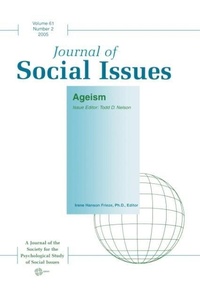
Ageism 2005
1st Edition
Published on 10. August 2005
Book
Paperback/Softback
208 pages
978-1-4051-3944-1 (ISBN)
Description
Humans automatically categorize others in social perception. Some categorizations - race, gender, and age -- are so automatic that they are termed "primitive categories." As we categorize, we develop stereotypes about the categories. Researchers know much about racism and sexism, but comparatively little about prejudice based on age. The papers in this issue highlight the current empirical and theoretical work on understanding the origins and consequences of stereotyping and prejudice against older adults.
With the aging baby boomer demographic, it is especially timely for researchers to work to understand how society can shed its institutionalized ageism and promote respect for elders.
With the aging baby boomer demographic, it is especially timely for researchers to work to understand how society can shed its institutionalized ageism and promote respect for elders.
More details
Series
Language
English
Place of publication
Hoboken
United Kingdom
Publishing group
John Wiley and Sons Ltd
Target group
Professional and scholarly
Product notice
Paperback (trade)
Dimensions
Height: 229 mm
Width: 163 mm
Thickness: 11 mm
Weight
290 gr
ISBN-13
978-1-4051-3944-1 (9781405139441)
Copyright in bibliographic data and cover images is held by Nielsen Book Services Limited or by the publishers or by their respective licensors: all rights reserved.
Schweitzer Classification
Persons
Todd D. Nelson is the Gemperle Foundation Distinguished Professor of Psychology at California State University - Stanislaus. His research focuses on the impact of ageism on older persons. Specifically, he is interested in understanding and how age prejudice, stereotyping, and discrimination at the individual and societal level influence how older people feel about themselves and the future.
Content
Ageism: Prejudice Against Our Feared Future Self. A Terror Management Perspective on Ageism.
Attitudes Toward Younger and Older Adults: An Updated Meta-Analytic Review.
This Old Stereotype: The Pervasiveness and Persistence of the Elderly Stereotype.
Ageism and Ageist Language Across the Life Span: Intimate Relationships and Non-intimate Interactions.
Re-Vision of Older Television Characters: A Stereotype-Awareness Intervention.
Perceiving Age Discrimination in Response to Intergenerational Inequity.
The Social Separation of Old and Young: A Root of Ageism.
Ageism and Age Categorization.
Models of the Aging Self.
Ageism Across the Lifespan: Towards a Self-Categorization Model of Ageing.
Erratum: "Mothers and Fathers in the Workplace: How Gender and Parental Status Influence Judgments of Job-Related Competence"
Attitudes Toward Younger and Older Adults: An Updated Meta-Analytic Review.
This Old Stereotype: The Pervasiveness and Persistence of the Elderly Stereotype.
Ageism and Ageist Language Across the Life Span: Intimate Relationships and Non-intimate Interactions.
Re-Vision of Older Television Characters: A Stereotype-Awareness Intervention.
Perceiving Age Discrimination in Response to Intergenerational Inequity.
The Social Separation of Old and Young: A Root of Ageism.
Ageism and Age Categorization.
Models of the Aging Self.
Ageism Across the Lifespan: Towards a Self-Categorization Model of Ageing.
Erratum: "Mothers and Fathers in the Workplace: How Gender and Parental Status Influence Judgments of Job-Related Competence"