

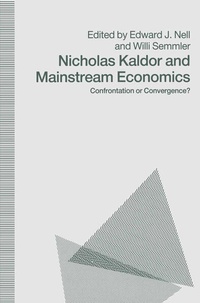
Nicholas Kaldor and Mainstream Economics
Confrontation or Convergence?
Published on 1. January 1991
Book
Paperback/Softback
XV, 620 pages
978-1-349-10949-4 (ISBN)
Description
An examination of the role of Nicholas Kaldor within economics. Topics covered range from Kaldor's discovery of the Von Neumann input-output model, to cyclical growth in a Kaldorian model, to Nicholas Kaldor as advocate of commodity reserve currency.
More details
Edition
1st ed. 1991
Language
English
Place of publication
London
United Kingdom
Target group
Professional and scholarly
Illustrations
XV, 620 p.
Dimensions
Height: 235 mm
Width: 155 mm
Thickness: 35 mm
Weight
955 gr
ISBN-13
978-1-349-10949-4 (9781349109494)
DOI
10.1007/978-1-349-10947-0
Schweitzer Classification
Other editions
Additional editions
Edward J. Nell | Willi Semmler
Nicholas Kaldor and Mainstream Economics
Confrontation or Convergence?
E-Book
06/1991
Palgrave Macmillan
€96.29
Available for download

Edward J. Nell | Willi Semmler
Nicholas Kaldor and Mainstream Economics
Confrontation or Convergence?
Book
03/1991
Palgrave Macmillan
€93.00
Article exhausted; check different version
Content
Part 1 Nicholas Kaldor - an overall evaluation: Nicholas Kalder 1908-1986, A.P.Thirwall; Nicholas Kaldor remembered, J.K.Galbraith. Part 2 Methodology and basic approach: Kaldor between Hayek and Keynes, or - did Nicky kill capital theory? M.Desai; a sweeping new non-substitution theorem - Kaldor's discovery of the Von Neumann input-output model, P.A.Samuelson; equilibrium and stability in classical theory, D.J.Harris; on the resolution of conflicts by compensation, U.Krause; the impact of the division of labour on market relations, T.Scitovsky. Part 3 Saving and distribution: profit squeeze and Keynesian theory, S.A.Marglin and A.Bhaduri; post-Keynesian theory of distribution in the long run, N.Salvadori; corporate behaviour, valuation ratio and macro-economic analysis, G.Abraham-Frois. Part 4 Money and macroeconomics: the endogeneity of money, H.P.Minsky; on the endogeneity of money supply, J.Tobin; Marx, Keynes, Kalecki and Kaldor on the rate of interest as a monetary phenomenon, B.J.Moore; money - cause or effect? exogenous or endogenous?, P.Davidson; change, continuity and originality in Kaldor's monetary theory, M.Lavoie. Part 5 Business cycles: a Keynesian business cycle, R.Day; perfect foresight cycles in a Marxian-Keynesian model of accumulation with money, D.K.Foley; wandering around the warranted path - dynamic nonlinear solutions to the harrodian knife-edge, A.Shaikh; a dynamical macroeconomic growth model wth external financing of firms - a numerical stability analysis, R.Franke and W.Semmler; a working model of slump and recovery from disturbances to capital-goods demand in a closed non-monetary economy, E.S.Phelps; cyclical growth in a Kaldorian model, P.Skott; endogenous credit and endogenous business cycles, M.Jarsulic. Part 6 Theory of growth: change and continuity in Kaldor's thought on growth and distribution, F.Targetti; technical change, growth and distribution - a steady state approach to "unsteady" growth on Kaldorian lines, H.D.Kurz; a Kaldorian saving function in a two-sectoral linear growth model, H.Hagemann; international debts and deficits - a Kaldor/Pasinetti model, H.Gram. Part 7 Empirical evidence on post-war growth: Kaldor's growth theories - past, present and prospects for the future, R.Boyer and P.Petit; Kaldor's macro system - too much cumulation, to few contradictions, D.M.Gordon; disembodied technical progress - theory and measurement, S.Nagy. Part 8 Economic policy and economic systems: Nicholas Kaldor as advocate of commodity reserve currency, A.G.Hart; Kaldor on international economic policy, S.Dell; demand scarcity and supply shortage in capitalism and socialism, E.Nell.