

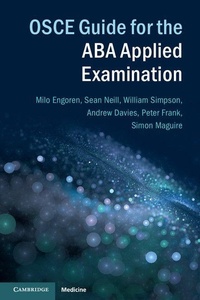
OSCE Guide for the ABA Applied Examination
Published on 26. October 2017
Book
Paperback/Softback
260 pages
978-1-107-59499-9 (ISBN)
Description
The OSCE (Objective Structured Clinical Examination) component of the ABA Applied exam is a new concept that involves a number of 'live' practical stations in which candidates must demonstrate communication, professionalism and technical skills to the examiners. This book covers topics that are outlined in the ABA curriculum, presented in a way that emulates the OSCE exam setting, and will help candidates prepare for the exam and test their knowledge. Each station is constructed in clear, logical fashion to make the revision of individual topics more accessible. The sample questions and answers allow self-testing and are complemented by discussions, numerous illustrations and up-to-date clinical guidelines which follow modern-day anesthetic practice. The OSCE Guide for the ABA Applied Examination is a must-have resource which will help candidates further understand and prepare for the OSCE process.
More details
Language
English
Place of publication
Cambridge
United Kingdom
Target group
Professional and scholarly
Product notice
Paperback (trade)
Dimensions
Height: 234 mm
Width: 156 mm
Thickness: 14 mm
Weight
404 gr
ISBN-13
978-1-107-59499-9 (9781107594999)
Copyright in bibliographic data and cover images is held by Nielsen Book Services Limited or by the publishers or by their respective licensors: all rights reserved.
Schweitzer Classification
Other editions
Additional editions
Sean Neill
OSCE Guide for the ABA Applied Examination
E-Book
10/2017
Cambridge University Press
€46.49
Available for download
Sean Neill | William Simpson | Andrew Davies
OSCE Guide for the ABA Applied Examination
E-Book
09/2017
Cambridge University Press
€54.49
Available for download
Persons
Sean Neill is Assistant Professor of Anesthesiology, Pharmacology and Therapeutics at the University of British Columbia, Canada. William Simpson is Consultant at the Department of Cardiothoracic Anaesthesia, Lancashire Cardiac Centre. Andrew Davies is Consultant in Cardiothoracic Anaesthesia and Critical Care, University Hospital of South Manchester NHS Foundation Trust. Peter Frank is Consultant in Anaesthesia and Intensive Care Medicine, Lancashire Teaching Hospitals NHS Foundation Trust. Simon Maguire is Consultant in Anaesthesia at the University Hospital of South Manchester, where he is also Training Programme Director and a Royal College Tutor. Milo Engoren is Professor of Anesthesiology at the University of Michigan, Ann Arbor.
Content
Preface; Acknowledgements; Part I. Anatomy: 1. Trachea; 2. Brachial plexus; 3. Great veins of the neck; 4. Antecubital fossa; 5. Ankle block; 6. Circle of Willis; 7. Coronary circulation; 8. Base of skull; 9. Diaphragm; 10. Spinal cord; 11. Wrist; 12. Larynx; Part II. History Taking: Introduction; 13. TURP surgery; 14. Laparoscopic cholecystectomy; 15. Thyroid surgery; 16. Shoulder replacement; 17. Caesarean section; 18. ENT surgery; Part III. Communication: Introduction; 19. Sickle cell test; 20. Rapid sequence induction; 21. Suxamethonium apnoea; 22. Cancelled surgery; 23. Tooth damage; 24. Jehovah's Witness; Part IV. Equipment: 25. Electrocautery; 26. Defibrillators; 27. Laryngoscopes; 28. Endotracheal tubes; 29. Breathing circuits; 30. Airways; 31. Vaporisers; 32. Scavenging; 33. Medical gases; 34. Filters; 35. Ventilators; Part V. Anesthetic Hazards: 36. Electricity; 37. Lasers; 38. Positioning; 39. Blood transfusion; Part VI. Radiology: 40. Chest x-ray 1; 41. Chest x-ray 2; 42. CT head; 43. Cervical spine; 44. Angiogram; Part VII. Physical Examination: 45. Cardiovascular examination; 46. Respiratory examination; 47. Cranial nerve examination; 48. Obstetric pre-operative assessment; 49. Peripheral circulation examination; 50. Airway examination; Part VIII. Resuscitation and Simulation: 51. Bradyarrhythmia; 52. Collapsed obstetric patient; 53. Malignant hyperthermia; 54. Failed intubation; 55. Displaced tracheostomy; 56. Paediatric emergency; 57. Intraoperative desaturation; 58. Tachyarrhythmia; 59. Anaphylaxis; 60. Obstetric haemorrhage; Part IX. Procedures: 61. Lumbar puncture; 62. Chest drain; 63. Epidural; 64. Surgical airway; 65. Central venous cannulation; 66. Intraosseous access; 67. Anesthesia of the eye; 68. Rapid sequence induction; 69. Transversus abdominis plane (TAP) block; Part X. Monitoring and Measurement: 70. Capnography; 71. Central venous pressure trace; 72. Electrocardiogram 1; 73. Electrocardiogram 2; 74. Humidity; 75. Invasive blood pressure; 76. Respiratory 1; 77. Respiratory 2; 78. Non-invasive blood pressure; 79. Oxygen measurement 1; 80. Oxygen measurement 2; 81. Pulmonary artery catheter; 82. Nerve stimulators; 83. Pulse oximetry; 84. Rotameters; 85. Temperature; Index.