

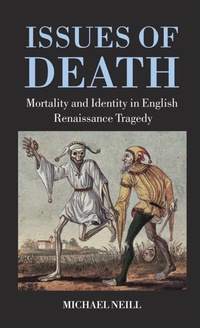
Issues of Death
Mortality and Identity in English Renaissance Tragedy
Published on 1. May 1997
Book
Hardback
420 pages
978-0-19-818386-0 (ISBN)
Description
Death, like most experiences that we think of as 'natural', is a product of the human imagination: all animals die, but only human beings suffer Death; and what they suffer is shaped by their own time and culture. Tragedy was one of the principal instruments through which the culture of early modern England imagined the encounter with mortality. The essays in this book approach the theatrical reinvention of Death from three perspectives. Those in Part 1 explore Death as a trope of apocalypse - a moment of un-veiling or dis-covery that is figured both in the fearful nakedness of the Danse Macabre and in the shameful 'openings' enacted in the new theatres of anatomy. Separate chapters explore the apocalyptic design of two of the period's most powerful tragedies - Shakespeare's Othello, and Middleton and Rowley's The Changeling.
In Part 2, Neill explores the psychological and affective consequences of tragedy's fiercely end-driven narrative in a number of plays where a longing for narrative closure is pitched against a particularly intense dread of ending. The imposition of an end is often figured as an act of writerly violence, committed by the author or his dramatic surrogate. Extensive attention is paid to Hamlet as an extreme example of the structural consequences of such anxiety. The function of revenge tragedy as a response to the radical displacement of the dead by the Protestant abolition of purgatory - one of the most painful aspects of the early modern re-imagining of death - is also illustrated with particular clarity.
Finally, Part 3 focuses on the way tragedy articulates its challenge to the undifferentiating power of death through conventions and motifs borrowed from the funereal arts. It offers detailed analyses of three plays - Shakespeare's Anthony and Cleopatra, Webster's The Duchess of Malfi, and Ford's The Broken Heart. Here, funeral is rewritten as triumph, and death becomes the chosen instrument of an heroic self-fashioning designed to dress the arbitrary abruption of mortal ending in a powerful aesthetic of closure.
In Part 2, Neill explores the psychological and affective consequences of tragedy's fiercely end-driven narrative in a number of plays where a longing for narrative closure is pitched against a particularly intense dread of ending. The imposition of an end is often figured as an act of writerly violence, committed by the author or his dramatic surrogate. Extensive attention is paid to Hamlet as an extreme example of the structural consequences of such anxiety. The function of revenge tragedy as a response to the radical displacement of the dead by the Protestant abolition of purgatory - one of the most painful aspects of the early modern re-imagining of death - is also illustrated with particular clarity.
Finally, Part 3 focuses on the way tragedy articulates its challenge to the undifferentiating power of death through conventions and motifs borrowed from the funereal arts. It offers detailed analyses of three plays - Shakespeare's Anthony and Cleopatra, Webster's The Duchess of Malfi, and Ford's The Broken Heart. Here, funeral is rewritten as triumph, and death becomes the chosen instrument of an heroic self-fashioning designed to dress the arbitrary abruption of mortal ending in a powerful aesthetic of closure.
Reviews / Votes
subtle, patient, and learned study of early modern English tragedy ... Neill's work is exemplary and important ... Issues of Death is the most consistently illuminating and rewarding book on English Renaissance tragedy written in the last twenty years ... the pleasure of learning from Neill's scholarship and critical sensitivity is reinforced by the attractiveness of the physical object in which those qualities are conveyed to us. Oxford University Press have designed the book beautifully, have printed it on excellent paper, and have included a generous number of illustrations. * David Wormersley, Jesus College, Oxford, The Review of English Studies, vol 50, no 199, 199901/09/99 *More details
Language
English
Place of publication
Oxford
United Kingdom
Publishing group
Oxford University Press
Target group
Professional and scholarly
Illustrations
halftones
Dimensions
Height: 222 mm
Width: 145 mm
Thickness: 26 mm
Weight
657 gr
ISBN-13
978-0-19-818386-0 (9780198183860)
Copyright in bibliographic data and cover images is held by Nielsen Book Services Limited or by the publishers or by their respective licensors: all rights reserved.
Schweitzer Classification
Other editions
Additional editions
Book
01/1999
Oxford University Press
€129.99
Shipment within 15-20 days
E-Book
01/1999
1st Edition
OUP eBook
€81.99
Available for download
E-Book
05/1997
1st Edition
OUP eBook
€81.99
Available for download