

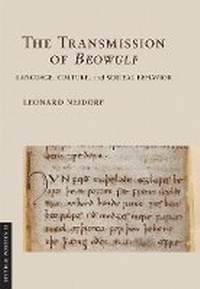
The Transmission of "Beowulf"
Language, Culture, and Scribal Behavior
Published on 16. May 2017
Book
Hardback
224 pages
978-1-5017-0511-3 (ISBN)
Description
The Transmission of "Beowulf" like The Iliad and The Odyssey, is a foundational work of Western literature that originated in mysterious circumstances. In The Transmission of Beowulf, Leonard Neidorf addresses philological questions that are fundamental to the study of the poem. Is Beowulf the product of unitary or composite authorship? How substantially did scribes alter the text during its transmission, and how much time elapsed between composition and preservation?
Neidorf answers these questions by distinguishing linguistic and metrical regularities, which originate with the Beowulf poet, from patterns of textual corruption, which descend from copyists involved in the poem's transmission. He argues, on the basis of archaic features that pervade Beowulf and set it apart from other Old English poems, that the text preserved in the sole extant manuscript (ca. 1000) is essentially the work of one poet who composed it circa 700. Of course, during the poem's written transmission, several hundred scribal errors crept into its text. These errors are interpreted in the central chapters of the book as valuable evidence for language history, cultural change, and scribal practice. Neidorf's analysis reveals that the scribes earnestly attempted to standardize and modernize the text's orthography, but their unfamiliarity with obsolete words and ancient heroes resulted in frequent errors. The Beowulf manuscript thus emerges from his study as an indispensible witness to processes of linguistic and cultural change that took place in England between the eighth and eleventh centuries. An appendix addresses J. R. R. Tolkien's Beowulf: A Translation and Commentary, which was published in 2014. Neidorf assesses Tolkien's general views on the transmission of Beowulf and evaluates his position on various textual issues.
Neidorf answers these questions by distinguishing linguistic and metrical regularities, which originate with the Beowulf poet, from patterns of textual corruption, which descend from copyists involved in the poem's transmission. He argues, on the basis of archaic features that pervade Beowulf and set it apart from other Old English poems, that the text preserved in the sole extant manuscript (ca. 1000) is essentially the work of one poet who composed it circa 700. Of course, during the poem's written transmission, several hundred scribal errors crept into its text. These errors are interpreted in the central chapters of the book as valuable evidence for language history, cultural change, and scribal practice. Neidorf's analysis reveals that the scribes earnestly attempted to standardize and modernize the text's orthography, but their unfamiliarity with obsolete words and ancient heroes resulted in frequent errors. The Beowulf manuscript thus emerges from his study as an indispensible witness to processes of linguistic and cultural change that took place in England between the eighth and eleventh centuries. An appendix addresses J. R. R. Tolkien's Beowulf: A Translation and Commentary, which was published in 2014. Neidorf assesses Tolkien's general views on the transmission of Beowulf and evaluates his position on various textual issues.
Reviews / Votes
A short review like this hardly does justice to the genius of this astonishing book. The Transmission of Beowulf is a coup de theatre, a scholarly manifesto of the utmost importance in its evidentiary rigor, theoretical utility, and vigorous prose. By any measure, it ranks as one of the most pivotal books ever written on Old English literature and will be recognized as a historic achievement.(Anglia) For close engagement with the linguistic idiosyncrasies of Beowulf, one may turn to Leonard Neidorf's recent study The Transmission of 'Beowulf': Language, culture, and scribal behavior. Here formidable scholarship provides rich insights into the attitudes and methods of the scribes who made the only surviving copy of Beowulf... [t]he evidence that he puts forward in this book, based on rigorous scrutiny of several hundred errors in Beowulf, is both fascinating and highly persuasive, and the book is indispensable reading for anyone interested in the manuscript context of Beowulf, scribal culture in Anglo-Saxon England more generally, or the early history of the English language.
(Times Literary Supplement) Neidorf....obviously understands that inhibitions of this kind are profoundly unhealthy. His study is essential reading for all future editors of Old English poems and, of course, for everyone interested in Beowulf and its place in literary history.
(Saga-Book) Leonard Neidorf's monograph is a thorough, detailed analysis of scribal error in the Beowulf text, an argument for the early date and Mercian origin of the poem, and a passionate defense of traditional philological research and textual emendation.
(TOEBI) Neidorf provides perceptive discussions... articulates a much needed theory of scribal behavior; he concisely establishes the unity of the poem.... This book is essential reading for anyone concerned with Beowulf or the study of Old English scribal practice.
(Studia Neophilologica) [The Transmission of "Beowulf": Language, Culture, and Scribal Behavior] is an essential treatment of the subject that no student of the poem can afford to ignore. The author shows himself exceptionally knowledgeable in matters of language and metre, and readers of this book have much to be grateful for.
(The Review of English Studies)
More details
Series
Language
English
Place of publication
Ithaca
United States
Product notice
Paper over boards
Dimensions
Height: 229 mm
Width: 152 mm
Thickness: 22 mm
Weight
907 gr
ISBN-13
978-1-5017-0511-3 (9781501705113)
Copyright in bibliographic data and cover images is held by Nielsen Book Services Limited or by the publishers or by their respective licensors: all rights reserved.
Schweitzer Classification
Other editions
Additional editions
E-Book
04/2017
Cornell University Press
€0.00
Available for download
Person
Leonard Neidorf is Professor of English at Nanjing University and a former Junior Fellow at the Harvard Society of Fellows. He is the editor of The Dating of Beowulf: A Reassessment and coeditor of Old English Philology: Studies in Honour of R. D. Fulk.
Content
1. Introduction1. The Duration of Transmission2. The Detection of Scribal Error3. Meter and Alliteration4. Probabilistic Reasoning5. General Prefatory Remarks2. Language History1. Diachronic Variation2. Dialectal Variation3. Syntactic Misconstruction4. Trivialization5. Interpolation3. Cultural Change1. Obliteration of Personal Names2. Obliteration of Ethnic Names3. Erroneous Spacing4. Scribal Self-Correction5. Chronological Significance4. Scribal Behavior1. The Lexemic Theory2. Competing Theories3. Variation in Parallel Texts4. The Four Poetic Codices5. Theory and Evidence5. Conclusion1. The Unity of Beowulf2. Linguistic Regularities3. Methodological Considerations4. Textual Criticism5. Manuscript ContextAppendix: J. R. R. Tolkien's Beowulf Textual Criticism