

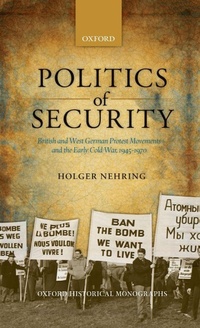
Politics of Security
British and West German Protest Movements and the Early Cold War, 1945-1970
Published on 24. October 2013
Book
Hardback
358 pages
978-0-19-968122-8 (ISBN)
Description
This is an open access title available under the terms of a CC BY-NC-ND 3.0 International licence. It is free to read at Oxford Scholarship Online and offered as a free PDF download from OUP and selected open access locations.
How did European societies experience the Cold War? Politics of Security focuses on a number of peace movements in Britain and West Germany from the end of Second World War in 1945 to the early 1970s to answer this question. Britons and West Germans had been fierce enemies in the Second World War. After 1945, however, many activists in both countries imagined themselves to be part of a common movement against nuclear armaments.
Combining comparative and transnational histories, Politics of Security stresses how these movements were deeply embedded in their own societies, but also transcended them. In particular, it highlights the centrality of the memories of the Second World War as a prism through which people made sense of the threat of nuclear war. By placing British and West German experiences side by side, Holger Nehring illuminates the general patterns and specific features of these debates, arguing that the key characteristic of these discussions was the countries' concerns with different notions of security. The volume highlights how these ideas changed over time, how they reflected more general political, social, and cultural trends, and how they challenged mainstream assumptions of politics and government.
This volume is the first to capture in a transnational fashion what activists did on marches against nuclear warfare, and what it meant to them and to others. It highlights the ways in which people became activists, and how they were transformed by these experiences. Nehring examines how these two societies with very different experiences and memories of the cruelties and atrocities of the Second World War drew on very similar arguments when they came to understand the Cold War through the prism of the previous world war.
How did European societies experience the Cold War? Politics of Security focuses on a number of peace movements in Britain and West Germany from the end of Second World War in 1945 to the early 1970s to answer this question. Britons and West Germans had been fierce enemies in the Second World War. After 1945, however, many activists in both countries imagined themselves to be part of a common movement against nuclear armaments.
Combining comparative and transnational histories, Politics of Security stresses how these movements were deeply embedded in their own societies, but also transcended them. In particular, it highlights the centrality of the memories of the Second World War as a prism through which people made sense of the threat of nuclear war. By placing British and West German experiences side by side, Holger Nehring illuminates the general patterns and specific features of these debates, arguing that the key characteristic of these discussions was the countries' concerns with different notions of security. The volume highlights how these ideas changed over time, how they reflected more general political, social, and cultural trends, and how they challenged mainstream assumptions of politics and government.
This volume is the first to capture in a transnational fashion what activists did on marches against nuclear warfare, and what it meant to them and to others. It highlights the ways in which people became activists, and how they were transformed by these experiences. Nehring examines how these two societies with very different experiences and memories of the cruelties and atrocities of the Second World War drew on very similar arguments when they came to understand the Cold War through the prism of the previous world war.
Reviews / Votes
A sophisticated comparative history of the anti-nuclear movement in its founding British heartland and on World War III's most likely atomic battlefield, West Germany. Nehring's book is both provocative and evocative, offering a compelling mix of intellectual and social history which brings alive the Cold War in its most dangerous decades. * Professor Patrick Major, University of Reading * a valuable and important study, one that makes great strides towards challenging the 'left-versus-right' dynamic that sits at the heart of so many studies of post-war protest, and particularly those that focus on the 1960s. The book will be of particular interest to those researching protest in a transnational perspective - which, as Nehring demonstrates, was as much about concrete exchange and experience as it was about 'imagined communities' of solidarity. * Rebecca Clifford, H-Soz-u-Kult * a ground-breaking study on the transnational history of two peace movements in the early phase of the Cold War. * Gerhard Altmann, Sehepunkte *More details
Series
Language
English
Place of publication
Oxford
United Kingdom
Target group
College/higher education
Illustrations
6 black and white images
Dimensions
Height: 222 mm
Width: 145 mm
Thickness: 23 mm
Weight
582 gr
ISBN-13
978-0-19-968122-8 (9780199681228)
Copyright in bibliographic data and cover images is held by Nielsen Book Services Limited or by the publishers or by their respective licensors: all rights reserved.
Schweitzer Classification
Other editions
Additional editions
Holger Nehring
Politics of Security
British and West German Protest Movements and the Early Cold War, 1945-1970
E-Book
10/2013
OUP eBook
€0.00
Available for download
Person
Holger Nehring completed his D.Phil. at University College, Oxford, before taking up a research fellowship at St. Peter's College, Oxford. He has been teaching at the University of Sheffield since March 2006. His interests lie in the transnational history of social movements and activism, peace history, the history of violence, and the history of the Cold War. He is one of the co-founders of the Centre for Peace History at Sheffield, one of the very few institutions in the world that specialises in research on and teaching of the historical contingencies of peace making and peace keeping.
Content
Acknowledgements ; List of Figures ; Introduction ; 1. From War to Post-War: Security Lost and Found ; 2. Identifying the Protests and the Protest Makers ; 3. Political Experiences and the Security of Community ; 4. Organising the Extra-Parliamentary Politics of Security ; 5. 'Peace', the Nation, and International Relations ; 6. Demonstrating Security ; 7. Openings: Politics, culture, and activism in the 1960s ; 8. Redefining Solidarity ; Epilogue: Redefining Experiences ; Bibliography ; Index