

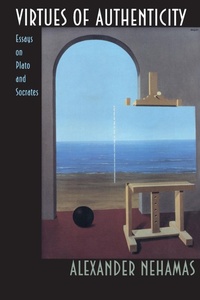
Virtues of Authenticity
Essays on Plato and Socrates
Published on 6. December 1998
Book
Paperback/Softback
376 pages
978-0-691-00178-4 (ISBN)
Description
The eminent philosopher and classical scholar Alexander Nehamas presents here a collection of his most important essays on Plato and Socrates. The papers are unified in theme by the idea that Plato's central philosophical concern in metaphysics, ethics, and aesthetics was to distinguish the authentic from the fake, the original from its imitations. In approach, the collection displays Nehamas's characteristic combination of analytical rigor and sensitivity to the literary form and dramatic effect of Plato's work. Together, the papers represent Nehamas's distinct and original contributions to scholarship on Plato and Socrates and serve as a comprehensive introduction to the thought of these two philosophers. In the book's opening section, Nehamas discusses Plato's representation of Socrates as a model of authentic human goodness, showing that Plato's Socrates is a more skeptical, troubling, and individualistic thinker than is usually supposed. The papers in the second section form a sustained defense of a new and important understanding of Plato's theory of the forms and the evolution of that theory in Plato's later writings.
The third section examines Plato's contention that popular entertainment--by which he meant Greek epic and tragic poetry--misleads its audience into a debased life, an argument Nehamas relates to modern anxieties about television and other forms of popular culture. The collection also includes a discussion of Plato's use of the dialogue form in his representation of Socrates and carefully examines the combination of literary and philosophical elements in his work. Nehamas argues in the book that Plato's specific judgments of what is authentic are often flawed, but that his idea of authenticity as the mark of truth, beauty, and goodness is stronger than many modern scholars have assumed. In drawing together Nehamas's many influential ideas about Plato and Socrates, Virtues of Authenticity is a major contribution to the study of ancient Greek philosophy.
The third section examines Plato's contention that popular entertainment--by which he meant Greek epic and tragic poetry--misleads its audience into a debased life, an argument Nehamas relates to modern anxieties about television and other forms of popular culture. The collection also includes a discussion of Plato's use of the dialogue form in his representation of Socrates and carefully examines the combination of literary and philosophical elements in his work. Nehamas argues in the book that Plato's specific judgments of what is authentic are often flawed, but that his idea of authenticity as the mark of truth, beauty, and goodness is stronger than many modern scholars have assumed. In drawing together Nehamas's many influential ideas about Plato and Socrates, Virtues of Authenticity is a major contribution to the study of ancient Greek philosophy.
More details
Language
English
Place of publication
New Jersey
United States
Target group
Professional and scholarly
College/higher education
Product notice
Paperback (trade)
Dimensions
Height: 229 mm
Width: 152 mm
Thickness: 24 mm
Weight
663 gr
ISBN-13
978-0-691-00178-4 (9780691001784)
Copyright in bibliographic data and cover images is held by Nielsen Book Services Limited or by the publishers or by their respective licensors: all rights reserved.
Schweitzer Classification
Person
Alexander Nehamas is Edmund N. Carpenter II Class of 1943 Professor in the Humanities, Professor of Philosophy, and Profes-sor of Comparative Literature at Princeton University. He is the author of Nietzsche: Life as Literature and The Art of Living: Socratic Reflections from Plato to Foucault. With Paul Woodruff, he translated and introduced Plato's Symposium and Plato's Phaedrus. With David J. Furley, he coedited Aristotle's Rhetoric: Philosophical Essays.
Content
AcknowledgmentsList of AbbreviationsIntroductionISocrates: Questions of Goodness and Method1Meno's Paradox and Socrates as a Teacher32Socratic Intellectualism273What Did Socrates Teach and to Whom Did He Teach It?594Voices of Silence: On Gregory Vlastos's Socrates835Eristic, Antilogic, Sophistic, Dialectic: Plato's Demarcation of Philosophy from Sophistry108IIPlato: Questions of Metaphysics and Epistemology6On Parmenides' Three Ways of Inquiry1257Plato on the Imperfection of the Sensible World1388Confusing Universals and Particulars in Plato's Early Dialogues1599Self-Predication and Plato's Theory of Forms17610Participation and Predication in Plato's Later Thought19611Episteme and Logos in Plato's Later Thought224IIIPlato: Questions of Beauty and the Arts12Plato on Imitation and Poetry in Republic X25113Plato and the Mass Media279IVPlato: Individual Works14The Symposium30315The Republic31616The Phaedrus329Index of Passages Cited359General Index365