

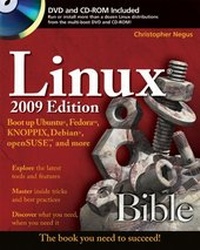
Linux Bible 2009 Edition
Boot up Ubuntu, Fedora, KNOPPIX, Debian, openSUSE, and more
1st Edition
Published on 13. January 2009
Book
Paperback/Softback
888 pages
978-0-470-37367-5 (ISBN)
Description
Run the world's most popular free operating system on your own computer
Get in on the Linux phenomenon! Play music and games, publish on paper or on the Web, and communicate over the Internet. This comprehensive book includes step-by-step instructions and software for 18 different Linux distributions. Whether you are an enterprising do-it-yourselfer or an aspiring Linux professional, you can start here on your path to software freedom.
* Master Linux for desktops, servers, and workstations
* Find, install, and use loads of free and open source software
* Create your own cool apps with useful programming tools
* Launch all your music, video, images, and documents in Linux
* Browse, e-mail, or chat over the Internet from a Linux desktop
* Set up your own e-mail and Web (LAMP) servers
* Make safe connections with firewalls and other security tools
A total of 18 different Linux distributions are included on the DVD and CD-ROM.
* To try out Linux, boot directly KNOPPIX, openSUSE, Ubuntu, Gentoo, BackTrack, and other live Linux distributions
* To keep Linux permanently, install Fedora, Ubuntu, openSUSE, Debian GNU, Damn Small Linux, Slackware Linux, and other distributions to your hard disk
More details
Edition
1., Auflage
Language
English
Place of publication
Chichester
United Kingdom
Publishing group
John Wiley and Sons Ltd
Target group
Professional and scholarly
Edition type
Revised edition
Illustrations
Illustrations
Dimensions
Height: 23.4 cm
Width: 18.8 cm
Thickness: 46 mm
Weight
1324 gr
ISBN-13
978-0-470-37367-5 (9780470373675)
Schweitzer Classification
Other editions
Additional editions
Christopher Negus
Linux Bible 2009 Edition
Boot up Ubuntu, Fedora, KNOPPIX, Debian, openSUSE, and more
E-Book
04/2009
5th Edition
Wiley
€54.60
Available for download
Person
Chris Negus has written or co-written dozens of books on Linux and UNIX, including Red Hat Linux Bible (all editions), Fedora and Red Hat Enterprise Linux Bible, Linux Troubleshooting Bible, Linux Toys, and Linux Toys II. Last year, Chris co-authored four books for the new Toolbox series for power users: Fedora Linux Toolbox, SUSE Linux Toolbox, Ubuntu Linux Toolbox, and BSD UNIX Toolbox.
For eight years, Chris worked with the organization at AT&T that developed UNIX before moving to Utah to help contribute to Novell's UnixWare project in the early 1990s. When not writing about Linux, Chris enjoys playing soccer and just hanging out with his family.
Content
Introduction.
Part I: Getting off the Ground with Linux.
Chapter 1: Starting with Linux.
Chapter 2: Linux Projects, Activities, and Careers.
Part II: Running a Linux Desktop.
Chapter 3: Getting into the Desktop.
Chapter 4: Playing Music and Video.
Chapter 5: Working with Words and Images.
Chapter 6: E-Mailing and Web Browsing.
Chapter 7: Gaming with Linux.
Part III: Learning System Administration Skills.
Chapter 8: Installing Linux.
Chapter 9: Running Commands from the Shell.
Chapter 10: Learning Basic Administration.
Chapter 11: Getting on the Internet.
Chapter 12: Securing Linux.
Part IV: Setting Up Linux Servers.
Chapter 13: Running a Linux, Apache, MySQL, and PHP (LAMP) Server.
Chapter 14: Running a Mail Server.
Chapter 15: Running a Print Server.
Chapter 16: Running a File Server.
Part V: Choosing and Installing Different Linux Distributions.
Chapter 17: Running Ubuntu Linux.
Chapter 18: Running Fedora and Red Hat Enterprise Linux.
Chapter 19: Running Debian GNU/Linux.
Chapter 20: Running SUSE and openSUSE Linux.
Chapter 21: Running KNOPPIX.
Chapter 22: Running Yellow Dog Linux.
Chapter 23: Running Gentoo Linux.
Chapter 24: Running Slackware Linux.
Chapter 25: Running Freespire and Xandros.
Chapter 26: Running Mandriva.
Chapter 27: Running a Linux Firewall/Router.
Chapter 28: Running Bootable Linux Distributions.
Part VI: Programming in Linux.
Chapter 29: Programming Environments and Interfaces.
Chapter 30: Programming Tools and Utilities.
Appendix A: Media.
Appendix B: Linux History and Background.
Index.