

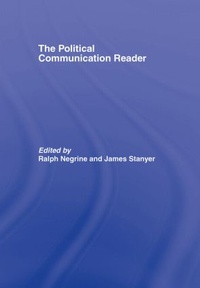
The Political Communication Reader
1st Edition
Published on 9. May 2007
Book
Hardback
336 pages
978-0-415-35935-1 (ISBN)
Description
The Political Communication Reader
gathers together key writings in a unique one-volume resource. The selected texts are grouped into thematic sections, each introduced by the editors, covering such areas as:
the exercise of power, media and democracy
the media and elections
media effects
political participation and the media
the personalization of politics
new technologies and the reshaping of political communication.
Available as a companion Reader to Brian McNair's Introduction to Political Communication textbook, students will find The Political Communication Reader a valuable resource in this popular subject area.
gathers together key writings in a unique one-volume resource. The selected texts are grouped into thematic sections, each introduced by the editors, covering such areas as:
the exercise of power, media and democracy
the media and elections
media effects
political participation and the media
the personalization of politics
new technologies and the reshaping of political communication.
Available as a companion Reader to Brian McNair's Introduction to Political Communication textbook, students will find The Political Communication Reader a valuable resource in this popular subject area.
Reviews / Votes
'Ralph Negrine and James Stanyer have constructed a valuable treasury of the key research and scholarly writing by distinguished academics, which has shaped the contemporary field of political communication. Lippmann's analysis of public opinion, Hall Jamieson's discussion of the 'packaging of the Presidency', as well as Robert McChesney's insightful unravelling of the implications of the economic organisation of US media for democracy, are just a few of the intellectual nuggets horded inside the covers of The Political Communication Reader. There are many other gems to enjoy. It is essential reading for anyone who wishes to be well informed about current debates and developments in the expansive field of political communication.' - Bob Franklin, Professor of Journalism Studies, Cardiff School of Journalism, Media and Cultural Studies, UK'This is a collection of some of the best works and finest writers in political communication. It provides the reader with a comprehensive overview of the state of the art and how the field developed over the last decades.' - Christina Holtz-Bacha, Professor of Communication, University of Erlangen-Nuernberg, Germany
'a very useful book' - The Australian Journal of Politics and History 'Ralph Negrine and James Stanyer have constructed a valuable treasury of the key research and scholarly writing by distinguished academics, which has shaped the contemporary field of political communication. Lippmann's analysis of public opinion, Hall Jamieson's discussion of the 'packaging of the Presidency', as well as Robert McChesney's insightful unravelling of the implications of the economic organisation of US media for democracy, are just a few of the intellectual nuggets horded inside the covers of The Political Communication Reader. There are many other gems to enjoy. It is essential reading for anyone who wishes to be well informed about current debates and developments in the expansive field of political communication.' - Bob Franklin, Professor of Journalism Studies, Cardiff School of Journalism, Media and Cultural Studies,UK
'This is a collection of some of the best works and finest writers in political communication. It provides the reader with a comprehensive overview of the state of the art and how the field developed over the last decades.' - Christina Holtz-Bacha, Professor of Communication, University of Erlangen-Nuernberg, Germany
'a very useful book' - The Australian Journal of Politics and History
More details
Language
English
Place of publication
London
United Kingdom
Publishing group
Taylor & Francis Ltd
Target group
College/higher education
Professional and scholarly
Illustrations
8 s/w Tabellen
8 Tables, black and white
Dimensions
Height: 246 mm
Width: 174 mm
Weight
748 gr
ISBN-13
978-0-415-35935-1 (9780415359351)
Copyright in bibliographic data and cover images is held by Nielsen Book Services Limited or by the publishers or by their respective licensors: all rights reserved.
Schweitzer Classification
Other editions
Additional editions
Ralph Negrine | James Stanyer
The Political Communication Reader
E-Book
04/2023
1st Edition
Routledge
€60.49
Available for download
Ralph Negrine | James Stanyer
The Political Communication Reader
E-Book
04/2023
1st Edition
Routledge
€60.49
Available for download
Ralph Negrine | James Stanyer
The Political Communication Reader
Book
05/2007
1st Edition
Routledge
€68.00
Shipment within 15-20 days
Persons
Ralph Negrine is Director of Research at the Department of Journalism Studies, University of Sheffield. His research interests are in political communication and media policy. Recent publications include Television and the Press Since 1945 (1999), and The Communication of Politics (1996). He is also co-editor of The 'Professionalization' of Political Communication in Europe (2007).
James Stanyer is Lecturer in Communication and Media Studies at the Department of Social Sciences, Loughborough University. His research focuses on developments in political communication in advanced industrial democracies. His work has appeared in a wide range of academic journals and he has also authored two books, The Creation of Political News (2001), and Modern Political Communication (2007).
James Stanyer is Lecturer in Communication and Media Studies at the Department of Social Sciences, Loughborough University. His research focuses on developments in political communication in advanced industrial democracies. His work has appeared in a wide range of academic journals and he has also authored two books, The Creation of Political News (2001), and Modern Political Communication (2007).
Content
Section 1: Media and Democracy. Section 2: Media and Political Advocates. Section 3: Elections and Campaigning. Section 4: Marketing Politics. Section 5: Media Effects. Section 6: Media and Political Engagement. Section 7: Personalization. Section 8: New Media, New Politics?